
Disclosure: As an Amazon Associate, Bookish Wisdom earns from qualifying purchases. This doesn't change our picks or your price.
TL;DR: Huge alien spaceships appear over Earth's major cities. The aliens, called the Overlords, end war, poverty and cruelty, but they refuse to show themselves for fifty years. Humanity enters a golden age of peace. Then a new generation of children begins to change in strange ways, and humanity learns the real reason the Overlords came.
Table of Contents
Childhood's End at a Glance
| Author | Arthur C. Clarke |
| First published | 1953 |
| Type | Science fiction |
| Best for | readers who want a thoughtful, unsettling classic about the end of humanity as we know it |
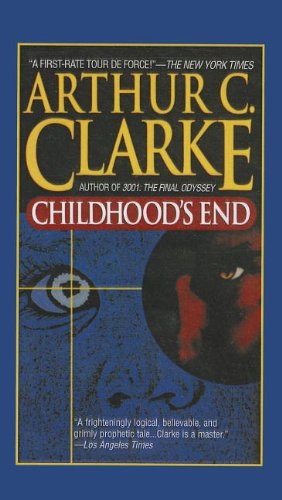
Childhood's End is a science fiction novel by Arthur C. Clarke, published in 1953. It is one of his most famous works and a landmark of the genre. Below you will find a part-by-part summary, five key takeaways, ideas worth remembering and a note on who will enjoy it.
Content note: Includes the destruction of Earth, the loss of humanity and suicide.
Main Characters
- Karellen: The Overlord who supervises Earth.
- Rikki Stormgren: The UN Secretary-General who speaks with Karellen.
- Jan Rodricks: A young scientist who sneaks onto an Overlord ship.
- George and Jean Greggson: Parents whose children begin to change.
- The Overmind: A vast cosmic intelligence behind the Overlords.
What Happens, Part by Part (Contains Spoilers)
Arrival
During the space race, enormous ships appear over Earth's cities. Karellen, the Overlord in charge, speaks only through the UN Secretary-General, Rikki Stormgren, and never appears in person. The Overlords stop wars and cruelty and set humanity on a new path. Stormgren tries to see Karellen's face, but he glimpses only a shadow.
The golden age
After fifty years, the Overlords finally reveal themselves. They look like the horned, winged monsters of old human legends, which explains why they waited. Humanity, now used to peace and plenty, accepts them. There is no war, little crime and no need to work hard. But creativity and science begin to fade, as people no longer need to struggle.
Questions
At a party, a strange guessing game played in the dark produces the name of the Overlords' home star. A young scientist, Jan Rodricks, uses this clue to stow away on an Overlord supply ship. Because of time dilation, his trip will take only a few months for him, but about eighty years will pass on Earth. Meanwhile, a group of artists founds an independent colony, New Athens, to keep human culture alive.
The children
In New Athens, George and Jean Greggson's son Jeff begins to have strange dreams of distant worlds. Soon all young children on Earth change. They stop speaking, develop psychic powers and form a single collective mind. Karellen explains that the Overlords are “midwives,” sent by the Overmind to guide humanity through this transformation, which they themselves can never experience.
The end
The older generation cannot follow its children, and many lose hope. The children leave their physical bodies and join the Overmind, and the Earth itself dissolves. Jan, returning from the Overlords' world, is the last human left. He describes Earth's end to Karellen by radio before he dies. The Overlords leave, still searching for meaning in the universe.
5 Key Takeaways
- Peace and comfort can lead to stagnation.
- Progress may require letting go of the familiar.
- Humanity may not be the final stage of evolution.
- Advanced powers may have limits too.
- Endings can also be new beginnings.
Ideas Worth Remembering
These are paraphrased, not direct quotes:
- Utopia may come at a cost.
- Understanding the future may require humility.
- Every generation hands the world to the next.
Who Should Read Childhood's End?
Read Childhood's End if you enjoy big-idea science fiction, alien contact stories and books that ask hard questions about humanity. It suits teens and adults.
About Arthur C. Clarke
Arthur C. Clarke (1917–2008) was a British science fiction writer and futurist. He proposed the idea of communication satellites in geostationary orbit in 1945. His works include 2001: A Space Odyssey, Rendezvous with Rama and The Fountains of Paradise. He lived in Sri Lanka from 1956 until his death and was knighted in 2000.
Questions to Think About After Reading
These prompts work for solo reading, a book club or a classroom discussion of Childhood's End:
- Is the Overlords' golden age good for humanity?
- Why can the Overlords not evolve like humans?
- Is the ending tragic or hopeful?
How to Use This Summary
Use this page as a quick reference before a book club meeting, an exam, or a decision about whether Childhood's End is worth your time. The takeaways are written to stand on their own. If a point interests you, go back to the book for the author's full story, characters and style, which no short summary can replace.
A Note on Accuracy and Spoilers
This summary is based on the published text of Childhood's End, not on any film, series or stage adaptation, which often change the story. Details are kept at the level of the main events so that nothing is invented. Editions differ slightly in length and wording, so page numbers and small details may vary between copies.
Should You Read the Book?
Yes. It is short, powerful and haunting, and its ending is unforgettable.
Check price of Childhood's End on Amazon
What to Read Next
- 2001: A Space Odyssey by Arthur C. Clarke: humanity's next step, guided by aliens
- Rendezvous with Rama by Arthur C. Clarke: explorers study a giant alien ship
- Solaris by Stanisław Lem: a mysterious, unknowable alien intelligence
Related: Rendezvous with Rama by Arthur C. Clarke: Summary and Key Takeaways
Frequently Asked Questions
What is Childhood's End about?
Aliens bring peace to Earth, then guide humanity's children to a new form of existence.
Who wrote it?
Arthur C. Clarke, in 1953.
What do the Overlords look like?
Like the horned, winged monsters of old legends.
Why do they hide at first?
Humans would have been frightened by their appearance.
What is the Overmind?
A huge cosmic intelligence that humanity's children join.
Who is Jan Rodricks?
A scientist who travels to the Overlords' world and becomes the last human.
What happens to Earth?
It is destroyed as the children leave to join the Overmind.
Is there a TV adaptation?
Yes, a 2015 Syfy miniseries.
What age is it for?
Teens and adults.
How long is it?
About 220 pages.
Is it optimistic?
It is mixed, both hopeful and sad.
Did it influence other works?
Yes, it influenced many later stories about aliens and human evolution.
Is Childhood's End a good first Clarke book?
Yes. It is short and complete, and it shows Clarke's big ideas at their most striking.
Is Childhood's End worth reading?
It depends on what you want. The book is best for readers who want a thoughtful, unsettling classic about the end of humanity as we know it. If that describes you, it is likely a good fit. If not, the titles under What to Read Next may suit you better.