
Disclosure: As an Amazon Associate, Bookish Wisdom earns from qualifying purchases. This doesn't change our picks or your price.
TL;DR: A magical harmonica links the lives of three children in three countries during the 1930s and 1940s. Friedrich lives in Nazi Germany, Mike is an orphan in Depression-era Pennsylvania, and Ivy is a Mexican American girl in wartime California. Each faces danger and discrimination, and each finds hope and courage through music. Their stories come together in a single night years later.
Table of Contents
Echo at a Glance
| Author | Pam Muñoz Ryan |
| First published | 2015 |
| Type | Historical fiction |
| Best for | young readers who want an inspiring story about music, courage and connection |
Echo is a novel by Pam Muñoz Ryan, published in 2015. It won a Newbery Honor in 2016. Below you will find a part-by-part summary, five key takeaways, ideas worth remembering and a note on who will enjoy it.
Content note: Includes discrimination, war, persecution and family separation.
Main Characters
- Otto: A boy who receives a magical harmonica in a fairy tale.
- Friedrich Schmidt: A boy in Nazi Germany who loves music.
- Mike Flannery: An orphan in Pennsylvania who plays piano.
- Ivy Maria Lopez: A Mexican American girl in California.
- The harmonica: A magical instrument passed between the children.
What Happens, Part by Part (Contains Spoilers)
The fairy tale
The book begins with a fairy tale. A boy named Otto gets lost in a forest and meets three sisters under a spell. They give him a harmonica and say it will help save a life. Otto promises to carry it into the world. The harmonica then appears in three different stories.
Friedrich
In Germany in 1933, Friedrich works in a harmonica factory. He has a birthmark on his face and dreams of becoming a conductor. As the Nazis rise, his family is in danger, his father is arrested, and his sister supports the regime. Friedrich uses the harmonica to keep his courage and plans to rescue his father.
Mike
In Pennsylvania in 1935, Mike and his younger brother Frankie live in a cruel orphanage. Mike is a gifted piano player. They are adopted by a wealthy, cold woman who seems to want only one of them. Mike finds the harmonica and joins a harmonica band, hoping to keep his brother safe and together with him.
Ivy
In California in 1942, Ivy's family moves to work on a farm belonging to a Japanese American family who have been sent to an internment camp. Ivy faces discrimination at school, where Mexican American children are separated. She loves music and plays the harmonica. She protects the family's farm and fights for fairness.
The concert
The three stories end at cliffhangers. In the final section, set in 1951, the three, now older, perform at Carnegie Hall in New York. The harmonica has helped each of them survive. The fairy tale also concludes, as the three sisters are freed. Music connects them all.
5 Key Takeaways
- Music can give courage and hope.
- Prejudice harms people across many places.
- Small acts of bravery matter.
- Family is worth fighting for.
- Stories can connect across time.
Ideas Worth Remembering
These are paraphrased, not direct quotes:
- Everyone's story is part of a bigger story.
- Kindness can echo through generations.
- Holding on to your dreams helps in hard times.
Who Should Read Echo?
Read Echo if you enjoy historical fiction, music and stories with interwoven lives. It suits ages 10 to 14 and adults.
About Pam Muñoz Ryan
Pam Muñoz Ryan (born 1951) is an American author of Mexican, Spanish and Italian heritage. Her books include Esperanza Rising, Becoming Naomi León and The Dreamer. She has received many honors, including the NEA's Human and Civil Rights Award. Echo won a Newbery Honor and the Kirkus Prize for Young Readers.
Questions to Think About After Reading
These prompts work for solo reading, a book club or a classroom discussion of Echo:
- How does the harmonica connect the characters?
- How does each child face prejudice?
- What does the final concert mean?
How to Use This Summary
Use this page as a quick reference before a book club meeting, an exam, or a decision about whether Echo is worth your time. The takeaways are written to stand on their own. If a point interests you, go back to the book for the author's full story, characters and style, which no short summary can replace.
A Note on Accuracy and Spoilers
This summary is based on the published text of Echo, not on any film, series or stage adaptation, which often change the story. Details are kept at the level of the main events so that nothing is invented. Editions differ slightly in length and wording, so page numbers and small details may vary between copies.
Should You Read the Book?
Yes. It is long but moving and beautifully connected.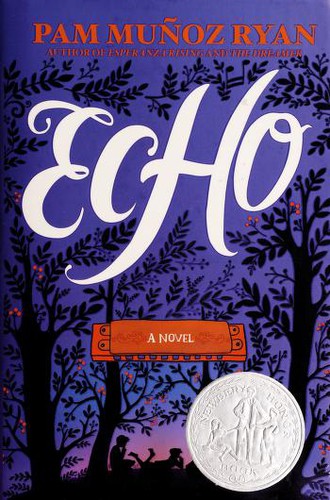
What to Read Next
- Esperanza Rising by Pam Muñoz Ryan: a girl's journey from Mexico to California
- Refugee by Alan Gratz: three children in different eras
- Wonderstruck by Brian Selznick: two connected stories across time
Related: Esperanza Rising by Pam Muñoz Ryan: Summary and Key Takeaways
Frequently Asked Questions
What is Echo about?
A magical harmonica connects three children in the 1930s and 1940s.
Who wrote it?
Pam Muñoz Ryan, in 2015.
Who are the main characters?
Friedrich, Mike and Ivy.
Where is it set?
Germany, Pennsylvania, California and New York.
Is it historical fiction?
Yes, with magical elements.
Did it win awards?
Yes, a Newbery Honor in 2016.
What age is it for?
About 10 to 14, and adults.
How long is it?
About 590 pages.
Is it sad?
It has hard moments but ends hopefully.
Where does the story end?
At a concert at Carnegie Hall in 1951.
Is there music in it?
Yes, music is central to the story.
Is it good for classrooms?
Yes, it is widely taught.
Is the book too long for younger readers?
It is long, but the four connected parts make it easier to read in stages.
Is Echo worth reading?
It depends on what you want. The book is best for young readers who want an inspiring story about music, courage and connection. If that describes you, it is likely a good fit. If not, the titles under What to Read Next may suit you better.