
Disclosure: As an Amazon Associate, Bookish Wisdom earns from qualifying purchases. This doesn't change our picks or your price.
TL;DR: Three children in three different times flee their homes in search of safety. Josef is a Jewish boy in 1930s Nazi Germany. Isabel is a Cuban girl in 1994, escaping on a homemade raft. Mahmoud is a Syrian boy in 2015, fleeing war in Aleppo. Each faces terrible dangers on their journey, and their stories connect in surprising ways.
Table of Contents
Refugee at a Glance
| Author | Alan Gratz |
| First published | 2017 |
| Type | Historical fiction |
| Best for | young readers who want a gripping, powerful story about refugees across history |
Refugee is a novel by Alan Gratz, published in 2017. It has become a widely taught book in middle schools. Below you will find a part-by-part summary, five key takeaways, ideas worth remembering and a note on who will enjoy it.
Content note: Includes war, persecution, death, drowning and violence.
Main Characters
- Josef Landau: A Jewish boy fleeing Nazi Germany.
- Isabel Fernandez: A Cuban girl escaping on a raft.
- Mahmoud Bishara: A Syrian boy fleeing war.
- Ruthie Landau: Josef's younger sister.
- Lito: Isabel's grandfather.
What Happens, Part by Part (Contains Spoilers)
Josef
In 1938, Nazis arrest Josef's father and later release him on condition that the family leave Germany. They board the MS St. Louis, a ship carrying hundreds of Jewish refugees to Cuba. On board, Josef's father struggles with trauma. When they arrive, Cuba refuses to let most passengers land, and the ship is forced to turn back to Europe.
Isabel
In 1994, Cuba faces food shortages and unrest. Isabel's family and neighbors build a small boat to escape to the United States. Isabel's pregnant mother, her father, her grandfather Lito and her friend Iván's family set out across the sea. They face storms, sharks and engine trouble. Isabel's trumpet becomes a symbol of hope.
Mahmoud
In 2015, Mahmoud's home in Aleppo is destroyed by a bomb. His family flees through Turkey, crossing the sea in a small boat to Greece. They walk through Europe, facing hostility, hunger and danger. Mahmoud learns that being invisible keeps him safe, but he also learns that being seen can bring help.
Losses
Each journey brings painful losses. Josef's family is torn apart, and his own story ends in tragedy. Isabel loses her grandfather and her friend Iván, but her mother gives birth on the boat. Mahmoud's family must hand their baby sister to another boat to save her.
Connections
Isabel's family reaches Florida and is allowed to stay. Mahmoud's family reaches Germany, where they are welcomed by an elderly woman, Ruthie Landau, Josef's sister, who survived. Ruthie offers them a home and a new start. The three stories show that the refugee experience connects people across generations.
5 Key Takeaways
- Refugees face great dangers in search of safety.
- Kindness from strangers can save lives.
- History often repeats itself.
- Families will risk everything for safety.
- Being seen and heard matters.
Ideas Worth Remembering
These are paraphrased, not direct quotes:
- Compassion can change lives.
- Every refugee has a story.
- Courage can come from desperate situations.
Who Should Read Refugee?
Read Refugee if you are a young reader who wants an exciting, emotional story about real history. It suits ages 10 to 14 and adults.
About Alan Gratz
Alan Gratz (born 1972) is an American author of historical fiction for young readers. His books include Prisoner B-3087, Ground Zero, Allies and Two Degrees. He donates part of his earnings from Refugee to UNICEF's refugee relief efforts. He lives in North Carolina.
Questions to Think About After Reading
These prompts work for solo reading, a book club or a classroom discussion of Refugee:
- How are the three stories similar?
- How does Mahmoud learn that being seen can help?
- What can people do to help refugees today?
How to Use This Summary
Use this page as a quick reference before a book club meeting, an exam, or a decision about whether Refugee is worth your time. The takeaways are written to stand on their own. If a point interests you, go back to the book for the author's full story, characters and style, which no short summary can replace.
A Note on Accuracy and Spoilers
This summary is based on the published text of Refugee, not on any film, series or stage adaptation, which often change the story. Details are kept at the level of the main events so that nothing is invented. Editions differ slightly in length and wording, so page numbers and small details may vary between copies.
Should You Read the Book?
Yes. It is gripping, eye-opening and moving.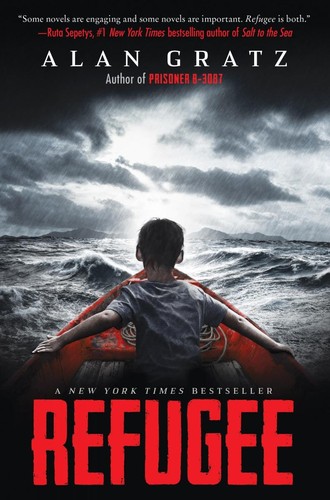
Check price of Refugee on Amazon
What to Read Next
- Prisoner B-3087 by Alan Gratz: a boy survives the Holocaust
- Inside Out and Back Again by Thanhha Lai: a Vietnamese girl's journey to America
- Echo by Pam Muñoz Ryan: three children's lives connected across time
Related: 15 Books Like Refugee You’ll Love · Prisoner B-3087 by Alan Gratz: Summary and Key Takeaways
Frequently Asked Questions
What is Refugee about?
Three refugee children from different times flee danger.
Who wrote it?
Alan Gratz, in 2017.
Who are the main characters?
Josef, Isabel and Mahmoud.
When are the stories set?
1938, 1994 and 2015.
Where are they from?
Germany, Cuba and Syria.
How are the stories connected?
Through family links that appear at the end.
Is it based on real events?
Yes, though the characters are fictional.
What age is it for?
About 10 to 14 and adults.
How long is it?
About 340 pages.
Is it sad?
Yes, but it also has hope.
Is it good for classrooms?
Yes, it is widely taught.
Does the author support refugees?
Yes, he donates to UNICEF.
What was the MS St. Louis?
A real ship carrying Jewish refugees in 1939 that was turned away by Cuba and the United States.
Is Refugee worth reading?
It depends on what you want. The book is best for young readers who want a gripping, powerful story about refugees across history. If that describes you, it is likely a good fit. If not, the titles under What to Read Next may suit you better.