
Disclosure: As an Amazon Associate, Bookish Wisdom earns from qualifying purchases. This doesn't change our picks or your price.
TL;DR: In a future New York, millions of people live packed inside a vast enclosed city and distrust robots. When a scientist from the Spacer worlds is murdered, detective Elijah Baley is ordered to solve the case with a partner he dislikes: R. Daneel Olivaw, a robot who looks exactly like a human. Together they must find a killer before tensions explode.
Table of Contents
The Caves of Steel at a Glance
| Author | Isaac Asimov |
| First published | 1954 |
| Type | Science fiction mystery |
| Best for | readers who want a classic detective story set in a future of robots and crowded cities |
The Caves of Steel is a science fiction mystery by Isaac Asimov, published in 1954. It is the first of his Robot novels featuring Elijah Baley and R. Daneel Olivaw. Below you will find a part-by-part summary, five key takeaways, ideas worth remembering and a note on who will enjoy it.
Content note: Includes murder, riots and prejudice.
Main Characters
- Elijah Baley: A New York City detective who distrusts robots.
- R. Daneel Olivaw: A humanoid robot detective from the Spacers.
- Julius Enderby: Baley's boss, the police commissioner.
- Jessie Baley: Elijah's wife.
- Dr. Han Fastolfe: A Spacer scientist working with Daneel.
What Happens, Part by Part (Contains Spoilers)
The city
Three thousand years in the future, Earth is overcrowded, and people live in enormous enclosed cities, the “caves of steel,” without ever seeing the sky. Robots are taking human jobs, and many people hate them. The Spacers, descendants of Earth people who settled other worlds, live long, healthy lives and keep a small base, Spacetown, near New York.
The murder
A Spacer scientist, Dr. Sarton, is found dead in Spacetown. The Spacers demand an investigation. Commissioner Enderby assigns Baley, an ordinary detective, and gives him a partner from the Spacers, R. Daneel Olivaw, a robot who looks human. Baley is uncomfortable and fears that if robots can do his job, he will lose it.
Suspicions
Baley accuses the Spacers of faking the murder and accuses Daneel of being the dead man. Both theories are proved wrong. He learns of a secret group, the Medievalists, who want to return to an older way of life and destroy robots. His wife, Jessie, has secretly belonged to it. Baley must protect his family while chasing the truth.
The Spacers' plan
Dr. Fastolfe explains that the Spacers want Earth people to leave Earth and settle new worlds, alongside robots, to keep humanity growing. Baley takes a test and starts to accept the idea. He also learns more about Daneel, who follows the Three Laws of Robotics and has his own kind of sense of justice.
The solution
Baley discovers that Commissioner Enderby, a secret Medievalist, killed Sarton by mistake. He meant to destroy Daneel, who looks exactly like Sarton, using a gun carried by a simple robot. Baley persuades Enderby to confess and to support the Spacers' plan for space settlement, instead of being arrested. Baley and Daneel part as respectful partners.
5 Key Takeaways
- Fear of technology can lead to prejudice.
- Humans and robots can work together.
- Crowded lives can make people afraid of change.
- Good detection relies on logic and empathy.
- A society that stops growing may decline.
Ideas Worth Remembering
These are paraphrased, not direct quotes:
- Partnership can overcome distrust.
- The future may require leaving our comfort zones.
- Every mystery has a human motive behind it.
Who Should Read The Caves of Steel?
Read The Caves of Steel if you enjoy detective stories, robots and classic science fiction. It suits teens and adults.
About Isaac Asimov
Isaac Asimov (1920–1992) was an American writer and biochemistry professor who wrote or edited more than 500 books. He created the Three Laws of Robotics and the Foundation series. His Robot novels include The Caves of Steel, The Naked Sun, The Robots of Dawn and Robots and Empire. He later tied his Robot and Foundation stories into one future history.
Questions to Think About After Reading
These prompts work for solo reading, a book club or a classroom discussion of The Caves of Steel:
- Why do people in the city hate robots?
- How does Baley's view of Daneel change?
- What does the novel say about technology and jobs?
How to Use This Summary
Use this page as a quick reference before a book club meeting, an exam, or a decision about whether The Caves of Steel is worth your time. The takeaways are written to stand on their own. If a point interests you, go back to the book for the author's full story, characters and style, which no short summary can replace.
A Note on Accuracy and Spoilers
This summary is based on the published text of The Caves of Steel, not on any film, series or stage adaptation, which often change the story. Details are kept at the level of the main events so that nothing is invented. Editions differ slightly in length and wording, so page numbers and small details may vary between copies.
Should You Read the Book?
Yes. It is a fun, clever mix of mystery and science fiction.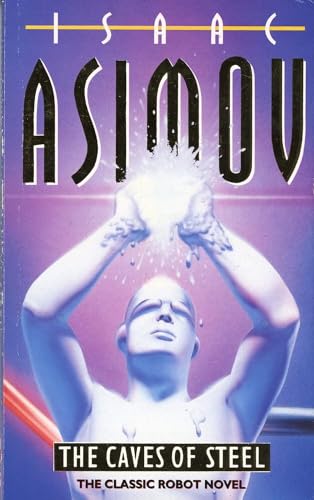
Check price of The Caves of Steel on Amazon
What to Read Next
- The Naked Sun by Isaac Asimov: the second Baley and Daneel mystery
- I, Robot by Isaac Asimov: classic stories about robots and the Three Laws
- Do Androids Dream of Electric Sheep? by Philip K. Dick: a detective and humanlike androids
Related: Foundation by Isaac Asimov: Summary and Key Takeaways
Frequently Asked Questions
What is The Caves of Steel about?
A human detective and a robot partner solve a murder in a future city.
Who wrote it?
Isaac Asimov, in 1954.
Who is R. Daneel Olivaw?
A humanoid robot from the Spacers.
Who killed Sarton?
Commissioner Julius Enderby, by mistake.
What are the caves of steel?
Huge enclosed cities where Earth people live.
Who are the Spacers?
Descendants of humans who settled other worlds.
What are the Three Laws of Robotics?
Rules that stop robots from harming humans and make them obey and protect themselves.
Is it a series?
Yes, the first of four Robot novels.
What age is it for?
Teens and adults.
How long is it?
About 270 pages.
What comes next?
The Naked Sun, published in 1957.
Is it a real mystery?
Yes. It plays fair with clues, like a classic detective story.
Is The Caves of Steel a good first Asimov book?
Yes. It is short and works as a mystery, so even readers who rarely try science fiction can enjoy it.
Is The Caves of Steel worth reading?
It depends on what you want. The book is best for readers who want a classic detective story set in a future of robots and crowded cities. If that describes you, it is likely a good fit. If not, the titles under What to Read Next may suit you better.