
Disclosure: As an Amazon Associate, Bookish Wisdom earns from qualifying purchases. This doesn't change our picks or your price.
TL;DR: A velveteen toy rabbit is given to a little boy as a gift, but at first the boy forgets him among the fancier toys. The wise old Skin Horse tells the Rabbit that toys become Real when a child loves them for a long time. The Boy grows to love the Rabbit deeply, and after a serious illness, the Rabbit's devotion leads to a magical change.
Table of Contents
The Velveteen Rabbit at a Glance
| Author | Margery Williams |
| First published | 1922 |
| Type | Children's book |
| Best for | readers who want a gentle, moving classic about love, loss and becoming real |
The Velveteen Rabbit, or How Toys Become Real is a children's book by Margery Williams, first published in 1922 with illustrations by William Nicholson. It remains one of the best-loved picture books about love. Below you will find a part-by-part summary, five key takeaways, ideas worth remembering and a note on who will enjoy it.
Content note: Includes a child's serious illness and the planned burning of toys.
Main Characters
- The Velveteen Rabbit: A simple stuffed toy who longs to be Real.
- The Boy: The child who comes to love the Rabbit.
- The Skin Horse: An old, wise toy who explains what Real means.
- Nana: The Boy's nurse, who looks after the nursery.
- The Fairy: A magical being who cares for loved toys.
What Happens, Part by Part (Contains Spoilers)
A new toy
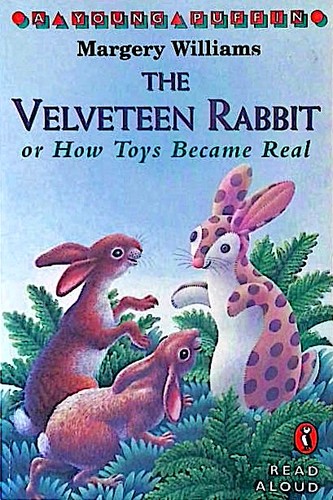
The Rabbit arrives as a gift, stuffed into the top of the Boy's stocking. He is fat and soft, with brown and white spots and pink satin-lined ears. For a little while, the Boy loves him, but then forgets him for flashier toys. The mechanical toys look down on the Rabbit because he is made of sawdust and cannot move by himself.
What is Real?
The Rabbit asks the old Skin Horse, who has lived in the nursery for a long time, what it means to be Real. The Skin Horse explains that being Real is not about how you are made. It happens when a child loves you for a long, long time. It can hurt, and it usually means your fur gets rubbed off and your eyes drop out. But once you are Real, you cannot be ugly, except to people who do not understand.
Loved
One night, Nana cannot find the Boy's usual toy and gives him the Rabbit. The Boy hugs him all night, and soon the Rabbit goes everywhere with him. The Rabbit's fur becomes worn, but he is happy. When Nana calls him “just a toy,” the Boy insists that he is Real. In the garden, the Rabbit meets wild rabbits who can hop and dance, and he feels sad that he cannot.
Illness
The Boy falls ill with scarlet fever. The Rabbit stays with him through long, hot days, whispering about the games they will play. When the Boy gets better, the doctor orders that his toys and books be burned to stop the illness from spreading. The Rabbit is put in a sack at the bottom of the garden to be burned the next day. He feels sad and alone.
Becoming Real
A real tear falls from the Rabbit's eye, and from the spot grows a flower. A Fairy steps out and says she takes care of toys that children have loved. She makes the Rabbit truly Real, a living rabbit who can run and jump with the others. The next spring, the Boy sees a wild rabbit in the garden that looks just like his old Bunny.
5 Key Takeaways
- Love is what makes us real.
- Being loved can be hard and painful.
- Appearances matter less than devotion.
- Loss can lead to new beginnings.
- Even simple things can be deeply valued.
Ideas Worth Remembering
These are paraphrased, not direct quotes:
- Real love accepts wear and tear.
- Patience is part of becoming who we are.
- Kindness and loyalty are rewarded in the end.
Who Should Read The Velveteen Rabbit?
Read The Velveteen Rabbit if you want a classic story to share with young children, or if you love gentle stories about love. It suits ages 4 to 8, and adults too.
About Margery Williams
Margery Williams (1881–1944) was an English-American author of children's books. The Velveteen Rabbit was her first and most famous children's book. She also wrote Poor Cecco and The Skin Horse, and won a Newbery Honor for Winterbound. Her daughter, Pamela Bianco, became a well-known artist and illustrated some of her books.
Questions to Think About After Reading
These prompts work for solo reading, a book club or a classroom discussion of The Velveteen Rabbit:
- What does it mean to be Real?
- Why does the Skin Horse say being Real can hurt?
- How does the Rabbit change by the end?
How to Use This Summary
Use this page as a quick reference before a book club meeting, an exam, or a decision about whether The Velveteen Rabbit is worth your time. The takeaways are written to stand on their own. If a point interests you, go back to the book for the author's full story, characters and style, which no short summary can replace.
A Note on Accuracy and Spoilers
This summary is based on the published text of The Velveteen Rabbit, not on any film, series or stage adaptation, which often change the story. Details are kept at the level of the main events so that nothing is invented. Editions differ slightly in length and wording, so page numbers and small details may vary between copies.
Should You Read the Book?
Yes. It is short, beautiful and emotional for readers of all ages.
Check price of The Velveteen Rabbit on Amazon
What to Read Next
- Winnie-the-Pooh by A.A. Milne: gentle stories about a boy and his beloved toys
- The Miraculous Journey of Edward Tulane by Kate DiCamillo: a toy rabbit learns to love
- Corduroy by Don Freeman: a teddy bear longs for a home
Frequently Asked Questions
What is The Velveteen Rabbit about?
A toy rabbit becomes real through a boy's love.
Who wrote it?
Margery Williams, in 1922.
Who illustrated it?
William Nicholson in the original edition.
What does “Real” mean in the book?
Being truly loved by a child for a long time.
Who is the Skin Horse?
An old toy who explains what being Real means.
Why is the Rabbit going to be burned?
Because the Boy had scarlet fever, and the doctor ordered his toys burned.
How does the Rabbit become alive?
A Fairy appears and makes him a real rabbit.
What age is it for?
About 4 to 8, but adults love it too.
How long is it?
About 40 pages.
Is it sad?
It has sad moments, but a hopeful ending.
Are there adaptations?
Yes, several animated and live-action films.
Is it read at weddings?
Yes, the Skin Horse passage is often read.
Is it good for reading aloud?
Yes. Its gentle language and short length make it a favorite bedtime story.
Is The Velveteen Rabbit worth reading?
It depends on what you want. The book is best for readers who want a gentle, moving classic about love, loss and becoming real. If that describes you, it is likely a good fit. If not, the titles under What to Read Next may suit you better.