
Disclosure: As an Amazon Associate, Bookish Wisdom earns from qualifying purchases. This doesn't change our picks or your price.
TL;DR: Science writer James Gleick tells the story of chaos theory, a new way of seeing the world that emerged in the 1960s and 1970s. Scientists in different fields discovered that simple systems can behave unpredictably and that tiny changes can have huge effects. From weather to population, from fractals to heartbeats, they found hidden order inside apparent randomness.
Table of Contents
Chaos at a Glance
| Author | James Gleick |
| First published | 1987 |
| Type | Science |
| Best for | readers who want a readable, exciting history of one of modern science's big ideas |
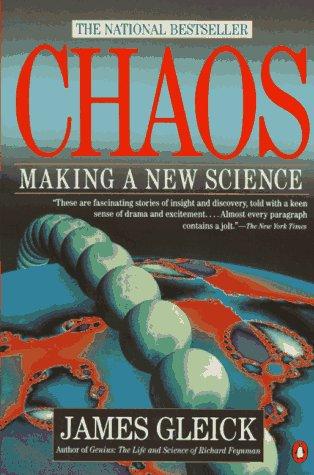
Chaos: Making a New Science is a nonfiction book by James Gleick, published in 1987. It was a finalist for the Pulitzer Prize and the National Book Award and helped popularize the “butterfly effect.” Below you will find a part-by-part summary, five key takeaways, ideas worth remembering and a note on who will enjoy it.
Content note: None.
Key Concepts
- Edward Lorenz: A meteorologist who discovered the butterfly effect.
- Benoit Mandelbrot: A mathematician who created fractal geometry.
- Mitchell Feigenbaum: A physicist who found universal patterns in chaos.
- Robert May: A biologist who studied chaotic populations.
- Stephen Smale: A mathematician who studied unstable systems.
The Main Ideas, Part by Part
The butterfly effect
In 1961, Edward Lorenz was running a simple weather model on a computer. He restarted a calculation using a number rounded to fewer decimal places. The results soon became completely different. He realized that tiny differences in starting conditions can grow into huge changes. This “sensitive dependence on initial conditions” later became known as the butterfly effect.
Order in disorder
Lorenz drew a picture of his system and found a beautiful, looping shape called the Lorenz attractor. The system never repeated itself, but it stayed within a pattern. Other scientists discovered “strange attractors” in many systems. Chaos, they learned, is not pure randomness; it has a hidden structure.
Populations and patterns
Biologist Robert May studied a simple equation for animal populations. As he changed one number, the population doubled its cycles, then doubled again, until it became chaotic. Mitchell Feigenbaum discovered that this pattern of “period doubling” happens at the same rate in many different systems, revealing a universal constant.
Fractals
Benoit Mandelbrot studied shapes that repeat their patterns at every scale, such as coastlines, clouds and mountains. He asked how long the coastline of Britain is, showing that the answer depends on how closely you measure. He called these shapes fractals. His famous Mandelbrot set showed endless complexity created by a simple rule.
A new science
Gleick describes how scientists in physics, biology, math and other fields began to share ideas. Young researchers in Santa Cruz studied dripping faucets. Others found chaos in turbulence, the heart and the brain. Chaos theory changed how scientists think about prediction, showing that some systems can never be predicted far ahead, even if they follow simple rules.
5 Key Takeaways
- Small changes can cause big effects.
- Simple rules can create complex behavior.
- Chaos has hidden patterns.
- Nature is full of fractal shapes.
- Some systems are impossible to predict long-term.
Ideas Worth Remembering
These are paraphrased, not direct quotes:
- Science advances when fields share ideas.
- Looking closely can reveal endless detail.
- Uncertainty is part of nature.
Who Should Read Chaos?
Read Chaos if you are curious about science, math or how the world works. It suits adults and older teens.
About James Gleick
James Gleick (born 1954) is an American author and journalist who worked as an editor and reporter for The New York Times. His books include Genius, a biography of Richard Feynman, Isaac Newton, The Information and Time Travel. Chaos was his first book and was translated into more than 20 languages.
Questions to Think About After Reading
These prompts work for solo reading, a book club or a classroom discussion of Chaos:
- What is the butterfly effect?
- Why does the length of a coastline depend on how you measure it?
- How has chaos theory changed science?
How to Use This Summary
Use this page as a quick reference before a book club meeting, an exam, or a decision about whether Chaos is worth your time. The takeaways are written to stand on their own. If a point interests you, go back to the book for the author's full argument, examples and evidence, which no short summary can replace.
A Note on Accuracy and Spoilers
This summary is based on the published text of Chaos, not on any film, series or stage adaptation, which often change the story. Details are kept at the level of the main arguments so that nothing is invented. Editions differ slightly in length and wording, so page numbers and small details may vary between copies.
Should You Read the Book?
Yes. It is a classic of popular science and still exciting to read.
Check price of Chaos on Amazon
What to Read Next
- The Information by James Gleick: a history of information and communication
- Genius by James Gleick: a biography of physicist Richard Feynman
- Gödel, Escher, Bach by Douglas Hofstadter: patterns in math, art and mind
Frequently Asked Questions
What is Chaos about?
The history of chaos theory and how it changed science.
Who wrote it?
James Gleick, in 1987.
What is the butterfly effect?
The idea that tiny changes can lead to huge differences.
Who discovered it?
Edward Lorenz, a meteorologist.
What is a fractal?
A shape with similar patterns at every scale.
Who created fractal geometry?
Benoit Mandelbrot.
What is a strange attractor?
A pattern that chaotic systems follow without repeating.
Is it technical?
No, it is written for general readers.
What age is it for?
Adults and older teens.
How long is it?
About 350 pages.
Was it nominated for awards?
Yes, the Pulitzer Prize and the National Book Award.
Is it still relevant?
Yes, chaos theory is still important in science.
Do I need a math background?
No. Gleick explains the ideas through stories about the scientists, not equations.
Is Chaos worth reading?
It depends on what you want. The book is best for readers who want a readable, exciting history of one of modern science's big ideas. If that describes you, it is likely a good fit. If not, the titles under What to Read Next may suit you better.