

Disclosure: As an Amazon Associate, Bookish Wisdom earns from qualifying purchases. This doesn't change our picks or your price.
TL;DR: Roger Fisher and William Ury present a method called principled negotiation, which focuses on interests rather than positions, seeks mutual gain and uses objective criteria. The book argues that negotiators can reach agreements that are fair and efficient without becoming adversaries.
Table of Contents
Getting to Yes at a Glance
| Author | Roger Fisher and William Ury |
| First published | 1981 |
| Type | Negotiation |
| Best for | readers who want a classic, practical framework for negotiating |
Getting to Yes is a nonfiction book by Roger Fisher and William Ury, first published in 1981. The book came out of the Harvard Negotiation Project. It is one of the most widely read books on negotiation. Below you will find a part-by-part summary, five key takeaways, a few ideas worth remembering and a note on who will enjoy it most. The summary paraphrases the author's ideas rather than quoting them at length, so it works as a refresher or a preview, not a replacement for the book.
Key Ideas, Part by Part
Do not bargain over positions
Haggling hardens positions and harms relationships.
Separate the people from the problem
Treat people with respect while being firm on the issue.
Focus on interests
Ask why a person wants something.
Invent options for mutual gain
Brainstorm solutions before deciding.
Insist on objective criteria
Use fair standards.
BATNA
Know your best alternative to a negotiated agreement.
The Summary at a Glance
| Part | In one line |
|---|---|
| Do not bargain over positions | Haggling hardens positions and harms relationships. |
| Separate the people from the problem | Treat people with respect while being firm on the issue. |
| Focus on interests | Ask why a person wants something. |
| Invent options for mutual gain | Brainstorm solutions before deciding. |
| Insist on objective criteria | Use fair standards. |
| BATNA | Know your best alternative to a negotiated agreement. |
5 Key Takeaways
- Look for interests behind positions.
- Be soft on people and hard on problems.
- Brainstorm options.
- Use objective standards.
- Know your alternative.
Ideas Worth Remembering
These are paraphrased, not direct quotes:
- The ideas are simple but powerful.
- It applies to business and personal life.
- Some situations require adaptation.
Who Should Read Getting to Yes?
Read it if you negotiate at work or at home. It is short.
Questions to Think About After Reading
These prompts work for solo reading, a book club or a classroom discussion of Getting to Yes:
- Which idea could you use this week, and what would the first step be?
- Where do you disagree with the author, and what evidence would change your mind?
- Who in your life would benefit most from this book, and why?
Quick Facts to Remember
- Book: Getting to Yes by Roger Fisher and William Ury (1981)
- Type: Negotiation
- Best for: readers who want a classic, practical framework for negotiating
- Main idea in one line: Look for interests behind positions.
Reading Time and Format
Nonfiction is easy to read in pieces. Many readers like an audiobook for the commute and a print or e-book copy for notes and highlights. Check the page count of your edition before you plan your reading time. Whichever format you choose, a library copy is a low-cost way to try the book before you buy, and used or digital editions are often cheaper than new print copies.
How to Use This Summary
Use this page as a quick reference before a book club meeting, an exam, or a decision about whether Getting to Yes is worth your time. The takeaways are written to stand on their own. If a point interests you, go back to the book for the author's full argument, examples and style, which no short summary can carry.
A simple way to get the most from it: first read the TL;DR and the takeaways to decide if the book fits your interests, then read the part-by-part section for the structure, and finally write down one idea you want to remember or one question you want answered by the full text.
A Note on Accuracy and Spoilers
This summary is based on the published text of Getting to Yes, not on any film, series or stage adaptation, which often change the story. Details are kept at the level of the main events so that nothing is invented. Editions differ slightly in length and wording, so page numbers and small details may vary from your copy.
Should You Read the Book?
If you decide to read it, skim the contents page first and read the sections that match your goal. Take notes in your own words, because ideas stick better when you rephrase them. If you are still unsure, read a free sample or the first chapter, because the opening pages usually show whether the voice and subject suit you. Reviews from readers with tastes like yours can help too, but your own reaction to a few pages is the best test.
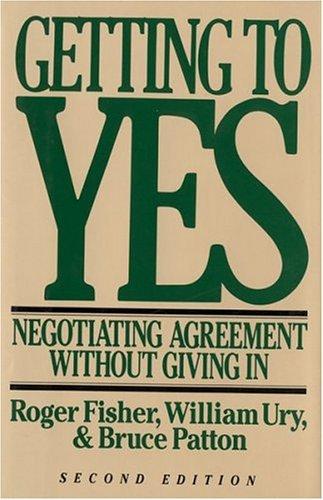
Check price of Getting to Yes on Amazon
What to Read Next
- Never Split the Difference by Chris Voss: negotiation from an FBI negotiator
- Difficult Conversations by Douglas Stone, Bruce Patton and Sheila Heen: how to talk about hard things
- Crucial Conversations by Kerry Patterson and others: high-stakes dialogue
Frequently Asked Questions
What is BATNA?
Best alternative to a negotiated agreement.
Who wrote Getting to Yes?
Roger Fisher and William Ury.
Is it still useful?
Yes, its principles are widely used.
Is Getting to Yes worth reading?
It depends on what you want. The book is best for readers who want a classic, practical framework for negotiating. If that describes you, it is likely a good fit. If not, the titles under What to Read Next may suit you better.
Can this summary replace reading Getting to Yes?
No. A summary covers the main events and ideas, but it cannot carry the author's voice, detail or pacing. Use it to decide whether to read the book, to refresh your memory or to prepare for a discussion.