
Disclosure: As an Amazon Associate, Bookish Wisdom earns from qualifying purchases. This doesn't change our picks or your price.
TL;DR: Con man Moist von Lipwig is hanged for his crimes, only to wake up and be offered a choice by the city's ruler, Lord Vetinari: run the dead Post Office of Ankh-Morpork or step through a door into nothing. Moist takes the job. He revives the post with tricks, stamps and showmanship, but he must compete with the powerful Grand Trunk clacks company run by a far bigger crook.
Table of Contents
Going Postal at a Glance
| Author | Terry Pratchett |
| First published | 2004 |
| Type | Comic fantasy |
| Best for | readers who want a fast, clever comic fantasy about cons, business and second chances |
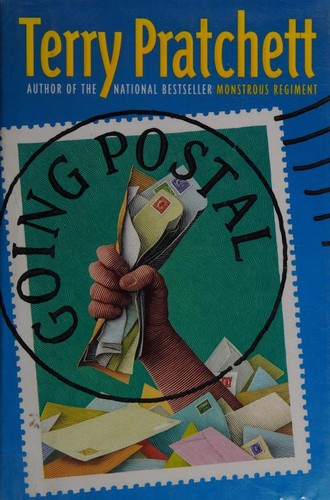
Going Postal is the 33rd Discworld novel by Terry Pratchett, published in 2004. It introduced Moist von Lipwig and was adapted for television in 2010. Below you will find a part-by-part summary, five key takeaways, ideas worth remembering and a note on who will enjoy it.
Content note: Includes murder, fraud and mild violence.
Main Characters
- Moist von Lipwig: A charming con man made Postmaster.
- Lord Vetinari: The clever ruler of Ankh-Morpork.
- Adora Belle Dearheart: A sharp-tongued woman who works with golems.
- Mr. Pump: A golem who watches over Moist.
- Reacher Gilt: The ruthless head of the Grand Trunk company.
What Happens, Part by Part (Contains Spoilers)
A second chance
Moist, a brilliant swindler, is hanged under a fake name. But the hanging is faked by Lord Vetinari, who gives him a choice: run the Post Office or die. Moist chooses the post. He is watched by Mr. Pump, a giant clay golem who will stop him if he runs away. The Post Office is a ruin, filled with piles of undelivered letters.
The Post Office
Moist meets the elderly Junior Postman Groat and the young, pin-obsessed Stanley. The undelivered letters seem to have a kind of life, and they show Moist visions. Moist begins delivering the old letters, which makes him popular. He invents postage stamps, which become a hit and help fund the post.
The clacks
The city's main communication system is the Grand Trunk clacks, a network of signal towers. Reacher Gilt has taken it over through fraud and runs it badly, causing breakdowns and even deaths. Adora Belle Dearheart, whose family built the clacks before Gilt stole it, hates him. Moist falls for her.
Competition
Gilt tries to destroy the Post Office. He has it set on fire, killing a postman. Moist fights back with clever publicity stunts. He challenges the clacks to a race: the Post Office will deliver a message to the distant city of Genua faster than the clacks can send it.
The con
Moist knows he cannot win the race honestly. Instead, with help from a group of clacks engineers, he sends a message through the clacks system that reveals Gilt's crimes to the whole city. Gilt is ruined. Vetinari gives Gilt the same choice Moist had. Moist stays as Postmaster, and the Post Office becomes a success.
5 Key Takeaways
- People can change and do good work.
- Showmanship can serve honest goals.
- Greedy business can harm everyone.
- Communication connects communities.
- A clever mind can be used for good.
Ideas Worth Remembering
These are paraphrased, not direct quotes:
- Second chances can bring out the best in people.
- Trust is a valuable business asset.
- Even old institutions can be revived.
Who Should Read Going Postal?
Read Going Postal if you enjoy comic fantasy, con artists and satire about business. It suits teens and adults.
About Terry Pratchett
Terry Pratchett (1948–2015) was an English fantasy writer whose Discworld series satirized politics, business and human nature. He worked as a journalist and press officer before writing full-time. Moist von Lipwig also stars in Making Money and Raising Steam. Pratchett received many honors, including the Carnegie Medal for The Amazing Maurice and His Educated Rodents.
Questions to Think About After Reading
These prompts work for solo reading, a book club or a classroom discussion of Going Postal:
- Why does Vetinari choose Moist?
- What does the clacks represent?
- How does Moist change from con man to hero?
How to Use This Summary
Use this page as a quick reference before a book club meeting, an exam, or a decision about whether Going Postal is worth your time. The takeaways are written to stand on their own. If a point interests you, go back to the book for the author's full story, characters and style, which no short summary can replace.
A Note on Accuracy and Spoilers
This summary is based on the published text of Going Postal, not on any film, series or stage adaptation, which often change the story. Details are kept at the level of the main events so that nothing is invented. Editions differ slightly in length and wording, so page numbers and small details may vary between copies.
Should You Read the Book?
Yes. It is one of the best Discworld books and an excellent place to start.
Check price of Going Postal on Amazon
What to Read Next
- Making Money by Terry Pratchett: Moist takes over the bank
- Guards! Guards! by Terry Pratchett: another great Discworld starting point
- The Lies of Locke Lamora by Scott Lynch: a clever con artist in a fantasy city
Related: Mort by Terry Pratchett: Summary and Key Takeaways · Dodger by Terry Pratchett: Summary and Key Takeaways
Frequently Asked Questions
What is Going Postal about?
A con man is forced to run a city's failing Post Office.
Who wrote it?
Terry Pratchett, in 2004.
Who is Moist von Lipwig?
A con man who becomes Postmaster.
What is the clacks?
A network of signal towers, like a telegraph.
Who is Reacher Gilt?
The greedy head of the Grand Trunk.
Who is Mr. Pump?
A golem assigned to watch Moist.
Is it part of a series?
Yes, the 33rd Discworld novel.
Can I start with it?
Yes, it stands alone well.
Is there an adaptation?
Yes, a 2010 Sky TV film with Richard Coyle.
What age is it for?
Teens and adults.
How long is it?
About 400 pages.
Does Moist appear again?
Yes, in Making Money and Raising Steam.
Is it funny?
Yes. It is full of jokes, puns and sharp satire about business.
Is Going Postal worth reading?
It depends on what you want. The book is best for readers who want a fast, clever comic fantasy about cons, business and second chances. If that describes you, it is likely a good fit. If not, the titles under What to Read Next may suit you better.