
Disclosure: As an Amazon Associate, Bookish Wisdom earns from qualifying purchases. This doesn't change our picks or your price.
TL;DR: In the 1950s and 1960s, Don and Mimi Galvin raised twelve children in Colorado. Six of their sons developed schizophrenia. The book follows the family's struggle, and how the case became important to scientists studying the disease.
Table of Contents
Hidden Valley Road at a Glance
| Author | Robert Kolker |
| First published | 2020 |
| Type | Narrative nonfiction |
| Best for | readers who like family stories and medical mystery |
Hidden Valley Road is a nonfiction book by Robert Kolker, first published in 2020. Robert Kolker spent years interviewing family members and researchers. The book blends family history and science. Below you will find a part-by-part summary, five key takeaways, a few ideas worth remembering and a note on who will enjoy it most. The summary paraphrases the author's ideas rather than quoting them at length, so it works as a refresher or a preview, not a replacement for the book.
Content note: Contains mental illness, abuse, suicide and sexual abuse.
Key Ideas, Part by Part
A family on the rise
Don Galvin is an Air Force officer and Mimi is a devoted mother. They move to Colorado Springs and seem like an ideal family.
The first signs
As the sons grow up, several begin to show signs of serious mental illness. The family is confused and receives little help.
Hard years
The illness shapes the family. Siblings, especially the sisters, have to deal with fear and violence at home, and secrets are kept.
Medical history
The book traces how psychiatry understood schizophrenia, including old theories that blamed mothers.
Science finds the Galvins
Researchers at the National Institute of Mental Health study the family. Their DNA helps scientists look for genetic factors.
Where they are now
The surviving family members look back on their lives. The book ends with reflections on loss, care and the limits of what is known.
5 Key Takeaways
- Mental illness affects whole families, not just individuals.
- Understanding of schizophrenia has changed, from blame to biology.
- Science benefits from families who share their stories.
- Silence and stigma can make suffering worse.
- Compassion and honesty matter in care.
Ideas Worth Remembering
These are paraphrased, not direct quotes:
- The book is both a family saga and a science story.
- Some family members disagree about events, which shows how memory works.
- It argues against old ideas that blamed parents.
Who Should Read Hidden Valley Road?
Read it if you like nonfiction that reads like a novel. It is heavy but moving.
Questions to Think About After Reading
These prompts work for solo reading, a book club or a classroom discussion of Hidden Valley Road:
- Which idea could you use this week, and what would the first step be?
- Where do you disagree with the author, and what evidence would change your mind?
- Who in your life would benefit most from this book, and why?
Quick Facts to Remember
- Book: Hidden Valley Road by Robert Kolker (2020)
- Type: Narrative nonfiction
- Best for: readers who like family stories and medical mystery
- Main idea in one line: Mental illness affects whole families, not just individuals.
Reading Time and Format
Nonfiction is easy to read in pieces. Many readers like an audiobook for the commute and a print or e-book copy for notes and highlights. Check the page count of your edition before you plan your reading time. Whichever format you choose, a library copy is a low-cost way to try the book before you buy, and used or digital editions are often cheaper than new print copies.
How to Use This Summary
Use this page as a quick reference before a book club meeting, an exam, or a decision about whether Hidden Valley Road is worth your time. The takeaways are written to stand on their own. If a point interests you, go back to the book for the author's full argument, examples and style, which no short summary can carry.
A simple way to get the most from it: first read the TL;DR and the takeaways to decide if the book fits your interests, then read the part-by-part section for the structure, and finally write down one idea you want to remember or one question you want answered by the full text.
A Note on Accuracy and Spoilers
This summary is based on the published text of Hidden Valley Road, not on any film, series or stage adaptation, which often change the story. Details are kept at the level of the main events so that nothing is invented. Editions differ slightly in length and wording, so page numbers and small details may vary from your copy.
Should You Read the Book?
If you decide to read it, skim the contents page first and read the sections that match your goal. Take notes in your own words, because ideas stick better when you rephrase them. If you are still unsure, read a free sample or the first chapter, because the opening pages usually show whether the voice and subject suit you. Reviews from readers with tastes like yours can help too, but your own reaction to a few pages is the best test.
Check price of Hidden Valley Road on Amazon
What to Read Next
- The Glass Castle by Jeannette Walls: a memoir of a chaotic childhood
- An Unquiet Mind by Kay Redfield Jamison: a memoir of bipolar disorder
- The Center Cannot Hold by Elyn R. Saks: a memoir of living with schizophrenia
Related: 15 Books Like Hidden Valley Road You’ll Love
Frequently Asked Questions
Is Hidden Valley Road a true story?
Yes. It is nonfiction.
What disease does the Galvin family have?
Six of the twelve sons were diagnosed with schizophrenia.
Was it a bestseller?
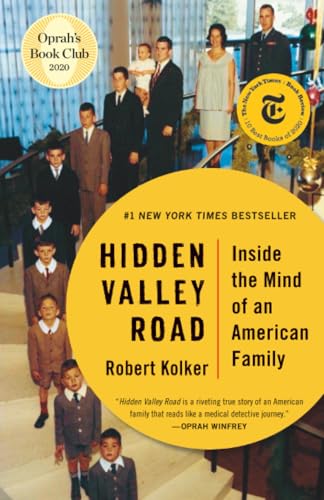
Yes, it was an Oprah's Book Club pick.
Is Hidden Valley Road worth reading?
It depends on what you want. The book is best for readers who like family stories and medical mystery. If that describes you, it is likely a good fit. If not, the titles under What to Read Next may suit you better.
Can this summary replace reading Hidden Valley Road?
No. A summary covers the main events and ideas, but it cannot carry the author's voice, detail or pacing. Use it to decide whether to read the book, to refresh your memory or to prepare for a discussion.