

Disclosure: As an Amazon Associate, Bookish Wisdom earns from qualifying purchases. This doesn't change our picks or your price.
TL;DR: Caroline Criado Perez shows how the world has been designed mostly around men, because much of the data used to make decisions is based on male bodies and lives. From car safety to medicine, from office temperatures to disaster relief, this “gender data gap” makes life harder, less safe and sometimes deadly for women. She argues that better data can fix it.
Table of Contents
Invisible Women at a Glance
| Author | Caroline Criado Perez |
| First published | 2019 |
| Type | Social science |
| Best for | readers who want an eye-opening, evidence-packed look at how data shapes our world |
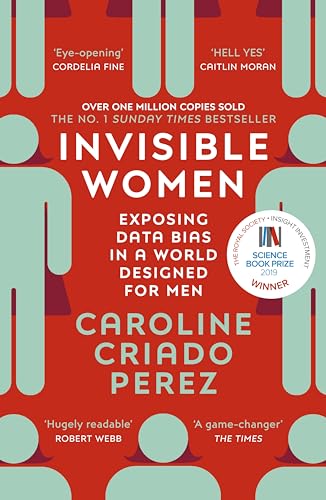
Invisible Women: Exposing Data Bias in a World Designed for Men is a nonfiction book by Caroline Criado Perez, published in 2019. It won the Royal Society Science Book Prize and the Financial Times Business Book of the Year. Below you will find a part-by-part summary, five key takeaways, ideas worth remembering and a note on who will enjoy it.
Content note: Discusses violence against women and medical harm.
Key Concepts
- The gender data gap: A lack of data about women's bodies and lives.
- Default male: The idea that men are treated as the standard human.
- Unpaid care work: Work, often done by women, that is not counted.
- Design bias: Products made for male bodies.
- Policy-makers: People who make decisions based on data.
The Main Ideas, Part by Part
Daily life
Criado Perez begins with examples from everyday life. In one Swedish town, snow was cleared from roads first, which helped male commuters more than women, who walked and took buses more often. When the order changed, accidents fell. Public toilets, transport and city planning often ignore women's needs.
Work
In the workplace, office temperatures are often set for men's metabolism, making women colder. Safety equipment, like protective clothing, is often designed for men. Unpaid care work, mostly done by women, is not counted in economic data, which hides a huge part of the economy.
Design
Many products are designed for the average man. Cars are tested with crash dummies based on male bodies, and women are more likely to be seriously injured in crashes. Phones are often too big for women's hands. Voice recognition software has historically worked better for male voices.
Medicine
Medical research has often focused on men. Women's heart attack symptoms can differ, and women are more likely to be misdiagnosed. Some drugs are tested mainly on men, causing side effects in women. Criado Perez shows how this gap can be deadly.
Public life
In politics and disasters, women's needs are often overlooked. Refugee camps can be unsafe for women. Women are underrepresented in decision-making. Criado Perez argues that the solution is simple in principle: collect data on women, include women in design and policy, and stop treating men as the default.
5 Key Takeaways
- Data is not neutral.
- Many systems treat men as the default.
- The gender data gap can be dangerous.
- Unpaid work should be counted.
- Including women in design benefits everyone.
Ideas Worth Remembering
These are paraphrased, not direct quotes:
- What is not measured is often not managed.
- Small design changes can save lives.
- Diverse teams catch hidden problems.
Who Should Read Invisible Women?
Read Invisible Women if you are interested in design, health, policy, economics or gender equality. It suits adults and older teens.
About Caroline Criado Perez
Caroline Criado Perez (born 1984) is a British writer and campaigner. She led the campaign to put a woman on English banknotes and the campaign for a statue of the suffragist Millicent Fawcett in Parliament Square. She was awarded an OBE in 2015. Her first book was Do It Like a Woman.
Questions to Think About After Reading
These prompts work for solo reading, a book club or a classroom discussion of Invisible Women:
- Which example of the data gap surprised you most?
- How could businesses close the gender data gap?
- Why does treating men as the default cause problems?
How to Use This Summary
Use this page as a quick reference before a book club meeting, an exam, or a decision about whether Invisible Women is worth your time. The takeaways are written to stand on their own. If a point interests you, go back to the book for the author's full argument, examples and evidence, which no short summary can replace.
A Note on Accuracy and Spoilers
This summary is based on the published text of Invisible Women, not on any film, series or stage adaptation, which often change the story. Details are kept at the level of the main arguments so that nothing is invented. Editions differ slightly in length and wording, so page numbers and small details may vary between copies.
Should You Read the Book?
Yes. It is full of surprising facts and changes how you see the world.
Check price of Invisible Women on Amazon
What to Read Next
- The Second Sex by Simone de Beauvoir: a classic study of women's position in society
- Weapons of Math Destruction by Cathy O'Neil: how algorithms can deepen inequality
- Doing Harm by Maya Dusenbery: how medicine fails women
Frequently Asked Questions
What is Invisible Women about?
How a lack of data about women leads to a world designed for men.
Who wrote it?
Caroline Criado Perez, in 2019.
What is the gender data gap?
A lack of data about women's bodies, lives and needs.
What examples does she use?
Cars, offices, phones, medicine and city planning, among others.
Did it win awards?
Yes, the Royal Society Science Book Prize.
Is it full of data?
Yes, it is packed with research and statistics.
Is it hard to read?
No, it is written for general readers.
What age is it for?
Adults and older teens.
How long is it?
About 410 pages.
Who should read it?
Designers, businesspeople, policy-makers and anyone curious.
Does it offer solutions?
Yes, mainly better data and inclusion.
Is it still relevant?
Yes, the issues remain current.
Is it only about women?
It focuses on women but shows that better data helps everyone.
Is Invisible Women worth reading?
It depends on what you want. The book is best for readers who want an eye-opening, evidence-packed look at how data shapes our world. If that describes you, it is likely a good fit. If not, the titles under What to Read Next may suit you better.