

Disclosure: As an Amazon Associate, Bookish Wisdom earns from qualifying purchases. This doesn't change our picks or your price.
TL;DR: A young sailor who calls himself Ishmael joins the crew of the whaling ship Pequod. Its captain, Ahab, lost his leg to a huge white sperm whale called Moby Dick, and he is obsessed with revenge. As the voyage goes on, Ahab drives his crew across the world's oceans in pursuit of the whale, toward a final, catastrophic confrontation.
Table of Contents
Moby-Dick at a Glance
| Author | Herman Melville |
| First published | 1851 |
| Type | Classic novel |
| Best for | readers who want a towering classic about obsession, nature and the sea |
Moby-Dick; or, The Whale is a novel by Herman Melville, published in 1851. It was little appreciated in Melville's lifetime but is now considered one of the greatest American novels. Below you will find a part-by-part summary, five key takeaways, ideas worth remembering and a note on who will enjoy it.
Content note: Includes violence, death, whaling and animal cruelty.
Main Characters
- Ishmael: The narrator, a young sailor.
- Captain Ahab: The obsessed captain of the Pequod.
- Queequeg: A skilled harpooner from a South Pacific island.
- Starbuck: The ship's thoughtful first mate.
- Moby Dick: The great white whale.
What Happens, Part by Part (Contains Spoilers)
Signing on
Ishmael, restless and depressed, decides to go to sea. In New Bedford, he shares a bed at an inn with Queequeg, a tattooed harpooner. At first Ishmael is frightened, but the two become close friends. They travel to Nantucket and sign on to the whaling ship Pequod, whose captain has not yet appeared.
Ahab
After the ship leaves port, Captain Ahab appears, with an ivory leg made from a whale's jawbone. He gathers the crew and nails a gold coin, a doubloon, to the mast. He promises it to the first man who spots Moby Dick. Ahab reveals that his only goal is revenge on the white whale. Starbuck objects, but the crew is swept up by Ahab's passion.
The whaling life
Ishmael describes the details of whaling: the different kinds of whales, how they are hunted, cut up and boiled for oil, and the dangers of the work. These long chapters mix science, history and philosophy. The crew hunts other whales, and Ishmael shares thoughts on nature and the meaning of the white whale.
Signs
The Pequod meets other ships, each with stories of Moby Dick, some full of warnings. A captain from the Rachel begs Ahab to help search for his lost son, but Ahab refuses. Pip, the ship's young cabin boy, is left alone in the sea and goes mad. Queequeg falls ill and has a coffin built, though he recovers. Starbuck considers stopping Ahab but cannot.
The chase
Moby Dick is finally sighted, and Ahab hunts him for three days. The whale destroys boats and kills crew members. On the third day, Ahab harpoons the whale but is caught by the line and dragged to his death. Moby Dick rams and sinks the Pequod. Ishmael alone survives, floating on Queequeg's coffin, until he is rescued by the Rachel.
5 Key Takeaways
- Obsession can destroy everything.
- Nature is vast and indifferent.
- Friendship can bridge cultures.
- Leaders can drag others into ruin.
- The meaning of things can be mysterious.
Ideas Worth Remembering
These are paraphrased, not direct quotes:
- Not every battle is worth fighting.
- Knowledge of the world is never complete.
- Survival can depend on what others leave behind.
Who Should Read Moby-Dick?
Read Moby-Dick if you enjoy classic literature, sea adventures and big philosophical questions. It suits adults and patient older teens.
About Herman Melville
Herman Melville (1819–1891) was an American writer who sailed on whaling ships in his youth. His early novels Typee and Omoo, based on his South Seas adventures, were popular. Moby-Dick sold poorly, and he later worked as a customs inspector in New York. His other works include Bartleby, the Scrivener and Billy Budd.
Questions to Think About After Reading
These prompts work for solo reading, a book club or a classroom discussion of Moby-Dick:
- What does the white whale represent?
- Why does the crew follow Ahab?
- Why does Melville include so many chapters about whaling?
How to Use This Summary
Use this page as a quick reference before a book club meeting, an exam, or a decision about whether Moby-Dick is worth your time. The takeaways are written to stand on their own. If a point interests you, go back to the book for the author's full story, characters and style, which no short summary can replace.
A Note on Accuracy and Spoilers
This summary is based on the published text of Moby-Dick, not on any film, series or stage adaptation, which often change the story. Details are kept at the level of the main events so that nothing is invented. Editions differ slightly in length and wording, so page numbers and small details may vary between copies.
Should You Read the Book?
Yes, if you are ready for a challenge. It is long and digressive, but unforgettable.
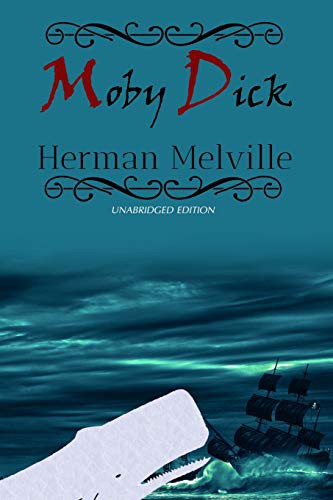
Check price of Moby-Dick on Amazon
What to Read Next
- Twenty Thousand Leagues Under the Seas by Jules Verne: another obsessed captain at sea
- The Old Man and the Sea by Ernest Hemingway: a fisherman's struggle with a great fish
- In the Heart of the Sea by Nathaniel Philbrick: the true story that inspired Moby-Dick
Related: Bartleby, the Scrivener by Herman Melville: Summary and Key Takeaways
Frequently Asked Questions
What is Moby-Dick about?
A captain's obsession with a white whale leads his ship to destruction.
Who wrote it?
Herman Melville, in 1851.
Who is Ahab?
The captain of the Pequod, who lost his leg to the whale.
Who narrates it?
Ishmael.
What is the famous first line?
“Call me Ishmael.”
Who survives?
Only Ishmael.
Is it based on a true story?
It was inspired partly by the sinking of the whaleship Essex in 1820.
Is it long?
Yes, about 600 to 700 pages.
What age is it for?
Adults and older teens.
Is it hard to read?
Yes, it has many long digressions.
Are there films?
Yes, including the 1956 film with Gregory Peck.
Was it successful when published?
No, it became famous long after Melville's death.
Can I skip the whaling chapters?
Some readers do on a first read, but they add a lot to the book's meaning.
Is Moby-Dick worth reading?
It depends on what you want. The book is best for readers who want a towering classic about obsession, nature and the sea. If that describes you, it is likely a good fit. If not, the titles under What to Read Next may suit you better.