
Disclosure: As an Amazon Associate, Bookish Wisdom earns from qualifying purchases. This doesn't change our picks or your price.
TL;DR: Over a single day, six astronauts aboard the International Space Station circle the Earth sixteen times. They eat, exercise, run experiments and look down at the planet, watching sunrises, storms and the lights of cities. In short, poetic chapters, the novel follows their thoughts about home, loss, beauty and what it means to be human.
Table of Contents
Orbital at a Glance
| Author | Samantha Harvey |
| First published | 2023 |
| Type | Literary fiction |
| Best for | readers who want a short, lyrical novel about Earth, wonder and human connection |
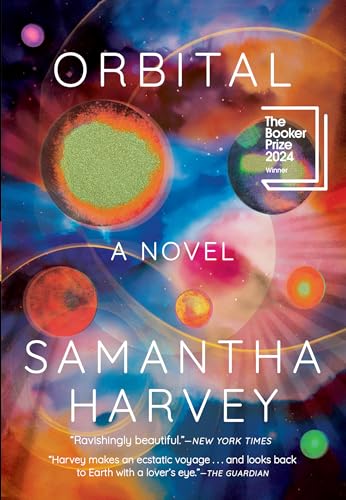
Orbital is a novel by Samantha Harvey, published in 2023. It won the Booker Prize in 2024. Below you will find a part-by-part summary, five key takeaways, ideas worth remembering and a note on who will enjoy it.
Content note: Includes grief and natural disaster.
Main Characters
- Shaun: An American astronaut.
- Chie: A Japanese astronaut who has just lost her mother.
- Nell: A British astronaut.
- Roman and Anton: Two Russian cosmonauts.
- Pietro: An Italian astronaut.
What Happens, Part by Part (Contains Spoilers)
A day in orbit
The novel follows one day, divided into sixteen orbits. The six astronauts live closely together in the station's small spaces. They follow tight routines, from exercise to experiments on mice and plants. They float, sleep in sleeping bags tied to walls and talk to Mission Control. Their days are both ordinary and extraordinary.
Looking down
The crew watches Earth constantly. They see continents, deserts, oceans and the thin blue line of the atmosphere. They see no borders. Each orbit brings a new sunrise and sunset. The view makes them feel small and full of awe, and they think about how fragile and beautiful the planet is.
Inner lives
Each astronaut has private thoughts. Chie learns that her mother has died back on Earth, and she grieves far from home. Anton thinks of his family and his marriage. Nell reflects on the strangeness of being away from ordinary life. Roman wonders whether he will return to space. They miss their loved ones and wonder how they have changed.
A storm
During the day, a huge typhoon moves toward the Philippines. The astronauts watch it grow from above, worried for the people below. They are powerless to help, which makes them feel both connected to and separated from Earth. Meanwhile, a new mission is heading to the Moon, and the crew thinks about humanity's future in space.
Home
As the day ends, the astronauts reflect on what they have learned. The Earth is their only true home, and everything that matters to them is on it. The novel ends with a sense of wonder and gratitude for life and for the planet, seen from a place where it looks like one shared world.
5 Key Takeaways
- Earth is fragile and beautiful.
- Distance can change perspective.
- Human connection matters everywhere.
- Grief can find us anywhere.
- Wonder is a powerful feeling.
Ideas Worth Remembering
These are paraphrased, not direct quotes:
- From above, there are no borders.
- Small routines can hold great meaning.
- We are all passengers on the same planet.
Who Should Read Orbital?
Read Orbital if you enjoy lyrical, reflective novels and stories about space and humanity. It suits adults.
About Samantha Harvey
Samantha Harvey (born 1975) is an English novelist and philosophy graduate. Her earlier novels include The Wilderness, Dear Thief and The Western Wind. She also wrote The Shapeless Unease, a memoir about insomnia. Orbital won the 2024 Booker Prize, and at about 136 pages it was one of the shortest books ever to win.
Questions to Think About After Reading
These prompts work for solo reading, a book club or a classroom discussion of Orbital:
- How does seeing Earth from space change the astronauts?
- What does the typhoon represent?
- Why does the novel focus on just one day?
How to Use This Summary
Use this page as a quick reference before a book club meeting, an exam, or a decision about whether Orbital is worth your time. The takeaways are written to stand on their own. If a point interests you, go back to the book for the author's full story, characters and style, which no short summary can replace.
A Note on Accuracy and Spoilers
This summary is based on the published text of Orbital, not on any film, series or stage adaptation, which often change the story. Details are kept at the level of the main events so that nothing is invented. Editions differ slightly in length and wording, so page numbers and small details may vary between copies.
Should You Read the Book?
Yes. It is short and beautiful, though it has little plot.
Check price of Orbital on Amazon
What to Read Next
- The Overstory by Richard Powers: a novel about connection and nature
- Station Eleven by Emily St. John Mandel: lyrical fiction about human connection
- A Man Called Ove by Fredrik Backman: a moving story about ordinary life
Related: 15 Books Like Orbital You’ll Love
Frequently Asked Questions
What is Orbital about?
One day in the lives of six astronauts on the International Space Station.
Who wrote it?
Samantha Harvey, in 2023.
Did it win the Booker Prize?
Yes, in 2024.
How many astronauts are there?
Six.
How many orbits are described?
Sixteen, in one day.
Is there a plot?
It has little plot and focuses on thoughts and images.
Is it science fiction?
No, it is literary fiction about real space travel.
What age is it for?
Adults.
How long is it?
About 140 pages.
Is it poetic?
Yes, very.
What is the main theme?
The beauty and fragility of Earth.
Is it a quick read?
Yes, but many readers read it slowly.
Is Orbital good for readers who usually prefer plot?
It may feel slow, but its short length makes it easy to try.
Is Orbital worth reading?
It depends on what you want. The book is best for readers who want a short, lyrical novel about Earth, wonder and human connection. If that describes you, it is likely a good fit. If not, the titles under What to Read Next may suit you better.