
Disclosure: As an Amazon Associate, Bookish Wisdom earns from qualifying purchases. This doesn't change our picks or your price.
Quick answer: The best quotes from A Streetcar Named Desire by Tennessee Williams include “They told me to take a street-car named Desire, and then transfer to one called Cemeteries and ride six blocks and get off at, Elysian Fields!” and “I don't want realism. I want magic!” Below are 4 of the most memorable lines, with who says them, where they come from and what they mean.
Quick facts
- Book: A Streetcar Named Desire by Tennessee Williams
- First published: 1947
- Quotes covered: 4
- Best for: essays, captions, book club talks and rereads
Table of Contents
What A Streetcar Named Desire Is About
Blanche DuBois, a fading Southern belle who has lost her family home, arrives at the cramped New Orleans apartment of her sister, Stella, and Stella's rough, working-class husband, Stanley Kowalski. Blanche hides her past behind fine manners and fantasy, while Stanley sets out to expose her. Their clash builds through a hot summer to a brutal climax that destroys Blanche's fragile hold on reality.
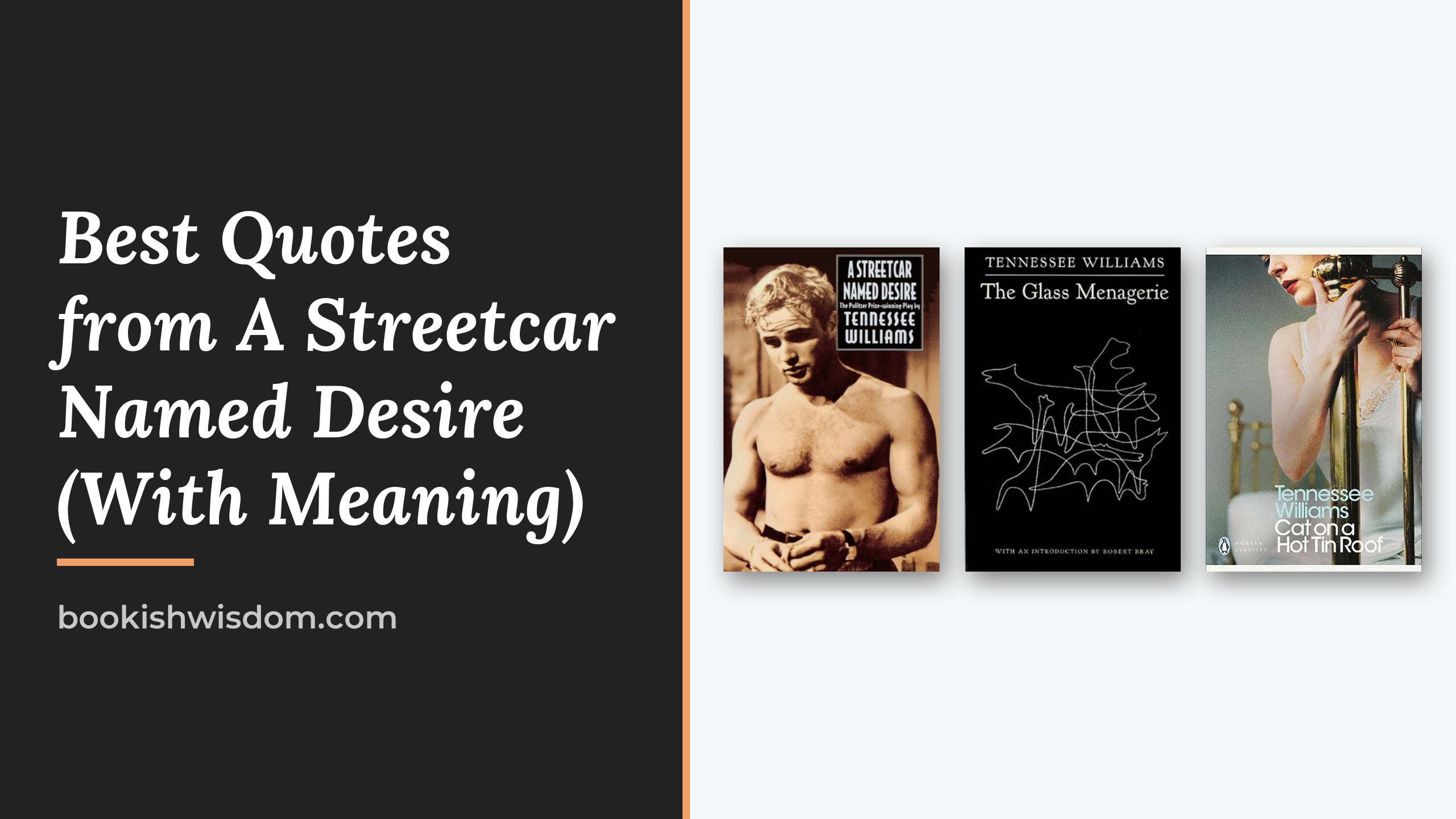
Check price of A Streetcar Named Desire on Amazon
The Best Quotes from A Streetcar Named Desire, Explained
1. “They told me to take a street-car named Desire, and then transfer to one called Cemeteries and ride six blocks and get off at, Elysian Fields!”
Blanche, Scene One. Blanche's arrival sums up her life's path. Desire led her to death and loss, and now she hopes for rest.
2. “I don't want realism. I want magic!”
Blanche, Scene Nine. Blanche admits she prefers illusion to harsh truth. It explains her lies and her tragedy.
3. “Stella! Hey, Stella!”
Stanley, Scene Three. Stanley's cry after a violent fight is one of the most famous moments in theater. It shows both his brutality and his need for Stella.
4. “I have always depended on the kindness of strangers.”
Blanche, final scene. As she is led away, Blanche speaks with fragile grace. The line is heartbreaking because strangers have so rarely been kind to her.
Why These Lines Stay With Readers
A Streetcar Named Desire won the Pulitzer Prize and made Marlon Brando a star in the 1951 film. Its lines are central to discussions about illusion and reality, desire and the clash between the old South and modern America. Blanche and Stanley represent two worlds: fragile refinement and raw power. Williams gives both characters moments of sympathy, so readers argue about who deserves blame. The play's poetic dialogue and harsh ending make it one of the most studied works of American drama.
How to Use These Quotes
- In an essay: introduce the quote, give its context in one sentence, then explain how it supports your point.
- For a book club: read one line aloud and ask whether everyone agrees with the speaker.
- For a caption or card: pick a short line and credit Tennessee Williams and A Streetcar Named Desire.
- For a reread: look for the moment each line appears and notice what changes around it.
A Note on Quoting A Streetcar Named Desire Accurately
Wording can differ slightly between editions, translations and film versions, and many lines shared online are paraphrased or misattributed. If you need an exact quote for an essay, check it against a printed copy of A Streetcar Named Desire and note the edition and page number. The lines above are given as they appear in the book, not as they were changed for later adaptations.
When you quote in an essay, keep the quotation short and let your own explanation do most of the work. A good pattern is to name the speaker, place the line in the story, quote it and then spend two or three sentences on what it shows. Quotes from A Streetcar Named Desire work best when they support a clear point about a character or theme, rather than standing alone.
Reading the Lines in Context
A quote often means more once you know where it falls in the story. Before using any of these lines, reread the surrounding page or two and ask what has just happened, who is listening and what the speaker wants. The same words can sound hopeful, ironic or desperate depending on that moment. Noticing this context is what turns a memorable line into real evidence for an argument about the book.
Discussion Questions
- Which quote above best sums up A Streetcar Named Desire for you, and why?
- Do any of these lines mean something different once you know how the book ends?
- Which quote would you disagree with, and what would you say back?
If You Love the Writing in A Streetcar Named Desire
-
The Glass Menagerie by Tennessee Williams
-
Cat on a Hot Tin Roof by Tennessee Williams
Related: A Streetcar Named Desire by Tennessee Williams: Summary and Key Takeaways · Themes in A Streetcar Named Desire Explained
Frequently Asked Questions
What is the most famous quote from A Streetcar Named Desire?
One of the best-known lines is “They told me to take a street-car named Desire, and then transfer to one called Cemeteries and ride six blocks and get off at, Elysian Fields!” (blanche, Scene One).
Who wrote A Streetcar Named Desire?
A Streetcar Named Desire was written by Tennessee Williams and first published in 1947.
Can I use quotes from A Streetcar Named Desire in an essay?
Yes. Short quotations with clear credit to Tennessee Williams are standard in essays and reviews. Always explain the quote in your own words.
What should I read after A Streetcar Named Desire?
Try The Glass Menagerie by Tennessee Williams or Cat on a Hot Tin Roof by Tennessee Williams.