
Disclosure: As an Amazon Associate, Bookish Wisdom earns from qualifying purchases. This doesn't change our picks or your price.
Quick answer: The best quotes from Peter Pan by J. M. Barrie include “All children, except one, grow up.” and “To die will be an awfully big adventure.” Below are 6 of the most memorable lines, with who says them, where they come from and what they mean.
Quick facts
- Book: Peter Pan by J. M. Barrie
- First published: 1911
- Quotes covered: 6
- Best for: essays, captions, book club talks and rereads
Table of Contents
What Peter Pan Is About
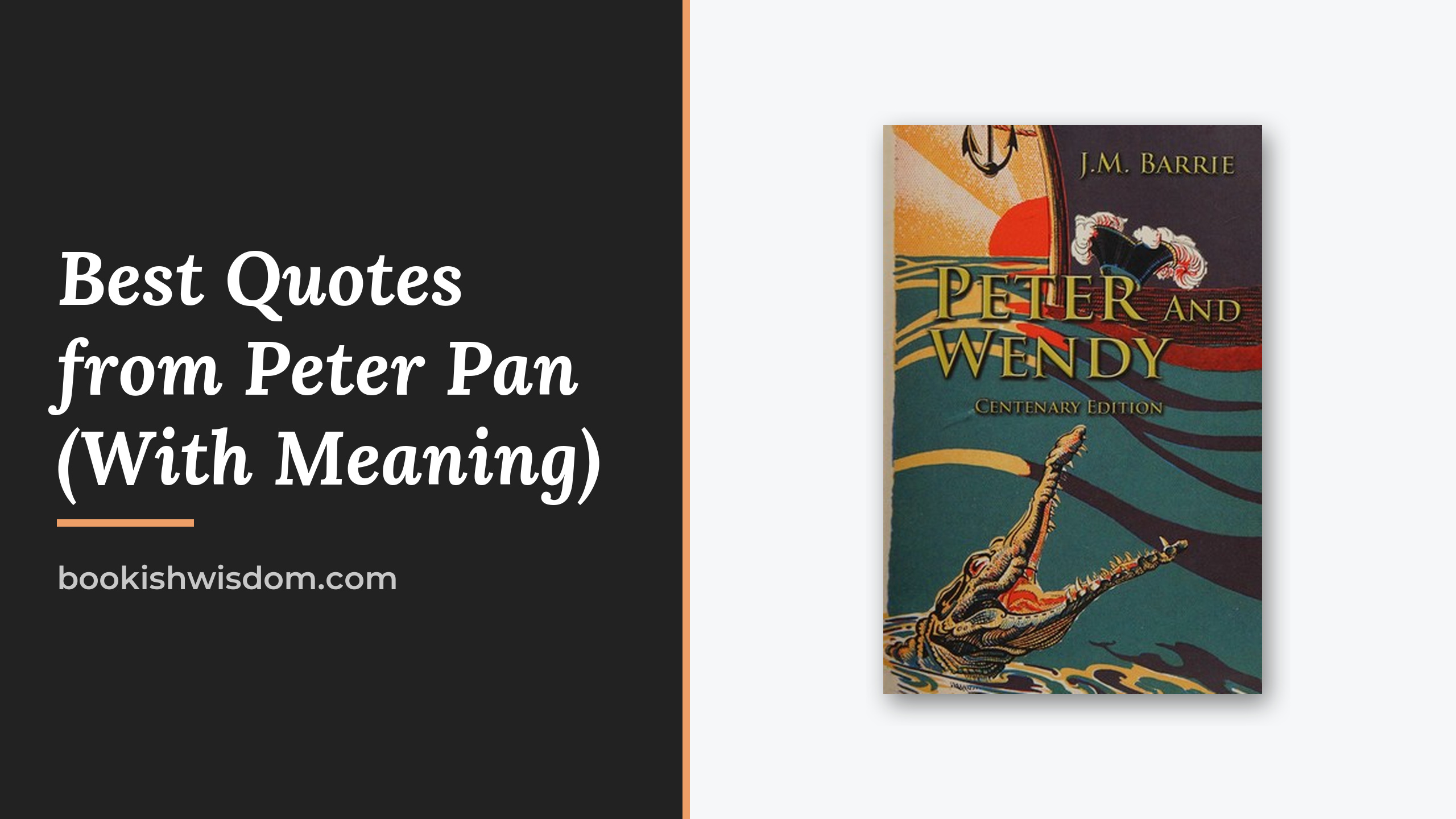
Wendy Darling and her brothers, John and Michael, live in London with their parents and a Newfoundland dog nurse named Nana. One night Peter Pan, a boy who refuses to grow up, flies into their nursery looking for his lost shadow. With the help of the fairy Tinker Bell, he teaches the children to fly and takes them to Neverland, home of the Lost Boys, mermaids and the pirate Captain Hook. Barrie first told the story as a play in 1904 and then as the novel Peter and Wendy.
Check price of Peter Pan on Amazon
The Best Quotes from Peter Pan, Explained
1. “All children, except one, grow up.”
The opening line. The first sentence tells readers what makes Peter special and sad. He is the one child who never grows up, which is both a gift and a loss. The rest of the book explores what that means.
2. “To die will be an awfully big adventure.”
Peter, stranded on a rock in the lagoon. Peter faces danger without fear because he sees everything as a game. The line is brave, childlike and a little unsettling. It has been quoted for a century as a way of facing the unknown.
3. “Second to the right, and straight on till morning.”
Peter's directions to Neverland. These playful directions show that Neverland is a place you reach by imagination rather than a map. The line has become a symbol of escape into fantasy.
4. “Every time a child says, I don't believe in fairies, there is a fairy somewhere that falls down dead.”
Peter, explaining fairies to Wendy. Barrie links belief and life in a way that becomes important when Tinker Bell is in danger. The line shows how much the story depends on imagination.
5. “If you believe, clap your hands.”
Peter, asking readers to save Tinker Bell. In one of the most famous moments in children's literature, Peter turns to the audience. In the play, theater crowds clap to save Tink, and readers often feel the same urge.
6. “I'm youth, I'm joy, I'm a little bird that has broken out of the egg.”
Peter, when Hook asks who he is. Peter answers with a burst of pride and freedom. The line sums up what he represents: endless childhood, energy and joy, without the wisdom or sadness of growing up.
Why These Lines Stay With Readers
Barrie's story has been retold many times, but the original lines are sharper and sadder than many people expect. They are quoted about childhood, imagination and the bittersweet cost of growing up.
How to Use These Quotes
- In an essay: introduce the quote, give its context in one sentence, then explain how it supports your point.
- For a book club: read one line aloud and ask whether everyone agrees with the speaker.
- For a caption or card: pick a short line and credit J. M. Barrie and Peter Pan.
- For a reread: look for the moment each line appears and notice what changes around it.
A Note on Quoting Peter Pan Accurately
Wording can differ slightly between editions, translations and film versions, and many lines shared online are paraphrased or misattributed. If you need an exact quote for an essay, check it against a printed copy of Peter Pan and note the edition and page number. The lines above are given as they appear in the book, not as they were changed for later adaptations.
When you quote in an essay, keep the quotation short and let your own explanation do most of the work. A good pattern is to name the speaker, place the line in the story, quote it and then spend two or three sentences on what it shows. Quotes from Peter Pan work best when they support a clear point about a character or theme, rather than standing alone.
Discussion Questions
- Which quote above best sums up Peter Pan for you, and why?
- Do any of these lines mean something different once you know how the book ends?
- Which quote would you disagree with, and what would you say back?
If You Love the Writing in Peter Pan
- Alice's Adventures in Wonderland by Lewis Carroll
- The Wonderful Wizard of Oz by L. Frank Baum
Related: Peter Pan by J. M. Barrie: Summary and Key Takeaways · Themes in Peter Pan Explained
Frequently Asked Questions
What is the most famous quote from Peter Pan?
One of the best-known lines is “All children, except one, grow up.” (the opening line).
Who wrote Peter Pan?
Peter Pan was written by J. M. Barrie and first published in 1911.
Can I use quotes from Peter Pan in an essay?
Yes. Short quotations with clear credit to J. M. Barrie are standard in essays and reviews. Always explain the quote in your own words.
What should I read after Peter Pan?
Try Alice's Adventures in Wonderland by Lewis Carroll or The Wonderful Wizard of Oz by L. Frank Baum.