
Disclosure: As an Amazon Associate, Bookish Wisdom earns from qualifying purchases. This doesn’t change our picks or your price.
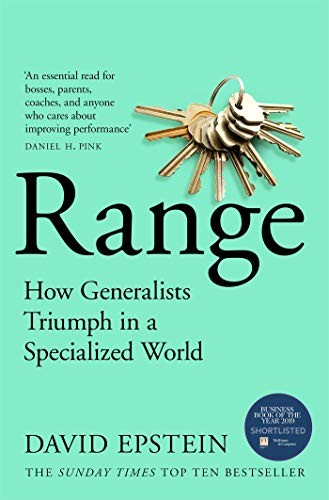
TL;DR: In Range: Why Generalists Triumph in a Specialized World, David Epstein argues that early specialization is overrated. In complex, unpredictable fields, people who sample widely, switch paths and connect ideas across domains often outperform narrow specialists. Late starts and career changes aren’t failures; they can be advantages.
We’re often told that success requires starting young and practicing one thing obsessively, like Tiger Woods swinging a golf club as a toddler. David Epstein, a science journalist and author of The Sports Gene, challenges that story. Drawing on research and examples from sports, music, science, business and the military, he shows that breadth, experimentation and even delay often lead to greater long-term success. Here’s a complete summary of the book’s key ideas and takeaways.
Table of Contents
Range at a Glance
| Detail | Info |
|---|---|
| Author | David Epstein |
| Published | 2019 |
| Genre | Psychology / careers / learning |
| Core idea | Breadth and varied experience beat early specialization in complex fields |
| Best for | Students, career changers, parents and leaders |
What Is Range About?
Epstein opens by contrasting Tiger Woods, who specialized in golf from early childhood, with Roger Federer, who played many sports before focusing on tennis in his teens. Both became champions, but Epstein argues Federer’s path is far more common among elite performers. The rest of the book explores why broad experience helps people learn better, solve harder problems and find work that truly fits them.
Key Ideas From the Book
Kind vs Wicked Learning Environments
Borrowing from psychologist Robin Hogarth, Epstein describes “kind” environments, like chess or golf, where rules are clear and feedback is fast and accurate. Specialization works well there. Most of life is “wicked”: rules are unclear, feedback is delayed or misleading, and patterns don’t repeat. In wicked environments, broad thinking and adaptability matter more.
The Sampling Period
Many top performers had a “sampling period” in which they tried many activities before choosing one. This helped them discover their strengths and interests and build general skills they later transferred.
Learning Slowly Sticks
Research on “desirable difficulties” shows that learning that feels harder, like spacing out practice, testing yourself and mixing different types of problems (interleaving), leads to deeper, longer-lasting understanding than easy, repetitive drills.
Thinking Outside Your Experience
Epstein shows how analogies from unrelated fields help solve problems. Outsiders often crack challenges that experts can’t because they bring different tools. He also describes Nintendo’s Gunpei Yokoi and his idea of “lateral thinking with withered technology,” using old, well-understood technology in new ways, which led to the Game Boy.
Match Quality and Late Starts
“Match quality” describes how well your work fits your abilities and interests. People who switch careers often find better matches and end up happier and more successful. Epstein points to late bloomers like Vincent van Gogh, who tried several careers before devoting himself to painting.
The Danger of Narrow Expertise
Specialists can become overconfident and trapped by their field’s habits. Epstein discusses how organizational cultures, such as the decision-making before NASA’s Challenger disaster, can fail when people stick rigidly to familiar tools and procedures.
5 Key Takeaways From Range
- Don’t rush to specialize. Sampling different fields builds skills and self-knowledge.
- Match the strategy to the environment. Narrow practice works in “kind” fields; breadth wins in “wicked” ones.
- Embrace harder learning. Spacing, self-testing and mixing topics feel slow but work better.
- Borrow ideas across fields. Analogies and outside perspectives spark creative solutions.
- Late starts are normal. Changing direction can improve fit, not waste time.
Ideas Worth Remembering
- Being a little behind early can be an advantage if it leads you to a path that truly fits. (paraphrased)
- Experiment with who you might become rather than committing too early to a single plan. (paraphrased)
- The most effective learning often feels the least effective while you’re doing it. (paraphrased)
Who Should Read Range?
It’s especially valuable for students choosing majors, adults considering a career change, parents worried their child isn’t specializing early enough and managers building innovative teams. Anyone who has felt behind for “wasting time” exploring different interests will find the book reassuring and practical.
What to Read Next
- Peak by Anders Ericsson and Robert Pool for the case for deliberate practice.
- Make It Stick by Peter C. Brown, Henry L. Roediger III and Mark A. McDaniel on the science of learning.
- Hidden Potential by Adam Grant on how people grow beyond their starting point.
Related: best books on logic and critical thinking and Mindset summary and key takeaways.
Frequently Asked Questions
What is the main idea of Range?
Range argues that in complex, unpredictable fields, generalists with broad experience often outperform early specialists, because they adapt better, think creatively across domains and find work that fits them.
What are kind and wicked learning environments?
Kind environments have clear rules and fast, accurate feedback, like chess or golf. Wicked environments have unclear rules and delayed or misleading feedback, like most careers and real-world problems.
Is Range against specialization?
Not entirely. Epstein agrees specialization works in some fields. His point is that early, narrow specialization is often overrated, especially in complex areas where breadth helps.