
Disclosure: As an Amazon Associate, Bookish Wisdom earns from qualifying purchases. This doesn't change our picks or your price.
TL;DR: On Saturday, February 15, 2003, the day of huge London protests against the Iraq War, neurosurgeon Henry Perowne moves through his day: squash, visiting his mother, preparing a family dinner. A minor car accident brings him into conflict with Baxter, a volatile man with a degenerative illness, who later invades Henry's home and threatens his family.
Table of Contents
Saturday at a Glance
| Author | Ian McEwan |
| First published | 2005 |
| Type | Novel |
| Best for | readers who want a tense, thoughtful literary novel set in one day |
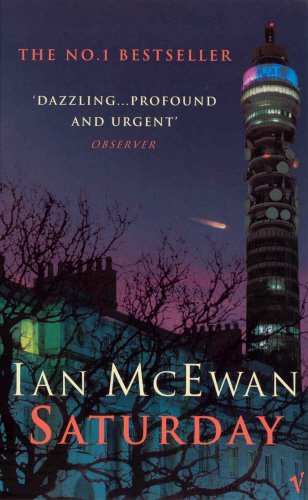
Saturday is a novel by Ian McEwan, published in 2005. It explores the anxieties of the post-9/11 world through one man's day. Below you will find a part-by-part summary, five key takeaways, ideas worth remembering and a note on who will enjoy it.
Content note: Includes a violent home invasion and threats of sexual violence.
Main Characters
- Henry Perowne: A successful, thoughtful neurosurgeon.
- Rosalind: Henry's wife, a newspaper lawyer.
- Daisy: Henry's daughter, a poet.
- Theo: Henry's son, a blues musician.
- Baxter: A troubled man with Huntington's disease.
What Happens, Part by Part (Contains Spoilers)
Before dawn
Henry wakes early and sees a burning plane descending toward Heathrow. He fears terrorism, but news later says it was a mechanical problem. The image sets the anxious tone of the day.
The accident
Driving to a squash game, Henry has a minor car collision with Baxter and two friends. Baxter turns aggressive. Henry notices signs of Huntington's disease and uses his medical knowledge to distract Baxter, humiliating him in front of his friends and escaping.
Henry's day
Henry plays squash with a colleague, visits his mother in a care home, where she has dementia, and listens to his son Theo's band. He thinks about the Iraq War protests, which he feels unsure about, and about luck, privilege and science.
The invasion
That evening, as the family gathers for dinner with Daisy and Rosalind's father, Baxter and an accomplice break into the house with a knife. Baxter threatens Rosalind and forces Daisy to undress, revealing she is pregnant. He makes her read a poem, and she recites Matthew Arnold's “Dover Beach,” which moves Baxter.
After
Henry and Theo overpower Baxter, who falls down the stairs and is badly injured. Henry is called to the hospital to operate on Baxter's brain. He saves his life and decides not to press charges. The day ends with Henry reflecting on fragility and the randomness of fate.
5 Key Takeaways
- Ordinary life is fragile.
- Knowledge brings power, but also responsibility.
- Literature can reach people in unexpected ways.
- Privilege shapes how we see the world.
- Compassion can follow fear.
Ideas Worth Remembering
These are paraphrased, not direct quotes:
- One small encounter can change a whole day.
- Fear of the world can enter even the safest home.
- Healing an enemy can be an act of grace.
Who Should Read Saturday?
Read Saturday if you enjoy literary novels, medical detail and stories set over a single day. It suits adults.
Questions to Think About After Reading
These prompts work for solo reading, a book club or a classroom discussion of Saturday:
- Was Henry right to humiliate Baxter?
- Why does the poem affect Baxter?
- Why does Henry choose not to press charges?
How to Use This Summary
Use this page as a quick reference before a book club meeting, an exam, or a decision about whether Saturday is worth your time. The takeaways are written to stand on their own. If a point interests you, go back to the book for the author's full story, characters and style, which no short summary can replace.
A Note on Accuracy and Spoilers
This summary is based on the published text of Saturday, not on any film, series or stage adaptation, which often change the story. Details are kept at the level of the main events so that nothing is invented. Editions differ slightly in length and wording, so page numbers and small details may vary between copies.
Should You Read the Book?
Yes, if you like reflective novels. It is slower in the middle, but the climax is gripping, and it captures early-2000s anxiety vividly.
Check price of Saturday on Amazon
What to Read Next
- Mrs Dalloway by Virginia Woolf: another novel set over one London day
- Atonement by Ian McEwan: McEwan's most famous novel
- On Chesil Beach by Ian McEwan: a short, tense McEwan novel
Related: Atonement by Ian McEwan: Summary and Key Takeaways
Frequently Asked Questions
What is Saturday about?
A London neurosurgeon's day, which ends in a violent home invasion.
Who wrote Saturday?
Ian McEwan, in 2005.
When is it set?
On February 15, 2003, the day of anti-Iraq War protests in London.
What disease does Baxter have?
Huntington's disease.
What poem does Daisy recite?
Matthew Arnold's “Dover Beach.”
Does Henry operate on Baxter?
Yes, and saves his life.
What age is it for?
Adults.
How long is it?
About 280 pages.
Is it based on Mrs Dalloway?
It is often compared to it because both follow one London day.
What is Henry's job?
He is a neurosurgeon.
Who is Grammaticus?
Rosalind's father, a famous poet who joins the family dinner.
Why does Henry notice Baxter's illness?
As a neurosurgeon, he recognizes the twitching and mood changes of Huntington's disease.
Is there a film?
No major film adaptation has been made.
Who are the main characters in Saturday?
The main characters are Henry Perowne, Rosalind, Daisy, Theo and Baxter. Henry Perowne: A successful, thoughtful neurosurgeon. Rosalind: Henry's wife, a newspaper lawyer. Daisy: Henry's daughter, a poet.
Is Saturday worth reading?
It depends on what you want. The book is best for readers who want a tense, thoughtful literary novel set in one day. If that describes you, it is likely a good fit. If not, the titles under What to Read Next may suit you better.