
Disclosure: As an Amazon Associate, Bookish Wisdom earns from qualifying purchases. This doesn't change our picks or your price.
TL;DR: In 1972, Jean McConville, a widowed mother of ten, was abducted from her Belfast home and never seen again. Patrick Radden Keefe uses her disappearance as a starting point to tell the story of the Troubles in Northern Ireland, through the lives of IRA members such as Dolours Price and Brendan Hughes.
Table of Contents
Say Nothing at a Glance
| Author | Patrick Radden Keefe |
| First published | 2018 |
| Type | Narrative nonfiction (true crime and history) |
| Best for | readers of true crime and modern history |
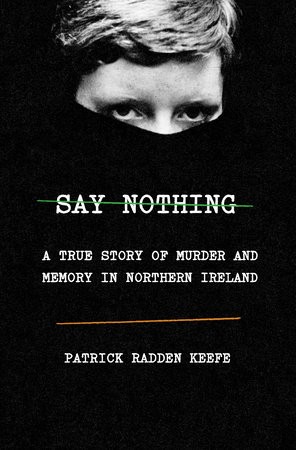
Say Nothing is a nonfiction book by Patrick Radden Keefe, first published in 2018. It won the Orwell Prize for Political Writing and became a TV series. Below you will find a part-by-part summary, five key takeaways, a few ideas worth remembering and a note on who will enjoy it most. The summary paraphrases the author's ideas rather than quoting them at length, so it works as a refresher or a preview, not a replacement for the book.
Content note: Describes political violence, murder, torture and trauma.
Key Ideas, Part by Part
Jean McConville
The book begins with the night in December 1972 when masked people took Jean McConville from her flat in Belfast, in front of her children. The family was left to survive without her, and for years nobody knew what had happened.
The Troubles
Keefe then goes back to explain the conflict between those who wanted Northern Ireland to remain in the United Kingdom and those who wanted a united Ireland. He describes the violence and the role of the Provisional IRA.
Dolours Price and Brendan Hughes
Dolours Price and Brendan Hughes were IRA members who took part in operations, including bombings. The book follows their lives from young idealism to prison, hunger strikes and disillusionment.
Gerry Adams
Keefe examines claims about the role of Gerry Adams in the IRA and the McConville case, which Adams has denied. The book presents the allegations and the denials.
The Belfast Project
Boston College collected interviews with former paramilitaries on the condition that they would be released only after their deaths. This archive became the subject of legal action and a major controversy.
Justice and memory
In the end, McConville's remains were found in 2003, and the question of responsibility remains unresolved. The book shows how a community's silence can protect the guilty and hurt the innocent.
5 Key Takeaways
- Violent conflict leaves long scars on families, including the ones who were not involved.
- Memory and silence are powerful forces, and some communities pay the price.
- Individuals who commit violence may carry lifelong guilt and doubt.
- Truth is hard to find when it is contested by those with power.
- A single case can illuminate a larger history.
Ideas Worth Remembering
These are paraphrased, not direct quotes:
- The title refers to a poem and to the culture of silence in Northern Ireland.
- The book is written like a thriller, but it deals with real victims.
- It does not offer neat conclusions about guilt.
Who Should Read Say Nothing?
Read it if you are interested in Irish history, true crime or how political violence reshapes people. It may be upsetting for readers who dislike graphic accounts.
Questions to Think About After Reading
These prompts work for solo reading, a book club or a classroom discussion of Say Nothing:
- Which idea could you use this week, and what would the first step be?
- Where do you disagree with the author, and what evidence would change your mind?
- Who in your life would benefit most from this book, and why?
Quick Facts to Remember
- Book: Say Nothing by Patrick Radden Keefe (2018)
- Type: Narrative nonfiction (true crime and history)
- Best for: readers of true crime and modern history
- Main idea in one line: Violent conflict leaves long scars on families, including the ones who were not involved.
Reading Time and Format
Nonfiction is easy to read in pieces. Many readers like an audiobook for the commute and a print or e-book copy for notes and highlights. Check the page count of your edition before you plan your reading time.
How to Use This Summary
Use this page as a quick reference before a book club meeting, an exam, or a decision about whether Say Nothing is worth your time. The takeaways are written to stand on their own. If a point interests you, go back to the book for the author's full argument, examples and style, which no short summary can carry.
A Note on Accuracy and Spoilers
This summary is based on the published text of Say Nothing, not on any film, series or stage adaptation, which often change the story. Details are kept at the level of the main events so that nothing is invented. Editions differ slightly in length and wording, so page numbers and small details may vary from your copy.
Should You Read the Book?
If you decide to read it, skim the contents page first and read the sections that match your goal. Take notes in your own words, because ideas stick better when you rephrase them.
Check price of Say Nothing on Amazon
What to Read Next
- Empire of Pain by Patrick Radden Keefe: another investigative work by Keefe
- Killers of the Flower Moon by David Grann: a gripping true crime history
- Milkman by Anna Burns: a novel set during the Troubles
Related: 15 Books Like Say Nothing You’ll Love · Empire of Pain by Patrick Radden Keefe: Summary and Key Takeaways
Frequently Asked Questions
Is Say Nothing a true story?
Yes. It is nonfiction based on interviews and records.
What happened to Jean McConville?
She was abducted and killed in 1972, and her remains were found in 2003.
Is there a TV series?
Yes. FX released a series in 2024.
Who is Gerry Adams in the book?
A leading Irish republican politician who has denied claims that he was in the IRA or involved in the McConville case.
Is Say Nothing worth reading?
It depends on what you want. The book is best for readers of true crime and modern history. If that describes you, it is likely a good fit. If not, the titles under What to Read Next may suit you better.
Can this summary replace reading Say Nothing?
No. A summary covers the main events and ideas, but it cannot carry the author's voice, detail or pacing. Use it to decide whether to read the book, to refresh your memory or to prepare for a discussion.