
Disclosure: As an Amazon Associate, Bookish Wisdom earns from qualifying purchases. This doesn't change our picks or your price.
TL;DR: The Oz Principle argues that most people and organizations get stuck in a “victim cycle,” blaming others and waiting for help, like the characters in The Wizard of Oz. The authors show how to move “above the line” by taking personal accountability. Their simple model, See It, Own It, Solve It, Do It, helps individuals and teams produce real results.
Table of Contents
The Oz Principle at a Glance
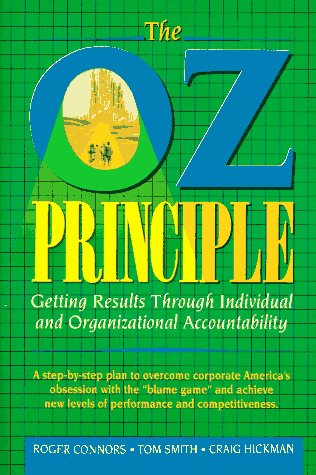
| Author | Roger Connors, Tom Smith and Craig Hickman |
| First published | 1994 |
| Type | Business |
| Best for | readers who want a clear, practical guide to accountability at work |
The Oz Principle: Getting Results Through Individual and Organizational Accountability is a business book by Roger Connors, Tom Smith and Craig Hickman, first published in 1994. It has become a widely used guide in management training. Below you will find a part-by-part summary, five key takeaways, ideas worth remembering and a note on who will enjoy it.
Content note: None.
Key Concepts
- Accountability: A personal choice to rise above circumstances and achieve results.
- The victim cycle: A pattern of blame and excuses.
- Above the line: Thinking and acting with ownership.
- Below the line: Thinking and acting like a victim.
- See It, Own It, Solve It, Do It: The four steps to accountability.
The Main Ideas, Part by Part
The Wizard of Oz
The authors compare people at work to the characters in The Wizard of Oz. Like Dorothy and her friends, people often believe that someone else, a “wizard,” will solve their problems. But in the end, the travelers discover they always had the power, courage, heart and brains they needed. Real results begin when people stop waiting for rescue.
The victim cycle
The authors describe stages of “below the line” behavior: ignoring or denying problems, saying “it's not my job,” pointing fingers, claiming confusion, “covering your tail” and “waiting to see” what happens. These habits waste time and energy. Even capable people can fall into them when things go wrong or when they feel powerless.
Steps to accountability
The book presents four steps. See It means recognizing reality and asking for honest feedback. Own It means accepting your part in creating the situation. Solve It means asking “What else can I do?” and looking for solutions. Do It means following through. The authors link these steps to the courage, heart, wisdom and means the Oz characters seek.
Accountability at work
The authors define accountability as a personal choice, not a punishment. They share company stories in which teams turned around results by taking ownership. Leaders should model accountability, set clear expectations and coach people instead of blaming them. Accountability, the authors argue, is something people choose, not something forced on them.
Building a culture
The final chapters explain how organizations can build a culture where people work “above the line.” This means honest conversations, clear goals and support for problem-solving. The authors argue that accountable cultures are more creative, more productive and more satisfying to work in, and they encourage readers to apply the principle in their personal lives too.
5 Key Takeaways
- Blaming others keeps people stuck.
- Accountability is a choice, not a punishment.
- See It, Own It, Solve It, Do It is a practical model.
- Leaders must model ownership.
- Results come from action, not excuses.
Ideas Worth Remembering
These are paraphrased, not direct quotes:
- We often have more power than we think.
- Honest feedback is a gift.
- Asking “What else can I do?” opens new options.
Who Should Read The Oz Principle?
Read The Oz Principle if you are a manager, team leader or employee who wants to build ownership and results. It suits adults.
About Roger Connors, Tom Smith and Craig Hickman
Roger Connors and Tom Smith are co-founders of Partners In Leadership, a training company focused on workplace accountability, now known as Culture Partners. Craig Hickman is a business author and consultant. Connors and Smith also wrote Journey to the Emerald City, How Did That Happen? and Change the Culture, Change the Game, which build on The Oz Principle.
Questions to Think About After Reading
These prompts work for solo reading, a book club or a classroom discussion of The Oz Principle:
- When have you fallen into the victim cycle?
- How can leaders encourage accountability without blame?
- Which of the four steps is hardest for you?
How to Use This Summary
Use this page as a quick reference before a book club meeting, an exam, or a decision about whether The Oz Principle is worth your time. The takeaways are written to stand on their own. If a point interests you, go back to the book for the author's full argument, examples and evidence, which no short summary can replace.
A Note on Accuracy and Spoilers
This summary is based on the published text of The Oz Principle, not on any film, series or stage adaptation, which often change the story. Details are kept at the level of the main arguments so that nothing is invented. Editions differ slightly in length and wording, so page numbers and small details may vary between copies.
Should You Read the Book?
Yes. It is practical and easy to apply, though some examples feel dated.
Check price of The Oz Principle on Amazon
What to Read Next
- Extreme Ownership by Jocko Willink and Leif Babin: leadership through total responsibility
- The 7 Habits of Highly Effective People by Stephen R. Covey: personal effectiveness and responsibility
- QBQ! The Question Behind the Question by John G. Miller: practical personal accountability
Frequently Asked Questions
What is The Oz Principle about?
It explains how individuals and organizations can get better results by taking accountability.
Who wrote it?
Roger Connors, Tom Smith and Craig Hickman.
When was it published?
First in 1994, with later updated editions.
What does “above the line” mean?
Thinking and acting with ownership and accountability.
What is the victim cycle?
A pattern of blaming, denying and waiting for others.
What are the steps?
See It, Own It, Solve It, Do It.
Why The Wizard of Oz?
Because the characters learn they had what they needed all along.
Is it for managers only?
No. It is useful for anyone.
What age is it for?
Adults.
How long is it?
About 240 pages.
Are there related books?
Yes, including Journey to the Emerald City.
Is it still relevant?
Yes. Its ideas are widely used in workplaces.
What is the single most useful idea in the book?
Asking “What else can I do?” whenever results fall short, instead of looking for someone to blame.
Is The Oz Principle worth reading?
It depends on what you want. The book is best for readers who want a clear, practical guide to accountability at work. If that describes you, it is likely a good fit. If not, the titles under What to Read Next may suit you better.