
Disclosure: As an Amazon Associate, Bookish Wisdom earns from qualifying purchases. This doesn't change our picks or your price.
TL;DR: During China's Cultural Revolution, astrophysicist Ye Wenjie watches her father beaten to death. Later, at a secret military base, she makes contact with an alien civilization and makes a choice that will change humanity's future. Decades later, nanomaterials scientist Wang Miao investigates a wave of scientists' suicides and a strange virtual reality game called Three Body.
Table of Contents
The Three-Body Problem at a Glance
| Author | Liu Cixin |
| First published | 2006 |
| Type | Science fiction |
| Best for | readers who want ambitious, idea-rich science fiction about first contact |
The Three-Body Problem is a science fiction novel by Chinese writer Liu Cixin, first published in 2006 and translated into English by Ken Liu in 2014. It became the first translated novel to win the Hugo Award. Below you will find a part-by-part summary, five key takeaways, ideas worth remembering and a note on who will enjoy it.
Content note: Includes political violence, suicide and mass death.
Main Characters
- Ye Wenjie: An astrophysicist who makes first contact with aliens.
- Wang Miao: A scientist investigating a mystery.
- Shi Qiang: A rough, clever police detective.
- The Trisolarans: An alien civilization from a three-star system.
- Mike Evans: A wealthy man who leads a secret group.
What Happens, Part by Part (Contains Spoilers)
The Cultural Revolution
In 1967, Ye Wenjie watches as her father, a physics professor, is beaten to death by Red Guards. She is sent to a labor camp and later to Red Coast Base, a secret military project. Disillusioned with humanity, she discovers how to use the sun to amplify signals and sends a message into space. Years later, a reply comes, warning her not to answer. She answers anyway.
A mystery
In the present, Wang Miao is asked to help police and military officials investigate the deaths of leading scientists. He begins to see a countdown in his vision and in his photographs. Detective Shi Qiang protects him. Wang discovers that the countdown is caused by a group that wants him to stop his research.
Three Body
Wang plays a virtual reality game called Three Body, set on a world with three suns whose unpredictable orbits destroy civilization again and again. Players try to solve the “three-body problem” of the orbits. Wang realizes the game is a recruitment tool for a secret organization that supports the aliens.
The ETO
Wang learns that Ye Wenjie helped create the Earth-Trisolaris Organization, a group of people who want the aliens to come and fix or replace humanity. Some members want the aliens to rule; others want them to destroy humankind. The Trisolarans, desperate to escape their chaotic world, have sent a fleet that will arrive in about 450 years.
Sophons
With Wang's nanofibers, the military captures an ETO ship and its messages. They learn that the Trisolarans have sent “sophons,” tiny intelligent particles that interfere with physics experiments on Earth and spy on everything. Human science is blocked. The aliens tell humanity, “You are bugs.” But Shi Qiang points out that bugs have never been defeated.
5 Key Takeaways
- Humanity's choices can affect the whole universe.
- Disillusionment can lead to dangerous decisions.
- Science can be targeted and stopped.
- First contact may not be friendly.
- Even “bugs” can survive against great odds.
Ideas Worth Remembering
These are paraphrased, not direct quotes:
- History shapes how people see the future.
- Knowledge is a form of power and defense.
- Hope can come from simple observations.
Who Should Read The Three-Body Problem?
Read The Three-Body Problem if you enjoy hard science fiction, big ideas and stories about alien contact. It suits adults and older teens.
About Liu Cixin
Liu Cixin (born 1963) is a Chinese science fiction writer who worked as an engineer at a power plant while writing. His Remembrance of Earth's Past trilogy, which begins with The Three-Body Problem, became a global success. His story The Wandering Earth was turned into a hit film. He has won China's Galaxy Award many times.
Questions to Think About After Reading
These prompts work for solo reading, a book club or a classroom discussion of The Three-Body Problem:
- Why does Ye Wenjie invite the aliens?
- What does the Three Body game represent?
- Is Shi Qiang's comparison to bugs hopeful?
How to Use This Summary
Use this page as a quick reference before a book club meeting, an exam, or a decision about whether The Three-Body Problem is worth your time. The takeaways are written to stand on their own. If a point interests you, go back to the book for the author's full story, characters and style, which no short summary can replace.
A Note on Accuracy and Spoilers
This summary is based on the published text of The Three-Body Problem, not on any film, series or stage adaptation, which often change the story. Details are kept at the level of the main events so that nothing is invented. Editions differ slightly in length and wording, so page numbers and small details may vary between copies.
Should You Read the Book?
Yes, especially if you like science. The start is slow, but the ideas are mind-blowing.
Check price of The Three-Body Problem on Amazon
What to Read Next
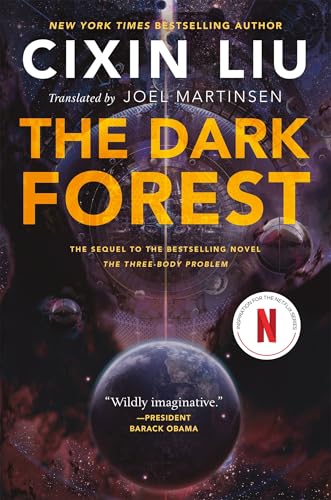
- The Dark Forest by Liu Cixin: the second book in the trilogy
- Contact by Carl Sagan: a scientist receives a signal from space
- Childhood's End by Arthur C. Clarke: aliens arrive and change humanity's future
Frequently Asked Questions
What is The Three-Body Problem about?
A scientist contacts aliens, who decide to invade Earth.
Who wrote it?
Liu Cixin, in 2006.
Who translated it into English?
Ken Liu, in 2014.
What is the three-body problem?
A physics problem about predicting the motion of three bodies under gravity.
Who are the Trisolarans?
An alien civilization from a system with three suns.
What are sophons?
Tiny alien supercomputers that block human physics research.
Did it win the Hugo?
Yes, in 2015.
Is there a TV series?
Yes, Netflix's 3 Body Problem (2024) and a Chinese series, Three-Body (2023).
What age is it for?
Adults and older teens.
How long is it?
About 400 pages.
Is it hard science fiction?
Yes, it includes a lot of science.
What comes next?
The Dark Forest.
Is the opening hard to get into?
Some readers find the first chapters slow, but the story speeds up once Wang Miao starts playing the game.
Is The Three-Body Problem worth reading?
It depends on what you want. The book is best for readers who want ambitious, idea-rich science fiction about first contact. If that describes you, it is likely a good fit. If not, the titles under What to Read Next may suit you better.