
Disclosure: As an Amazon Associate, Bookish Wisdom earns from qualifying purchases. This doesn't change our picks or your price.
TL;DR: Hampton Sides tells the story of Captain James Cook's third and final voyage (1776–1780), which set out to return a Tahitian man named Omai to his home and to search for the Northwest Passage. Cook, once a careful explorer, grows erratic and harsh, and his clashes with Pacific islanders end in his violent death in Hawaii in 1779.
Table of Contents
The Wide Wide Sea at a Glance
| Author | Hampton Sides |
| First published | 2024 |
| Type | Nonfiction |
| Best for | readers who enjoy narrative history about exploration and its consequences |
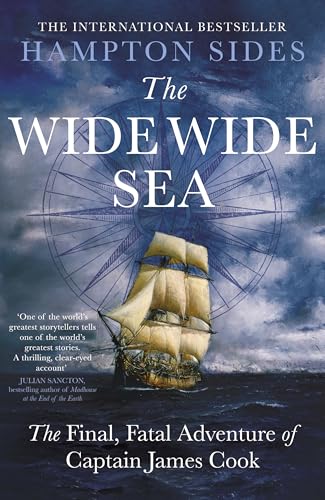
The Wide Wide Sea: Imperial Ambition, First Contact and the Fateful Final Voyage of Captain James Cook is a work of narrative history by Hampton Sides, published in 2024. It looks at Cook's last voyage from both British and Pacific perspectives. Below you will find a part-by-part summary of the main ideas, five key takeaways, ideas worth remembering and a note on who will enjoy it.
Content note: Includes violence, colonial conflict and death.
Key Concepts
- First contact: Meetings between Europeans and Pacific peoples, with lasting consequences.
- The Northwest Passage: A hoped-for sea route across the top of North America.
- Omai (Mai): A Tahitian man who visited England and was being returned home.
- Cook's decline: Signs that Cook became more irritable and punitive on this voyage.
- Imperial ambition: Britain's goals of trade, mapping and power behind the expedition.
The Main Ideas, Part by Part
The mission
In 1776, Cook, already famous for two great Pacific voyages, sets out with the ships Resolution and Discovery. His tasks are to return Omai, who had become a celebrity in London, to the Society Islands, and to search for a Northwest Passage from the Pacific side. The voyage begins the same year as the American Revolution.
Across the Pacific
The ships stop in Tasmania, New Zealand and Tonga before reaching Tahiti. Sides describes the islands' cultures and the complicated exchanges of gifts, trade and misunderstanding. Omai is settled on Huahine with a house and livestock, but his future is uncertain.
A changed captain
On this voyage, Cook grows harsher. He punishes thefts with severe reprisals, burning canoes and houses and flogging islanders and sailors. Sides explores possible reasons, including exhaustion, illness and the pressures of command, while showing how his men noticed the change.
Hawaii and the Arctic
Cook becomes the first European to reach the Hawaiian Islands, in 1778. He then sails north along the coast of North America, into the Bering Strait, and is stopped by a wall of ice. The Northwest Passage proves impossible. He returns south to Hawaii for winter.
Death at Kealakekua Bay
At Kealakekua Bay, the Hawaiians first welcome the British with great ceremony. When the ships leave and then return for repairs, relations sour. After the theft of a boat, Cook tries to take the Hawaiian chief Kalaniʻōpuʻu hostage, and a confrontation on the shore ends with Cook killed in February 1779. The voyage returns to England without its leader.
5 Key Takeaways
- Exploration often carried hidden costs for the peoples encountered.
- Even great leaders can decline under pressure.
- Misunderstandings across cultures can turn deadly.
- History looks different from each side of first contact.
- Ambition and empire shaped scientific voyages.
Ideas Worth Remembering
These are paraphrased, not direct quotes:
- How a story is told depends on whose perspective is included.
- Exhaustion and stress can change a person's judgment.
- Respect is easier to lose than to rebuild.
Who Should Read The Wide Wide Sea?
Read The Wide Wide Sea if you enjoy narrative history, exploration and stories of cultural encounter. It suits adult readers.
Questions to Think About After Reading
These prompts work for solo reading, a book club or a classroom discussion of The Wide Wide Sea:
- Why did Cook change on his final voyage?
- How should we remember explorers like Cook today?
- What does the story of Omai tell us about cultural exchange?
How to Use This Summary
Use this page as a quick reference before a book club meeting, an exam, or a decision about whether The Wide Wide Sea is worth your time. The takeaways are written to stand on their own. If a point interests you, go back to the book for the author's full argument, examples and evidence, which no short summary can replace.
A Note on Accuracy and Spoilers
This summary is based on the published text of The Wide Wide Sea, not on any film, series or stage adaptation, which often change the story. Details are kept at the level of the main arguments so that nothing is invented. Editions differ slightly in length and wording, so page numbers and small details may vary between copies.
Should You Read the Book?
Yes. Sides writes vividly and balances Cook's achievements with honest attention to the harm his voyages brought. It reads like an adventure while raising serious questions.
Check price of The Wide Wide Sea on Amazon
What to Read Next
- In the Heart of the Sea by Nathaniel Philbrick: a whaling disaster in the Pacific
- Endurance by Alfred Lansing: Shackleton's Antarctic survival story
- Blue Latitudes by Tony Horwitz: retracing Cook's voyages today
Frequently Asked Questions
What is The Wide Wide Sea about?
Captain James Cook's third and final voyage, which ended with his death in Hawaii.
Who wrote it?
Hampton Sides, in 2024.
How did Captain Cook die?
He was killed in a fight with Hawaiians at Kealakekua Bay in February 1779.
Who was Omai?
A Tahitian man who visited England and whom Cook was returning home.
Did Cook find the Northwest Passage?
No. Ice blocked his way in the Arctic.
Is it fiction?
No. It is narrative nonfiction based on historical records.
What age is it for?
Adults and older teens interested in history.
How long is it?
About 400 pages.
Who else wrote by Hampton Sides?
He also wrote Ghost Soldiers and In the Kingdom of Ice.
Is The Wide Wide Sea worth reading?
It depends on what you want. The book is best for readers who enjoy narrative history about exploration and its consequences. If that describes you, it is likely a good fit. If not, the titles under What to Read Next may suit you better.