
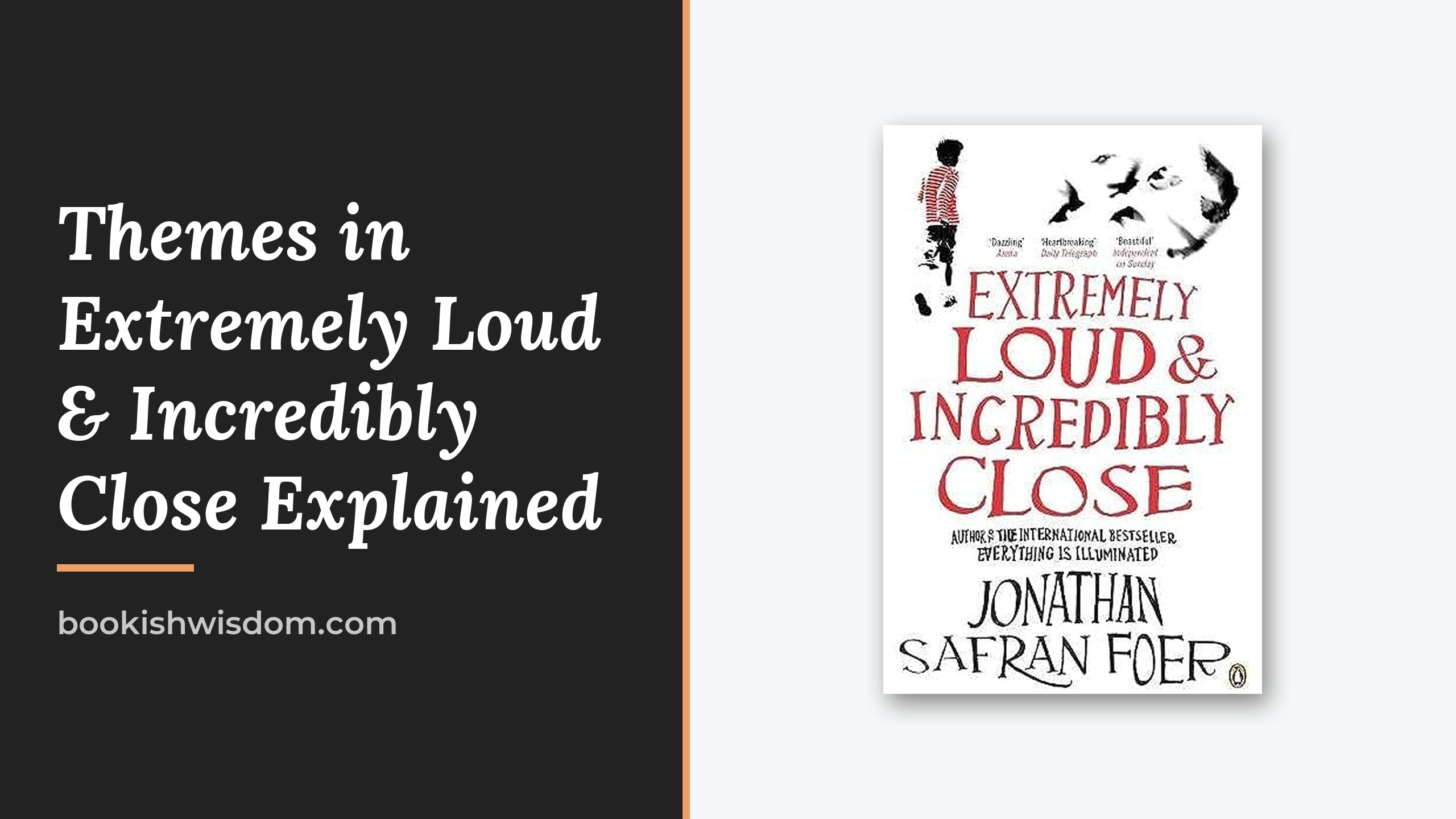
Disclosure: As an Amazon Associate, Bookish Wisdom earns from qualifying purchases. This doesn't change our picks or your price.
Spoiler warning: this analysis discusses the whole book, including the ending of Extremely Loud & Incredibly Close.
Quick answer: The main themes in Extremely Loud & Incredibly Close by Jonathan Safran Foer are grief and loss, searching for meaning, trauma across generations, communication and connection. Each is explained below with what it means, how it develops in the story and questions you can use for study or discussion.
Quick facts
- Book: Extremely Loud & Incredibly Close by Jonathan Safran Foer
- First published: 2005
- Main themes: grief and loss, searching for meaning, trauma across generations, communication and connection
Table of Contents
About Extremely Loud & Incredibly Close
Nine-year-old Oskar Schell, a brilliant, anxious boy in New York City, lost his father in the attacks on the World Trade Center on September 11, 2001. A year later, he finds a key in an envelope marked “Black” in his father's closet. Believing it will unlock a final message, Oskar sets out across the five boroughs to visit every person named Black. His journey is woven with letters from his grandparents, survivors of the bombing of Dresden, whose own grief has shaped the family.
Check price of Extremely Loud & Incredibly Close on Amazon
The Main Themes in Extremely Loud & Incredibly Close
1. Grief and loss
Oskar's grief is overwhelming and expressed in unusual ways. Foer shows how children and adults struggle to process sudden, violent loss.
Question to consider: Where in Extremely Loud & Incredibly Close does grief and loss matter most to the characters, and what does Jonathan Safran Foer want readers to think about it?
2. Searching for meaning
Oskar's quest for the lock is a search for meaning in his father's death. The novel suggests that the journey matters more than the answer.
Question to consider: Where in Extremely Loud & Incredibly Close does searching for meaning matter most to the characters, and what does Jonathan Safran Foer want readers to think about it?
3. Trauma across generations
Oskar's grandparents survived the Dresden bombing. Their trauma echoes his, showing how loss passes through families.
Question to consider: Where in Extremely Loud & Incredibly Close does trauma across generations matter most to the characters, and what does Jonathan Safran Foer want readers to think about it?
4. Communication
Oskar's grandfather stopped speaking, and Oskar hides his feelings. The novel explores how hard it is to express pain.
Question to consider: Where in Extremely Loud & Incredibly Close does communication matter most to the characters, and what does Jonathan Safran Foer want readers to think about it?
5. Connection
Oskar's search brings him into contact with strangers who share their own losses.
Question to consider: Where in Extremely Loud & Incredibly Close does connection matter most to the characters, and what does Jonathan Safran Foer want readers to think about it?
Symbols and Motifs
- The key. It represents hope and searching.
- The phone messages. His father's last messages symbolise guilt and grief.
- The flipbook. Images of a falling man reversed represent the wish to undo the past.
- The grandfather's notebook. It stands for silence.
How the Themes Connect
Grief and loss drive Oskar's story, while searching for meaning gives it structure. Trauma across generations links Oskar to his grandparents, communication shows the struggle to express pain and connection offers healing. The book's final pages, with images reversed, express a powerful wish to turn back time.
How to Write About the Themes of Extremely Loud & Incredibly Close
If you are writing an essay or preparing for class, these steps help:
- Pick one theme. A focused argument is stronger than a list of everything.
- Find evidence in the text. Point to specific scenes, characters and choices rather than general impressions.
- Explain, don't just describe. After each example, say what it shows about the theme.
- Connect to the ending. Ask how the final chapters resolve or complicate the theme.
- Consider other readings. A fair essay acknowledges that readers can disagree.
Discussion Questions
- Which of the themes above feels most relevant to your own life, and why?
- Do the characters in Extremely Loud & Incredibly Close handle grief and loss well or badly?
- How does the title relate to the themes of the book?
- Would the story change if it were set in a different time or place?
- What does Jonathan Safran Foer leave unresolved, and why might that be?
Books With Similar Themes
- The Curious Incident of the Dog in the Night-Time by Mark Haddon
- The Book Thief by Markus Zusak
Related: Extremely Loud & Incredibly Close by Jonathan Safran Foer: Summary and Key Takeaways · Extremely Loud & Incredibly Close Ending Explained
Frequently Asked Questions
What is the main theme of Extremely Loud & Incredibly Close?
The central theme is grief and loss, supported by searching for meaning and trauma across generations.
How many themes does Extremely Loud & Incredibly Close have?
This guide covers 5 main themes, but readers may find others.
Who wrote Extremely Loud & Incredibly Close?
Extremely Loud & Incredibly Close was written by Jonathan Safran Foer and first published in 2005.
Is Extremely Loud & Incredibly Close a good book for studying themes?
Yes. Its themes are clear enough to follow and rich enough to support essays and group discussion.
What should I read after Extremely Loud & Incredibly Close?
Try The Curious Incident of the Dog in the Night-Time by Mark Haddon or The Book Thief by Markus Zusak.