
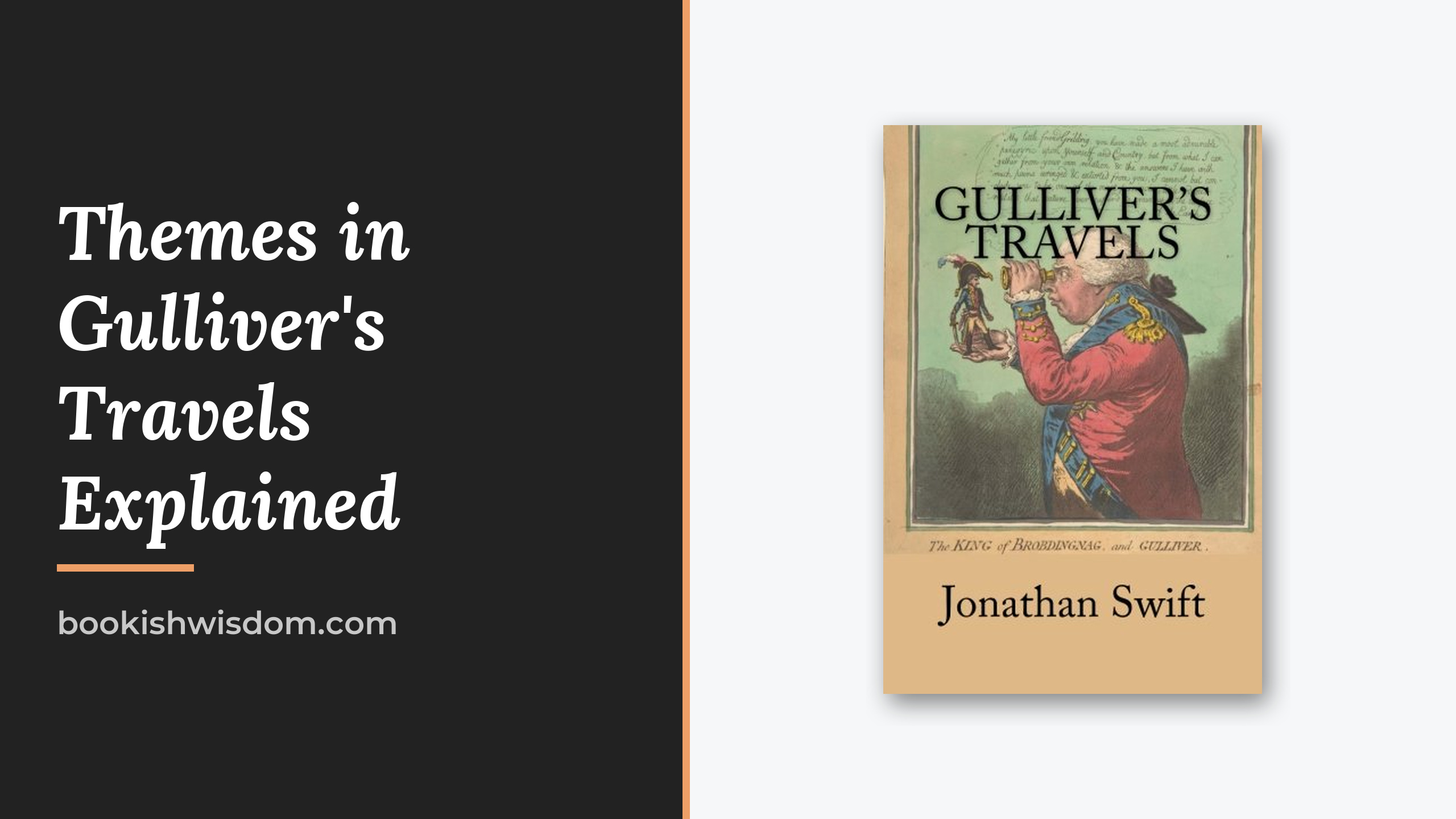
Disclosure: As an Amazon Associate, Bookish Wisdom earns from qualifying purchases. This doesn't change our picks or your price.
Spoiler warning: this analysis discusses the whole book, including the ending of Gulliver's Travels.
Quick answer: The main themes in Gulliver's Travels by Jonathan Swift are satire of politics, human nature, perspective and size, science and reason and pride. Each is explained below with what it means, how it develops in the story and questions you can use for study or discussion.
Quick facts
- Book: Gulliver's Travels by Jonathan Swift
- First published: 1726
- Main themes: satire of politics, human nature, perspective and size, science and reason and pride
Table of Contents
About Gulliver's Travels
Lemuel Gulliver, an English ship's surgeon, describes four strange voyages. In Lilliput, he is a giant among people six inches tall who fight wars over which end to crack an egg. In Brobdingnag, he is tiny among giants who find European politics disgusting. In Laputa, a flying island, he meets scientists so lost in theory that their experiments are useless. Finally, in the land of the Houyhnhnms, he meets wise, rational horses who rule over the Yahoos, filthy, savage creatures who look like humans. Gulliver returns home unable to bear human company.
Check price of Gulliver's Travels on Amazon
The Main Themes in Gulliver's Travels
1. Satire of politics
Swift mocks the pettiness of politics, from Lilliput's absurd wars over eggs to its ministers who win office by rope-dancing. The book exposes how trivial disputes can lead to great harm.
Question to consider: Where in Gulliver's Travels does satire of politics matter most to the characters, and what does Jonathan Swift want readers to think about it?
2. Human nature
Each voyage shows humans from a new angle. By the end, Gulliver sees humans as no better than Yahoos, a dark judgement on human pride.
Question to consider: Where in Gulliver's Travels does human nature matter most to the characters, and what does Jonathan Swift want readers to think about it?
3. Perspective and size
Gulliver's change in size changes how he sees everything, showing how perspective shapes judgement. Among giants, Gulliver feels small and disgusting.
Question to consider: Where in Gulliver's Travels does perspective and size matter most to the characters, and what does Jonathan Swift want readers to think about it?
4. Science and reason
Swift mocks impractical science in Laputa. Laputan scientists try to extract sunbeams from cucumbers.
Question to consider: Where in Gulliver's Travels does science and reason matter most to the characters, and what does Jonathan Swift want readers to think about it?
5. Pride
Gulliver's final pride is itself absurd. He refuses to sit near his family.
Question to consider: Where in Gulliver's Travels does pride matter most to the characters, and what does Jonathan Swift want readers to think about it?
Symbols and Motifs
- Lilliput. It represents petty politics.
- The Yahoos. They symbolise humanity's worst side.
- The Houyhnhnms. They stand for cold reason.
- The egg war. It represents absurd conflict.
How the Themes Connect
Satire of politics, human nature, perspective, science and pride shape the novel. Swift's satire is so sharp that, nearly three hundred years later, its targets still feel familiar, and the word “Lilliputian” has entered the language.
How to Write About the Themes of Gulliver's Travels
If you are writing an essay or preparing for class, these steps help:
- Pick one theme. A focused argument is stronger than a list of everything.
- Find evidence in the text. Point to specific scenes, characters and choices rather than general impressions.
- Explain, don't just describe. After each example, say what it shows about the theme.
- Connect to the ending. Ask how the final chapters resolve or complicate the theme.
- Consider other readings. A fair essay acknowledges that readers can disagree.
Discussion Questions
- Which of the themes above feels most relevant to your own life, and why?
- Do the characters in Gulliver's Travels handle satire of politics well or badly?
- How does the title relate to the themes of the book?
- Would the story change if it were set in a different time or place?
- What does Jonathan Swift leave unresolved, and why might that be?
Books With Similar Themes
- Animal Farm by George Orwell
- Alice's Adventures in Wonderland by Lewis Carroll
Related: Gulliver’s Travels Ending Explained · 15 Books Like Gulliver’s Travels You’ll Love
Frequently Asked Questions
What is the main theme of Gulliver's Travels?
The central theme is satire of politics, supported by human nature and perspective and size.
How many themes does Gulliver's Travels have?
This guide covers 5 main themes, but readers may find others.
Who wrote Gulliver's Travels?
Gulliver's Travels was written by Jonathan Swift and first published in 1726.
Is Gulliver's Travels a good book for studying themes?
Yes. Its themes are clear enough to follow and rich enough to support essays and group discussion.
What should I read after Gulliver's Travels?
Try Animal Farm by George Orwell or Alice's Adventures in Wonderland by Lewis Carroll.