

Disclosure: As an Amazon Associate, Bookish Wisdom earns from qualifying purchases. This doesn't change our picks or your price.
TL;DR: In 1890s England, Nancy Astley, an oyster girl from the seaside town of Whitstable, falls in love with Kitty Butler, a music-hall performer who dresses as a man. Nancy follows Kitty to London and joins her on stage. When Kitty breaks her heart, Nancy disappears into the hidden worlds of the city and slowly finds herself, love and purpose.
Table of Contents
Tipping the Velvet at a Glance
| Author | Sarah Waters |
| First published | 1998 |
| Type | Historical fiction |
| Best for | readers who want a lively, sensual Victorian novel about love and self-discovery |
Tipping the Velvet is the first novel by Sarah Waters, published in 1998. It was adapted into a BBC drama in 2002. Below you will find a part-by-part summary, five key takeaways, ideas worth remembering and a note on who will enjoy it.
Content note: Includes explicit sexual content, homophobia, prostitution and emotional abuse.
Main Characters
- Nancy “Nan” Astley: An oyster girl who becomes a performer.
- Kitty Butler: A music-hall star who performs as a man.
- Walter Bliss: Kitty's manager.
- Diana Lethaby: A wealthy, controlling widow.
- Florence Banner: A kind social worker and activist.
What Happens, Part by Part (Contains Spoilers)
Whitstable
Nancy works in her family's oyster restaurant in Whitstable. One night at the local theater, she sees Kitty Butler, a performer who dresses as a gentleman. Nancy is dazzled and goes to every show. Kitty notices her and offers her a job as her dresser. Nancy follows her to London.
The stage
In London, Nancy and Kitty fall in love, though Kitty insists they keep it secret. Walter, Kitty's manager, creates a double act, and Nancy goes on stage as “Nan King,” dressed as a man. They become successful. But one day Nancy finds Kitty in bed with Walter. Kitty says she will marry him to keep her reputation safe.
The streets
Heartbroken, Nancy disappears into London's streets. She survives by dressing as a young man and working as a “renter,” a male prostitute. She discovers a hidden world of people who live outside the rules. The work is dangerous, and she becomes lonely and hardened, but she also gains confidence in her own identity.
Diana
A wealthy widow, Diana Lethaby, notices Nancy and takes her to her mansion. Nancy becomes her kept companion and performs for Diana's circle of rich women. At first it is exciting, but Diana treats Nancy as a possession. After a quarrel, Nancy is thrown out on the street with nothing.
Florence
Nancy finds Florence Banner, a young woman she once met. Florence is a socialist who works for the poor and lives with her brother Ralph and a baby, Cyril. Nancy joins their household and slowly falls in love with Florence. She helps at a political rally by giving a speech for Ralph. Kitty appears and asks Nancy to come back, but Nancy chooses Florence and a life of honesty and love.
5 Key Takeaways
- Self-discovery can take many paths.
- Love can hurt, but it can also heal.
- Hiding your true self has a cost.
- Power in relationships can turn into control.
- Real love involves respect and honesty.
Ideas Worth Remembering
These are paraphrased, not direct quotes:
- Finding a community can transform a life.
- Courage grows through experience.
- People can reinvent themselves more than once.
Who Should Read Tipping the Velvet?
Read Tipping the Velvet if you enjoy historical fiction, love stories and lively, frank storytelling. It suits adults.
About Sarah Waters
Sarah Waters (born 1966) is a Welsh novelist who earned a PhD in lesbian and gay historical fiction. Her novels include Fingersmith, The Night Watch, The Little Stranger and The Paying Guests. Three of her novels were shortlisted for the Booker Prize. Fingersmith was adapted by director Park Chan-wook as the film The Handmaiden.
Questions to Think About After Reading
These prompts work for solo reading, a book club or a classroom discussion of Tipping the Velvet:
- How does performing change Nancy?
- Why does Kitty choose to marry Walter?
- What does Florence offer Nancy that others did not?
How to Use This Summary
Use this page as a quick reference before a book club meeting, an exam, or a decision about whether Tipping the Velvet is worth your time. The takeaways are written to stand on their own. If a point interests you, go back to the book for the author's full story, characters and style, which no short summary can replace.
A Note on Accuracy and Spoilers
This summary is based on the published text of Tipping the Velvet, not on any film, series or stage adaptation, which often change the story. Details are kept at the level of the main events so that nothing is invented. Editions differ slightly in length and wording, so page numbers and small details may vary between copies.
Should You Read the Book?
Yes. It is witty, vivid and moving, with strong characters.
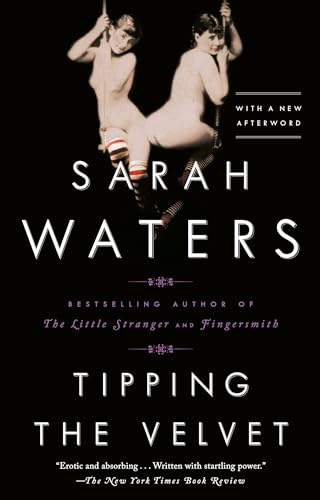
Check price of Tipping the Velvet on Amazon
What to Read Next
- Fingersmith by Sarah Waters: a twisting Victorian novel of thieves and love
- The Price of Salt by Patricia Highsmith: a classic love story between two women
- The Paying Guests by Sarah Waters: love and crime in 1920s London
Related: 15 Books Like Tipping the Velvet You’ll Love
Frequently Asked Questions
What is Tipping the Velvet about?
An oyster girl follows a music-hall star to London and discovers herself.
Who wrote it?
Sarah Waters, in 1998.
When is it set?
The 1890s.
Who is Kitty Butler?
A male impersonator on the music-hall stage.
Who does Nancy end up with?
Florence Banner.
What does the title mean?
It is a Victorian slang phrase with a sexual meaning.
Is there a TV adaptation?
Yes, a 2002 BBC drama.
What age is it for?
Adults.
How long is it?
About 470 pages.
Is it explicit?
Yes, it includes explicit scenes.
Was it Sarah Waters's first novel?
Yes.
Is it funny?
Yes, it has a lively, witty voice.
Is Tipping the Velvet a good first Sarah Waters book?
Yes. It is her most playful novel, though readers who love twisty plots may prefer to start with Fingersmith.
Is Tipping the Velvet worth reading?
It depends on what you want. The book is best for readers who want a lively, sensual Victorian novel about love and self-discovery. If that describes you, it is likely a good fit. If not, the titles under What to Read Next may suit you better.