
Disclosure: As an Amazon Associate, Bookish Wisdom earns from qualifying purchases. This doesn't change our picks or your price.
TL;DR: Two young women leave school together: clever, penniless Becky Sharp, who climbs society by charm and deception, and kind, sheltered Amelia Sedley, who loves her selfish husband George. Through the Napoleonic Wars and the social whirl of London, their fortunes rise and fall in a satirical “novel without a hero.”
Table of Contents
Vanity Fair at a Glance
| Author | William Makepeace Thackeray |
| First published | 1848 |
| Type | Novel |
| Best for | readers who enjoy witty satire and a brilliant antiheroine |
Vanity Fair: A Novel without a Hero is a novel by William Makepeace Thackeray, published in 1847–48. It satirizes greed, snobbery and ambition in early nineteenth-century England. Below you will find a part-by-part summary, five key takeaways, ideas worth remembering and a note on who will enjoy it.
Content note: Includes war deaths, manipulation and neglect of a child.
Main Characters
- Becky Sharp: A clever, ruthless social climber.
- Amelia Sedley: A gentle, naive young woman.
- George Osborne: Amelia's vain husband.
- William Dobbin: George's loyal friend, who secretly loves Amelia.
- Rawdon Crawley: Becky's husband, a gambling soldier.
What Happens, Part by Part (Contains Spoilers)
Leaving school
Becky Sharp, orphaned daughter of an artist, leaves Miss Pinkerton's academy with her friend Amelia Sedley. Becky tries to catch Amelia's brother Jos, but fails. She becomes a governess for the Crawley family and secretly marries the younger son, Rawdon, ruining her chances of a large inheritance from his rich aunt.
Waterloo
Amelia marries George Osborne, despite his father's opposition after the Sedleys lose their money. Dobbin, who loves Amelia, encourages the match. In Brussels before the Battle of Waterloo, George flirts with Becky. George is killed in the battle. Amelia, pregnant, is devastated and idolizes his memory.
Living on nothing
Becky and Rawdon live in style in London on credit, deceiving tradesmen. Becky wins the attention of the powerful Lord Steyne. Amelia, poor and devoted to her son Georgy, gives him up to his wealthy grandfather so he can have a better life.
Becky's fall
Rawdon is arrested for debt and, after his release, finds Becky alone with Lord Steyne, wearing jewels from him. He leaves her. Becky's reputation collapses, and she wanders Europe. Rawdon takes a post abroad and dies there.
The ending
Dobbin returns from India. Becky, now a shady figure in Germany, shows Amelia a note proving George had planned to run off with her. Freed from her illusions, Amelia marries Dobbin, though his love has cooled. Becky lives on comfortably, possibly having helped Jos to his death for insurance, and presents herself as respectable.
5 Key Takeaways
- Society often rewards appearance over virtue.
- Ambition without principle can win and still be empty.
- Blind devotion can waste a life.
- Money shapes relationships and reputations.
- No one in “Vanity Fair” is entirely good or bad.
Ideas Worth Remembering
These are paraphrased, not direct quotes:
- People chase things that will not make them happy.
- The narrator invites us to laugh at ourselves as well as the characters.
- Loyalty, like Dobbin's, often goes unnoticed for years.
Who Should Read Vanity Fair?
Read Vanity Fair if you enjoy witty satire, complex antiheroes and big historical novels. It suits adults and older teens.
Questions to Think About After Reading
These prompts work for solo reading, a book club or a classroom discussion of Vanity Fair:
- Do you admire Becky Sharp?
- Why does Thackeray call it a novel without a hero?
- Is Amelia's devotion to George a strength or a weakness?
How to Use This Summary
Use this page as a quick reference before a book club meeting, an exam, or a decision about whether Vanity Fair is worth your time. The takeaways are written to stand on their own. If a point interests you, go back to the book for the author's full story, characters and style, which no short summary can replace.
A Note on Accuracy and Spoilers
This summary is based on the published text of Vanity Fair, not on any film, series or stage adaptation, which often change the story. Details are kept at the level of the main events so that nothing is invented. Editions differ slightly in length and wording, so page numbers and small details may vary between copies.
Should You Read the Book?
Yes. Becky Sharp is one of literature's great characters, and the satire still bites. It is long, so pace yourself.
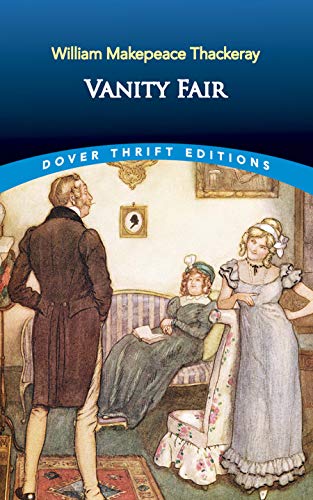
Check price of Vanity Fair on Amazon
What to Read Next
- Middlemarch by George Eliot: another panoramic English novel
- Pride and Prejudice by Jane Austen: money and marriage with lighter wit
- Gone with the Wind by Margaret Mitchell: a determined heroine in wartime
Related: 15 Books Like Vanity Fair You’ll Love
Frequently Asked Questions
What is Vanity Fair about?
Two women, one ambitious and one kind, make their way through English society during the Napoleonic era.
Who wrote Vanity Fair?
William Makepeace Thackeray.
Who is Becky Sharp?
A clever, ruthless social climber and the novel's most famous character.
Why is it called a novel without a hero?
Because none of the characters is a traditional moral hero.
What does Vanity Fair mean?
A world of empty pleasures and show, a phrase from Pilgrim's Progress.
What age is it for?
Older teens and adults.
How long is it?
About 800 pages.
Are there adaptations?
Yes, including a 2004 film and a 2018 TV series.
Who are the main characters in Vanity Fair?
The main characters are Becky Sharp, Amelia Sedley, George Osborne, William Dobbin and Rawdon Crawley. Becky Sharp: A clever, ruthless social climber. Amelia Sedley: A gentle, naive young woman. George Osborne: Amelia's vain husband.
Is Vanity Fair worth reading?
It depends on what you want. The book is best for readers who enjoy witty satire and a brilliant antiheroine. If that describes you, it is likely a good fit. If not, the titles under What to Read Next may suit you better.