
Disclosure: As an Amazon Associate, Bookish Wisdom earns from qualifying purchases. This doesn't change our picks or your price.
TL;DR: Two Princeton computer scientists explain what artificial intelligence can and cannot do. They separate generative AI, which is useful but often misused, from predictive AI, which claims to forecast who will commit a crime, succeed at a job or need medical care, and which often does not work. They show how hype spreads and how we can spot “AI snake oil.”
Table of Contents
AI Snake Oil at a Glance
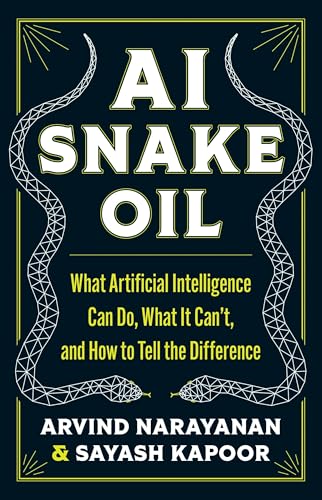
| Author | Arvind Narayanan and Sayash Kapoor |
| First published | 2024 |
| Type | Technology |
| Best for | readers who want a clear, skeptical guide to separating real AI progress from hype |
AI Snake Oil is a nonfiction book by Arvind Narayanan and Sayash Kapoor, published in 2024. It grew out of their popular newsletter of the same name. Below you will find a part-by-part summary, five key takeaways, ideas worth remembering and a note on who will enjoy it.
Content note: Discusses discrimination, wrongful decisions and online harms.
Key Concepts
- Predictive AI: Systems that claim to forecast future outcomes about people.
- Generative AI: Tools that create text, images and other content.
- Content moderation AI: Systems used to filter social media.
- AI hype: Exaggerated claims made by companies, media and researchers.
- Snake oil: A product that does not work as advertised.
The Main Ideas, Part by Part
Three kinds of AI
The authors argue that “AI” is used for very different technologies, which causes confusion. A tool that writes text is not the same as a tool that decides who gets a loan. They focus on three areas: predictive AI, generative AI and AI used in content moderation. They want readers to ask, for any product, whether it actually works and how it could be misused.
Why prediction fails
Predictive AI is used to decide who gets hired, who gets bail and who gets extra medical care. The authors show that many of these systems are barely better than random guessing and often hide unfair results. They describe a large study in which hundreds of teams tried to predict children's life outcomes from rich data, and none did much better than simple methods. Human lives, they say, are hard to predict.
Generative AI
The authors trace the long history behind chatbots and image generators. They admit these tools are genuinely useful for many tasks, but they also discuss harms: fake images, bad advice, labor exploitation and mistakes made with confidence. They argue that fears of AI taking over the world are overblown and distract from real, present risks.
Social media and moderation
The book explains why AI cannot simply “fix” social media. Moderating speech requires understanding context, culture and intention, which machines often get wrong. Platforms promise that AI will remove harmful content, but the problems are as much about policy and human choices as about technology.
Why the myths persist
The authors explain how hype spreads: companies exaggerate to sell products, researchers chase headlines, journalists repeat claims, and institutions want quick fixes. They call for better regulation, independent testing and more public understanding. They end with hope that people can use AI wisely if they ask good questions.
5 Key Takeaways
- “AI” covers very different technologies.
- Predictive AI often fails to predict human lives.
- Generative AI is useful but brings real harms.
- Hype comes from many sources, not just companies.
- Regulation and testing can reduce harm.
Ideas Worth Remembering
These are paraphrased, not direct quotes:
- Ask whether an AI product really works before trusting it.
- Present harms deserve as much attention as future risks.
- Humans, not machines, are responsible for how AI is used.
Who Should Read AI Snake Oil?
Read AI Snake Oil if you want a balanced, readable guide to AI, especially if you work in business, policy, education or tech. It suits adults and older teens.
About Arvind Narayanan and Sayash Kapoor
Arvind Narayanan is a professor of computer science at Princeton University and director of its Center for Information Technology Policy. He is known for research on privacy and the limits of AI. Sayash Kapoor is a PhD researcher at Princeton who studies the societal impact of AI. Both were named among Time's 100 most influential people in AI in 2023, and they write the AI Snake Oil newsletter together.
Questions to Think About After Reading
These prompts work for solo reading, a book club or a classroom discussion of AI Snake Oil:
- Which AI products in your life might be snake oil?
- Why is predicting human behavior so hard?
- How should AI be regulated?
How to Use This Summary
Use this page as a quick reference before a book club meeting, an exam, or a decision about whether AI Snake Oil is worth your time. The takeaways are written to stand on their own. If a point interests you, go back to the book for the author's full argument, examples and evidence, which no short summary can replace.
A Note on Accuracy and Spoilers
This summary is based on the published text of AI Snake Oil, not on any film, series or stage adaptation, which often change the story. Details are kept at the level of the main arguments so that nothing is invented. Editions differ slightly in length and wording, so page numbers and small details may vary between copies.
Should You Read the Book?
Yes. It is clear, practical and helps you think critically about AI claims.
Check price of AI Snake Oil on Amazon
What to Read Next
- Weapons of Math Destruction by Cathy O'Neil: how algorithms can deepen inequality
- The Coming Wave by Mustafa Suleyman: an insider's view of AI risks
- Co-Intelligence by Ethan Mollick: how to work productively with AI
Related: 15 Books Like AI Snake Oil You’ll Love
Frequently Asked Questions
What is AI Snake Oil about?
It explains which AI claims are real and which are hype.
Who wrote it?
Arvind Narayanan and Sayash Kapoor, in 2024.
What is predictive AI?
AI that claims to forecast things like crime, job success or health.
Does predictive AI work?
The authors argue it often does not, especially for predicting people's lives.
Is the book against AI?
No. It praises some uses of AI and criticizes others.
Do the authors think AI is an existential threat?
They are skeptical of that claim and focus on present harms.
Is it technical?
No. It is written for general readers.
Is there a newsletter?
Yes. The book grew out of the authors' AI Snake Oil newsletter on Substack.
What age is it for?
Adults and older teens.
How long is it?
About 360 pages.
Who should read it?
Anyone who uses, buys or makes decisions about AI.
Is it up to date?
It was published in 2024 and covers recent tools such as chatbots.
What is the main advice?
Ask whether a specific AI product has been tested and shown to work before trusting it with important decisions.
Is AI Snake Oil worth reading?
It depends on what you want. The book is best for readers who want a clear, skeptical guide to separating real AI progress from hype. If that describes you, it is likely a good fit. If not, the titles under What to Read Next may suit you better.