
Disclosure: As an Amazon Associate, Bookish Wisdom earns from qualifying purchases. This doesn't change our picks or your price.
Quick answer: Neither is better for everyone. Research suggests many people understand and remember complex text slightly better on paper, and print books avoid screen glare and notifications. E-books are lighter, cheaper on average, adjustable in font size and easy to borrow from libraries. Many readers use both: print for deep reading and e-books for travel and convenience.
Table of Contents
Key Facts
| Item | Detail |
|---|---|
| Print strengths | Focus, memory for details, no screen distractions |
| E-book strengths | Portability, adjustable text, instant access |
| Research finding | Comprehension is often slightly better on paper for longer texts |
| Eye comfort | E-ink readers are closer to paper than phones |
| Best approach | Use each for what it does best |
Comparing Print Books and E-Books
1. Understanding and memory
Studies have found that readers often understand and remember long, complex texts a little better on paper, possibly because the physical book helps them track where they are.
2. Focus
Print has no notifications or apps, so it is easier to stay focused. E-readers without internet distractions come close.
3. Convenience
An e-reader can hold thousands of books and weighs less than a paperback, which is ideal for travel.
4. Accessibility
E-books let you enlarge text, change fonts and use text-to-speech, which helps many readers with visual or reading difficulties.
5. Cost and access
E-books are often cheaper and can be borrowed instantly through library apps like Libby.
6. Sleep and eyes
E-ink screens are gentle on the eyes, while phones and tablets emit more light that can disturb sleep.
Mistakes When Choosing a Format
- Reading on a phone with notifications on. Turn them off or use an e-reader.
- Assuming e-books are always cheaper. Some cost as much as paperbacks.
- Ignoring library e-books. They are free with a library card.
- Thinking print is always better for kids. Interactive features can help or distract, so choose carefully.
- Forgetting audiobooks. They are another great format.
Making Reading Part of Everyday Life
Small habits make the biggest difference. Keep a book where you naturally spend idle minutes, such as by the bed, in a bag or on your phone through a library app. Set a gentle goal, like ten pages a day, rather than a large number that feels like pressure. Mix formats, since audiobooks count too and can fit into commutes and chores. Let yourself stop reading books you do not enjoy, because forcing your way through them is one of the fastest ways to lose the habit. And talk about what you read with friends or a book club, since sharing a story is one of the best reasons to finish it.
If you want to read more, track what you finish in a notebook or app. Seeing a growing list is motivating, and it helps you notice what you enjoy most, so you can choose better books next time.
Finally, be patient with yourself. Reading habits grow slowly, and a few pages most days will add up to many books over a year.
It also helps to keep a list of books you want to read next. When you finish one book, you will already know what to pick up, which keeps the habit going without a gap.
Above all, choose books that match your mood and interests. Reading should feel like a reward, not a test, and the right book at the right time makes the habit easy.
Libraries are the best free resource for any reader. Librarians can suggest books, help you find formats that suit you and introduce you to digital lending apps.
Helpful Books and Resources
-
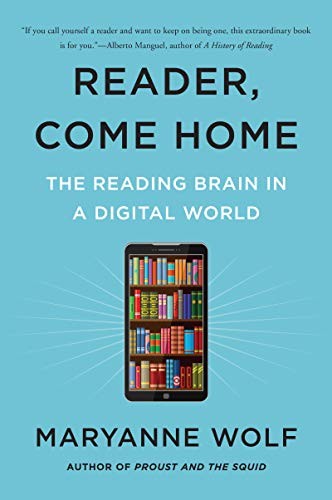
Reader, Come Home by Maryanne Wolf
-
Proust and the Squid by Maryanne Wolf
-
The Shallows by Nicholas Carr
Related: Are eBooks Better Than Printed Books? 10 Reasons to Decide · 10 Reasons Why Are Books Better Than Movies
Frequently Asked Questions
Are physical books better than e-books?
For deep reading many people prefer print, but e-books are more convenient.
Do e-books hurt your eyes?
E-ink readers are gentle, while bright screens can cause strain.
Do people remember more from print?
Studies suggest a small advantage for paper with long texts.
Are e-books cheaper?
Often, but not always.
Can I borrow e-books for free?
Yes, through library apps.
Are e-readers good for kids?
They can be, especially without games or internet.
Which is better for the environment?
It depends on how many books you read on one device.
What is the best e-reader?
Kindle and Kobo devices are popular choices.
Is reading on a tablet the same as an e-reader?
Tablets have bright screens and apps, while e-readers are built only for reading.
Do students learn better from printed textbooks?
Some studies suggest a small advantage for print, especially for long readings.