
Disclosure: As an Amazon Associate, Bookish Wisdom earns from qualifying purchases. This doesn't change our picks or your price.
TL;DR: In this rhyming alphabet book, the lowercase letters race one another up a coconut tree. The tree gets too crowded, and all the letters tumble down. The capital letters then come to help their lowercase friends.
Table of Contents
Chicka Chicka Boom Boom at a Glance
| Author | Bill Martin Jr. and John Archambault |
| First published | 1989 |
| Type | Alphabet picture book |
| Best for | parents and teachers of toddlers and preschoolers learning the alphabet |
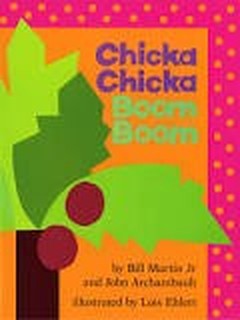
Chicka Chicka Boom Boom is a picture book by Bill Martin Jr. and John Archambault, first published in 1989. Lois Ehlert created the bright, bold illustrations. The book is known for its rhythm, which makes it fun to read aloud and to chant. Below you will find a part-by-part summary, five key takeaways, a few ideas worth remembering and a note on who will enjoy it most. The part-by-part section gives away the plot, including the ending, so skip it if you have not read the book yet.
What Happens, Page by Page (Contains Spoilers)
The story begins
The text opens with a playful rhyme about the letters, with “A told B, and B told C, I'll meet you at the top of the coconut tree.” The letters are shown as bright shapes against a clear background.
The climb
One by one, the lowercase letters climb up the tree, and the chant repeats with a catchy beat.
The crash
Eventually there are too many letters, and the tree bends and drops them all with a “chicka chicka boom boom!” The rhyme gets quick and loud.
Bumps and bruises
The letters are tangled in a heap. Some are bruised, and the uppercase letters come to pick them up and check on them.
Back on the tree
The letters recover, and the book closes with the sense that they are ready to climb again.
5 Key Takeaways
- Rhythm and repetition help children learn letters.
- Reading aloud can be active, with clapping and chanting.
- A simple story can teach letter names and the difference between small and capital letters.
- Mistakes and tumbles are part of play, and you can try again.
- Bright, bold pictures keep young readers looking and pointing.
Ideas Worth Remembering
These are paraphrased, not direct quotes:
- The sound of the words is as important as the meaning.
- The pairing of lowercase and uppercase letters makes the alphabet feel like a family.
- The book has been used in classrooms for decades.
Who Should Read Chicka Chicka Boom Boom?
Read it with children ages 2 to 5 who are starting to learn letters. It also works for early reading practice and for a rhythm game.
Questions to Think About After Reading
These prompts work for solo reading, a book club or a classroom discussion of Chicka Chicka Boom Boom:
- What do you notice in the pictures that the words do not say?
- How would you change the ending, and why?
- Which line would a child most like to repeat?
Quick Facts to Remember
- Book: Chicka Chicka Boom Boom by Bill Martin Jr. and John Archambault (1989)
- Type: Alphabet picture book
- Best for: parents and teachers of toddlers and preschoolers learning the alphabet
- Main idea in one line: Rhythm and repetition help children learn letters.
Reading Time and Format
A picture book takes only a few minutes, so it suits bedtime or a classroom circle. Look for a sturdy board or hardcover edition if small hands will handle it.
How to Use This Summary
Use this page as a quick reference before a book club meeting, an exam, or a decision about whether Chicka Chicka Boom Boom is worth your time. The takeaways are written to stand on their own. If a point interests you, go back to the book for the author's full argument, examples and style, which no short summary can carry.
A Note on Accuracy and Spoilers
This summary is based on the published text of Chicka Chicka Boom Boom, not on any film, series or stage adaptation, which often change the story. Details are kept at the level of the main events so that nothing is invented. Editions differ slightly in length and wording, so page numbers and small details may vary from your copy.
Should You Read the Book?
This is a short book, so it takes only a few minutes to read aloud. Read it once for the story, then again slowly so children can spot details in the pictures and join in on repeated lines. Many families keep a copy near the bed for months, because toddlers learn the chant quickly and like to say the letters along with the reader. It also works well in classrooms as a playful way to practise the alphabet.
Check price of Chicka Chicka Boom Boom on Amazon
What to Read Next
- Alphabet Under Construction by Denise Fleming: a playful look at the alphabet
- LMNO Peas by Keith Baker: a counting-and-alphabet picture book
- Chicka Chicka 1, 2, 3 by Bill Martin Jr.: a follow-up counting book
Related: 15 Books Like Chicka Chicka Boom Boom You’ll Love
Frequently Asked Questions
What is Chicka Chicka Boom Boom about?
The lowercase letters climb a coconut tree, fall down and are helped by the uppercase letters.
Who illustrated it?
Lois Ehlert.
What age is it for?
It is best for ages 2 to 5.
Is Chicka Chicka Boom Boom worth reading?
It depends on what you want. The book is best for parents and teachers of toddlers and preschoolers learning the alphabet. If that describes you, it is likely a good fit. If not, the titles under What to Read Next may suit you better.
Can this summary replace reading Chicka Chicka Boom Boom?
No. A summary covers the main events and ideas, but it cannot carry the author's voice, detail or pacing. Use it to decide whether to read the book, to refresh your memory or to prepare for a discussion.