
Disclosure: As an Amazon Associate, Bookish Wisdom earns from qualifying purchases. This doesn't change our picks or your price.
TL;DR: Immanuel Kant asks what human reason can know without relying on experience. He argues that our minds shape experience through space, time and basic concepts such as cause. We can have real knowledge of the world as it appears to us, but not of things as they are in themselves, and reason goes wrong when it tries to answer questions beyond all possible experience.
Table of Contents
Critique of Pure Reason at a Glance
| Author | Immanuel Kant |
| First published | 1781 |
| Type | Philosophy |
| Best for | readers who want to understand one of the most important books in modern philosophy |
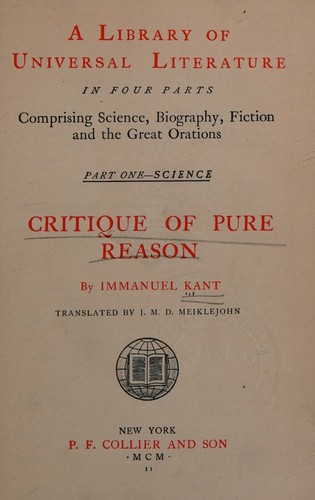
Critique of Pure Reason is a philosophy book by Immanuel Kant, first published in 1781 and revised in 1787. It changed the study of knowledge, science and the mind. Below you will find a part-by-part summary, five key takeaways, ideas worth remembering and a note on who will enjoy it.
Content note: Very dense, technical writing with a lot of specialist vocabulary.
Key Concepts
- Space and time: The forms through which we experience everything.
- The categories: Basic concepts, such as cause and substance, that organize thought.
- Phenomena: Things as they appear to us.
- Noumena: Things as they may be in themselves, beyond experience.
- Synthetic a priori knowledge: Knowledge that is informative but does not come from experience.
The Main Ideas, Part by Part
The big question
Kant begins by noting that rationalists claimed reason alone could reveal truths about reality, while empiricists such as David Hume argued that all knowledge comes from experience. Hume's doubts about cause and effect “woke” Kant up. He asks how some knowledge, such as mathematics and basic laws of nature, can be both certain and about the world. He calls this synthetic a priori knowledge.
The Copernican turn
Kant proposes a radical idea. Instead of assuming our knowledge must match objects, perhaps objects must match the way our minds work. Just as Copernicus explained the sky by changing the viewer's position, Kant explains knowledge by focusing on the knower. The mind is not a blank slate; it actively shapes what we experience.
Space, time and the categories
In the Transcendental Aesthetic, Kant argues that space and time are not things we discover out there but forms of our own perception. In the Transcendental Analytic, he argues that the understanding uses twelve categories, including unity, cause and substance. These rules make experience possible, which is why we can be sure that every event has a cause.
The limits of reason
Because our knowledge depends on these forms and categories, it reaches only the world as it appears to us. We cannot know things in themselves. In the Transcendental Dialectic, Kant shows what happens when reason ignores this limit. It produces illusions and contradictions, such as equally strong arguments that the universe had a beginning and that it did not.
What follows
Kant concludes that philosophy should not try to prove grand claims about reality beyond experience. Its job is to map the powers and limits of reason. This leaves room for freedom and moral responsibility, which cannot be proved or disproved by science. His later works on ethics and judgment build on this foundation.
5 Key Takeaways
- The mind actively shapes experience.
- Some knowledge is certain without coming from experience.
- We know the world only as it appears to us.
- Reason creates illusions when it goes beyond experience.
- Philosophy should study the limits of knowledge.
Ideas Worth Remembering
These are paraphrased, not direct quotes:
- Questioning how we know is as important as what we know.
- Certainty in science rests on the structure of the mind.
- Not every question can be answered by reason alone.
Who Should Read Critique of Pure Reason?
Read Critique of Pure Reason if you are serious about philosophy, the theory of knowledge or the history of ideas. It suits patient adult readers and students.
About Immanuel Kant
Immanuel Kant (1724–1804) was a German philosopher who spent his whole life in Königsberg, in East Prussia. He taught at the university there and was famous for his strict daily routine. His three Critiques, on pure reason, practical reason and judgment, shaped modern philosophy. He also wrote Groundwork of the Metaphysics of Morals and the essay Perpetual Peace, which influenced ideas about international cooperation.
Questions to Think About After Reading
These prompts work for solo reading, a book club or a classroom discussion of Critique of Pure Reason:
- What does Kant mean by the Copernican turn in philosophy?
- Can we ever know things as they are in themselves?
- How does Kant answer Hume's doubts about cause and effect?
How to Use This Summary
Use this page as a quick reference before a book club meeting, an exam, or a decision about whether Critique of Pure Reason is worth your time. The takeaways are written to stand on their own. If a point interests you, go back to the book for the author's full argument, examples and evidence, which no short summary can replace.
A Note on Accuracy and Spoilers
This summary is based on the published text of Critique of Pure Reason, not on any film, series or stage adaptation, which often change the story. Details are kept at the level of the main arguments so that nothing is invented. Editions differ slightly in length and wording, so page numbers and small details may vary between copies.
Should You Read the Book?
Yes, but with a guide. It is extremely hard, and a good introduction or study companion helps a great deal.
Check price of Critique of Pure Reason on Amazon
What to Read Next
- An Enquiry Concerning Human Understanding by David Hume: the empiricist challenge Kant answered
- Meditations on First Philosophy by René Descartes: a classic rationalist starting point
- Sophie's World by Jostein Gaarder: a friendly guide to the history of philosophy
Frequently Asked Questions
What is Critique of Pure Reason about?
It explores what human reason can know and where its limits lie.
Who wrote it?
Immanuel Kant, first published in 1781.
What is synthetic a priori knowledge?
Knowledge that tells us something new about the world but does not depend on experience, such as basic mathematics.
What are the categories?
Basic concepts, such as cause and substance, that the mind uses to organize experience.
What are things in themselves?
Reality as it might be apart from our minds, which Kant says we cannot know.
Who influenced Kant?
David Hume, among others, whose doubts about causation pushed Kant to rethink knowledge.
Is it hard to read?
Yes. It is one of the most difficult classics in philosophy.
Are there two editions?
Yes, the A edition of 1781 and the revised B edition of 1787.
How long is it?
About 700 to 800 pages, depending on the edition.
What age is it for?
Adults and university students.
Should I read a guide first?
Yes. A short introduction makes the book much easier to follow.
What did Kant write next?
Critique of Practical Reason and Critique of Judgment.
Why is it still important?
It shaped modern debates on science, knowledge and the mind, and almost every later philosopher responds to it in some way.
Is Critique of Pure Reason worth reading?
It depends on what you want. The book is best for readers who want to understand one of the most important books in modern philosophy. If that describes you, it is likely a good fit. If not, the titles under What to Read Next may suit you better.