
Disclosure: As an Amazon Associate, Bookish Wisdom earns from qualifying purchases. This doesn’t change our picks or your price.
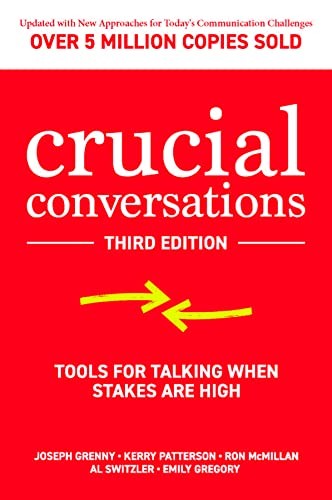
TL;DR: Crucial Conversations: Tools for Talking When Stakes Are High by Kerry Patterson, Joseph Grenny, Ron McMillan and Al Switzler explains how to handle talks where opinions differ, emotions run strong and the outcome matters. The authors teach readers to start with heart, make it safe, master their stories, state their views persuasively and move to action.
Think of the conversations that shape our careers and relationships: asking for a raise, confronting a coworker, discussing money with a spouse, giving critical feedback. In these moments, many people either clam up or blow up. Crucial Conversations, first published in 2002 and updated in 2011 and 2021, offers a research-based approach for staying dialogue-focused when pressure rises. The authors are leaders of a corporate training company, and they base the book on studies of people who handle high-stakes talks well. Here’s a summary of its main ideas.
Table of Contents
Crucial Conversations at a Glance
| Detail | Info |
|---|---|
| Authors | Kerry Patterson, Joseph Grenny, Ron McMillan and Al Switzler |
| First published | 2002 (updated editions follow) |
| Genre | Communication, business, relationships |
| Core idea | Keep the free flow of meaning in a conversation, especially when stakes are high |
| Structure | Chapters on skills such as starting with heart, making it safe and moving to action |
| Best for | Managers, teams, couples and anyone who dreads difficult talks |
What Is Crucial Conversations About?
A crucial conversation is defined as a discussion between two or more people where stakes are high, opinions vary and emotions run strong. In such conversations, we often do our worst work, because adrenaline pushes us toward fight or flight, which makes us less able to think.
The authors argue that people who are skilled at crucial conversations have one thing in common: they get all relevant information, from themselves and others, into the shared pool of meaning. The more information shared, the better the decisions.
Key Ideas, Part by Part
Start With Heart and Learn to Look
The first principle is to start with heart: focus on what you really want, for yourself, for others and for the relationship. Asking, what do I really want? and what would I do if I wanted these results? helps avoid the fool’s choice that you must pick between honesty and kindness. Instead, look for a way to be both.
The second principle is learning to look for signs that a conversation is turning crucial. People tend to react with silence, such as masking, avoiding or withdrawing, or with violence, such as controlling, labeling or attacking. Noticing these patterns in yourself and others helps you step back and fix the dialogue.
Make It Safe and Master Your Stories
When people feel unsafe, they stop sharing. The authors advise making it safe by establishing mutual purpose, the sense that you are working toward a shared goal, and mutual respect. When safety is at risk, step out of the content and repair it, for example by apologizing or contrasting, which means explaining what you do not mean and what you do mean.
Mastering your stories involves understanding how emotions arise. The path to action begins when you see and hear something, tell yourself a story, feel an emotion and then act. Because the story is the part you control, you can retrace your path, separate facts from conclusions and consider other explanations. Asking, why would a reasonable, rational person do this? helps.
State Your Path and Explore Others’ Paths
To speak persuasively, use the STATE method: Share your facts, Tell your story, Ask for others’ paths, Talk tentatively and Encourage testing. This approach lets you be confident without being aggressive. It begins with the least controversial facts, adds your interpretation and invites others to challenge it.
To explore others’ paths, use AMPP: Ask to get things rolling, Mirror to confirm feelings, Paraphrase to acknowledge the story and Prime when others are reluctant to speak. These tools help bring out the other person’s view, particularly when they are upset or silent.
Move to Action
Dialogue only matters if it leads to results. The authors advise deciding how decisions will be made, such as command, consult, vote or consensus, and then clarifying who does what by when and how you will follow up. They also stress the importance of documenting commitments.
The book closes with suggestions for combining the skills and practicing them in low-stakes settings. The authors share cases of couples, teams and leaders who improved results by changing how they talk.
6 Key Takeaways From Crucial Conversations
- Start with heart. Clarify what you want for everyone.
- Watch for silence and violence. They signal a conversation going wrong.
- Make it safe. Mutual purpose and respect keep people talking.
- Master your stories. Separate facts from interpretations.
- STATE your path. Share facts, tell your story, ask, talk tentatively and encourage testing.
- End with clear action. Decide who does what by when.
Ideas Worth Remembering
- When stakes are high, we often act poorly. (paraphrased)
- Dialogue is the free flow of meaning. (paraphrased)
- You can be honest and respectful at once. (paraphrased)
- Follow-up turns talk into results. (paraphrased)
How to Apply Crucial Conversations in Real Life
- Define your goals. Write what you want before a hard talk.
- Notice your style under stress. Do you go silent or aggressive?
- Use contrasting. Say I don’t want… I do want…
- Check your story. Ask what other explanations might exist.
- Close with a plan. Agree on who does what and when.
Criticisms and Limits
Critics say that the methods can feel formulaic if used mechanically, and that some tools, such as contrasting, may seem unnatural at first. The book also assumes that both parties are willing to engage, which is not always true in situations involving power imbalances, bullying or abuse. Some of the research is proprietary, and the examples reflect corporate settings more than other contexts.
Still, the framework is clear and easy to remember. Adapt the tools to your style and stay alert to when a conversation requires professional support or a different approach.
Crucial Conversations in One Minute
Stay in dialogue when stakes are high. Start with what you want for everyone, watch for silence and violence, make it safe with mutual purpose and respect, and master your stories. Use STATE to share your view and AMPP to explore others’, then decide who does what by when.
Examples of Contrasting
Contrasting is a quick way to fix misunderstandings. If a colleague hears criticism, you might say, I don’t mean to suggest that you haven’t put in effort; I do want us to find a way to meet the deadline. In a family setting you might say, I’m not saying that you’re a bad parent; I am saying that the evenings have been tense, and I want us to feel closer. The tool clears away fears so that the real message gets heard.
Using the Book at Work
Teams can use the tools in feedback sessions, project reviews and conflict resolution. Managers might practice STATE before performance talks, and teams can agree on norms such as speaking up early and checking assumptions. Leaders can model the skills by acknowledging their mistakes and asking for disagreement. Over time, these habits reduce rumors and build trust.
Practice Makes It Easier
Because the skills are tough to use under stress, practice in lower-stakes talks first. Try mirroring in a casual conversation, practice contrasting when giving small feedback or review your stories after a tense meeting. Write a brief reflection on what worked. Over time you will build a habit that holds up when the stakes rise.
Spotting Silence and Violence in Yourself
Everyone has a default under pressure. Masking means understating or sugarcoating, avoiding means steering away from the topic and withdrawing means leaving the conversation. Controlling means forcing your view, labeling means putting a tag on the person and attacking means trying to hurt. Identify your top two habits, ask a friend what they notice and plan a small alternative, such as taking a short break or using contrasting.
A Template for a Hard Conversation
Before a difficult talk, write four lines. What I want for myself, for the other person and for our relationship. The facts I can state without judgment. The story I am telling myself and one alternative story. The question I will ask to hear their view. Then choose a calm moment, begin with mutual purpose and follow the STATE steps. Having notes keeps emotions from taking over.
Who Should Read Crucial Conversations?
Read it if you manage people, work in a team or find difficult conversations stressful. It suits readers who like structured frameworks. For a negotiation-focused perspective, pair it with Never Split the Difference.
What to Read Next
- Never Split the Difference by Chris Voss with Tahl Raz negotiation tactics from an FBI negotiator
- Radical Candor by Kim Scott caring personally while challenging directly
- Nonviolent Communication by Marshall B. Rosenberg a language of compassion
Related: Never Split the Difference summary and key takeaways and How to Win Friends and Influence People summary and key takeaways.
Frequently Asked Questions
What is the main idea of Crucial Conversations?
That you can handle high-stakes talks by keeping dialogue open, making it safe and sharing your views honestly and respectfully.
What is a crucial conversation?
A discussion where stakes are high, opinions differ and emotions are strong.
What does STATE stand for?
Share your facts, Tell your story, Ask for others’ paths, Talk tentatively, Encourage testing.
What are silence and violence?
Two ways people respond under stress: withdrawing or attacking.
Is the book useful at home?
Yes, the skills apply to family and personal relationships as well as work.