
Disclosure: As an Amazon Associate, Bookish Wisdom earns from qualifying purchases. This doesn’t change our picks or your price.
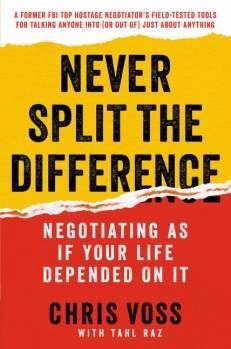
TL;DR: Never Split the Difference: Negotiating As If Your Life Depended On It by former FBI hostage negotiator Chris Voss with Tahl Raz teaches negotiation as emotional intelligence in action. Instead of compromising, Voss shows how tactical empathy, mirroring, labeling and calibrated questions help you understand the other side and reach better deals.
Chris Voss spent two decades with the FBI, rising to become its lead international kidnapping negotiator. He learned that the best negotiators don’t rely on logic and bargaining alone but on listening and emotional insight. In Never Split the Difference, published in 2016, Voss teams with writer Tahl Raz to adapt hostage-negotiation tools to business, salary talks, car buying and everyday disagreements. The book is vivid, full of high-stakes stories, and widely used in negotiation training. Here’s a summary of its main ideas.
Table of Contents
Never Split the Difference at a Glance
| Detail | Info |
|---|---|
| Authors | Chris Voss with Tahl Raz |
| Published | 2016 |
| Genre | Negotiation, communication, business |
| Core idea | Negotiation is about understanding emotions and using empathy to influence |
| Structure | Ten chapters, each introducing a tool |
| Best for | Professionals, managers, buyers and anyone who negotiates, which is everyone |
What Is Never Split the Difference About?
Voss challenges the rational model of negotiation popularized in books like Getting to Yes. He argues that people are not purely logical, and that emotions drive decisions. Effective negotiators therefore start by understanding what the other side feels and needs.
The central concept is tactical empathy, the ability to recognize the other person’s perspective and the emotions behind it, and to vocalize that understanding. It isn’t agreeing or being nice, but demonstrating that you hear them, which lowers defenses and builds trust.
Key Ideas, Part by Part
Mirroring, Labeling and Tactical Empathy
Mirroring is repeating the last few words, or the critical ones, of what someone says, often with a questioning tone. It encourages them to elaborate and shows interest. Labeling is naming the other person’s emotions, using phrases like it seems like you’re worried about… or it sounds like you value… Labels can defuse negative feelings and reveal what matters.
Voss recommends using a calm, warm voice, which he calls the late-night FM DJ voice, to keep the tone steady, and an accusation audit, in which you list the worst things the other side might think of you before they say them. Surprisingly, voicing those concerns reduces their power.
Getting to No, That’s Right and Calibrated Questions
Voss argues that a no is not a failure but the start of a conversation. People feel safe when they can say no, and it gives them a sense of control. He suggests asking questions that invite a no, such as, is now a bad time to talk? He also explains that you’re right is a polite brush-off, whereas that’s right signals genuine understanding. A good summary of someone’s position can earn a that’s right.
Another key tool is the calibrated question, an open-ended question starting with how or what, such as, how am I supposed to do that? These questions shift the burden of problem-solving to the other side and avoid direct confrontation. Voss recommends avoiding questions that begin with why, because they can sound accusatory.
Bargaining, Leverage and Hidden Information
Voss offers tactics for bargaining. He describes the Ackerman model, in which you plan your target price and make offers in decreasing steps, such as 65, 85, 95 and 100 percent of your target, using precise non-round numbers at the end to signal that you have made your best offer. He also advises using anchors, framing and loss aversion in careful, ethical ways.
He introduces the idea of leverage in three forms: positive, negative and normative, which is based on the other side’s own standards. He stresses learning the other side’s constraints and looking for hidden information. Voss calls surprising discoveries Black Swans, unknown facts that can change a negotiation entirely.
Putting It Into Practice
The book gives examples of everyday negotiations: getting a better price from a car dealer, asking for a raise, dealing with a difficult customer or resolving a family dispute. Voss reminds readers that negotiation is communication, and that patience and curiosity pay off.
He also warns against splitting the difference, which can lead to poor results for both sides. Instead, aim for agreements that truly work for everyone, based on understanding what each person needs.
6 Key Takeaways From Never Split the Difference
- Empathy is a tool. Understanding emotions gives influence.
- Mirror and label. Repeat key words and name feelings.
- Use calibrated questions. How and what questions guide the conversation.
- Aim for that’s right. Summarize their position so they agree.
- Embrace no. It builds safety and clarity.
- Seek hidden information. Black Swans can change everything.
Ideas Worth Remembering
- Slow down; speed can feel like aggression. (paraphrased)
- Listen to what’s behind the words. (paraphrased)
- Compromise often leaves both sides unhappy. (paraphrased)
- Calm tone matters as much as content. (paraphrased)
How to Apply Never Split the Difference in Real Life
- Try a mirror. Repeat the last three words someone says.
- Add a label. Say It sounds like… before making your case.
- Use How questions. Ask How can we make this work?
- Prepare an accusation audit. List what they may think of you and say it first.
- Plan your numbers. Set a target and a step-down plan.
Criticisms and Limits
Critics note that hostage negotiations differ from business deals, since the relationship and stakes are different, and that some tactics may seem manipulative or formulaic. Others say the book underplays preparation and the role of power or alternatives, which matter in many negotiations. Some of the stories are told without independent verification.
Still, the toolkit of listening, labeling and calibrated questions is widely praised for being practical. Adapt it to your setting and use it with honesty.
Never Split the Difference in One Minute
Treat negotiation as emotional intelligence. Use tactical empathy, mirroring and labeling to understand the other side. Ask calibrated how and what questions, invite no, aim for that’s right and look for hidden information. Plan offers using the Ackerman steps and don’t compromise just to meet in the middle.
The 7-38-55 Rule
Voss cites research by Albert Mehrabian suggesting that in communicating feelings, words account for 7 percent, tone of voice 38 percent and body language 55 percent. This finding is often misquoted, since it applies only to ambiguous messages about feelings. Still, the point holds that tone and body language matter a lot. A calm, warm voice and open posture can make your words land better.
A Salary Negotiation Example
Suppose you want a raise. Instead of saying, I deserve more, you might begin with, I want to make sure I’m adding value; how can I help the team? Then ask, what would it take to bring my compensation in line with the market? Label concerns such as, it seems like budgets are tight. Offer a specific number with a short rationale and be ready for a no. If the answer is no, ask what would change it.
Ethics and Limits
Some tactics, like anchoring or strategic silence, can be used to manipulate. Voss presents them as part of honest influence but emphasizes building trust. Using empathy only to extract concessions can backfire in long-term relationships. Aim for solutions that respect both sides, and be aware that cultural norms around directness and bargaining differ.
Ten Minutes of Practice
You can practice the tools in everyday life. When a friend tells you about a problem, mirror a few words and label the feeling. In a customer service call, start with an accusation audit such as, I know you’re probably frustrated about this. When someone asks for something, try a calibrated question: how would we make that work? Notice how the other person responds. Practicing in small settings builds confidence for higher-stakes talks.
Preparing a Negotiation Sheet
Voss recommends preparing a one-page summary before an important negotiation. Include your goal and a few calibrated questions to ask, your list of labels about the other side’s likely concerns, a plan for your accusation audit, and your fallback options. Also write down the information you hope to learn. Reviewing the sheet right before the conversation keeps you focused on listening, not just making your case.
Who Should Read Never Split the Difference?
Read it if you negotiate for work, buy or sell often or want to handle disagreements more calmly. It’s an exciting read. For a related approach to hard talks, pair it with Crucial Conversations.
What to Read Next
- Crucial Conversations by Kerry Patterson, Joseph Grenny, Ron McMillan and Al Switzler tools for talking when stakes are high
- Getting to Yes by Roger Fisher, William Ury and Bruce Patton principled negotiation
- Influence by Robert B. Cialdini the psychology of persuasion
Related: How to Win Friends and Influence People summary and key takeaways and Thinking, Fast and Slow summary and key takeaways.
Frequently Asked Questions
What is the main idea of Never Split the Difference?
That negotiation succeeds through emotional intelligence, empathy and listening, not through compromise or pure logic.
What is tactical empathy?
Understanding the other person’s feelings and perspective and showing that you do.
What is mirroring?
Repeating the last few words someone said to encourage them to keep talking.
What is a calibrated question?
An open how or what question that invites the other side to solve the problem.
Who is Chris Voss?
A former FBI lead international kidnapping negotiator and founder of a negotiation consultancy.