
Disclosure: As an Amazon Associate, Bookish Wisdom earns from qualifying purchases. This doesn’t change our picks or your price.
TL;DR: In Factfulness, physician and statistician Hans Rosling shows that most people, including experts, hold an outdated, overly dramatic view of the world. Ten instincts, like the gap instinct and the negativity instinct, distort how we see data. The world is still full of problems, but by many measures it’s far better than most people think.
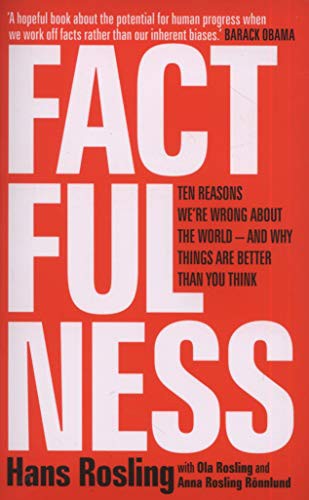
Published in 2018, Factfulness: Ten Reasons We’re Wrong About the World and Why Things Are Better Than You Think was written by Hans Rosling with his son Ola Rosling and daughter-in-law Anna Rosling Rönnlund, co-founders of the Gapminder Foundation. Rosling died in 2017 before the book’s release. Bill Gates famously offered a free copy to every US college graduate who wanted one that year.
Table of Contents
Factfulness at a Glance
| Detail | Info |
|---|---|
| Authors | Hans Rosling, with Ola Rosling and Anna Rosling Rönnlund |
| Published | 2018 |
| Genre | Data / global development / critical thinking |
| Structure | An opening quiz, then ten chapters, one for each instinct |
| Best for | Students, teachers, journalists, professionals and curious readers |
What Is Factfulness About?
The book opens with a quiz of factual questions about global trends, such as poverty, life expectancy and girls’ education. Around the world, people answer worse than random guessing, which Rosling compares to chimpanzees picking answers at random. The problem isn’t a lack of knowledge but a set of instincts that push us toward a dramatic, negative worldview.
The Four Income Levels
Instead of dividing the world into developed and developing countries, Rosling uses four income levels. Level 1 is extreme poverty, living on less than about $2 a day. Level 2 is roughly $2 to $8, Level 3 roughly $8 to $32, and Level 4 above $32 a day. Most of the world’s people live in the middle levels, not at the extremes.
The 10 Instincts
- The gap instinct: We divide the world into two groups, rich and poor, when most people are in the middle.
- The negativity instinct: We notice bad news more than slow, steady improvements.
- The straight line instinct: We assume trends continue in a straight line, like population growth, when many curves level off.
- The fear instinct: Frightening risks grab attention, while more common dangers are ignored.
- The size instinct: Single numbers look impressive without comparison. Always compare and divide.
- The generalization instinct: We lump people and countries into misleading categories.
- The destiny instinct: We assume cultures and countries never change, when change is often slow but steady.
- The single perspective instinct: One idea or tool can’t explain everything.
- The blame instinct: We look for villains instead of understanding systems.
- The urgency instinct: Pressure to act now leads to poor, rushed decisions.
5 Key Takeaways From Factfulness
- The world is better than you think. Extreme poverty has fallen dramatically, and life expectancy has risen.
- Bad and better can both be true. Things can be bad and improving at the same time.
- Look at the middle. Most people live between the extremes.
- Always compare. Numbers mean little without context.
- Slow down. Urgent, fearful thinking leads to mistakes.
Ideas Worth Remembering
- Things can be bad and getting better at the same time. (paraphrased)
- Never trust a lonely number; compare it with something. (paraphrased)
- Most of what we fear isn’t what is most likely to hurt us. (paraphrased)
What Do Critics Say?
Some critics argue the book underplays problems like climate change and inequality, or that its optimism can lead to complacency. Rosling himself called his view possibilism: neither optimistic nor pessimistic, just based on facts. He also named climate change, pandemics, financial collapse, world war and extreme poverty as risks worth worrying about.
Who Should Read Factfulness?
It’s a great read for students, teachers and anyone overwhelmed by negative news. Its short chapters, personal stories and simple charts make it accessible even if you don’t like numbers.
What to Read Next
- Thinking in Systems by Donella H. Meadows on understanding complex problems.
- Enlightenment Now by Steven Pinker for another data-driven look at progress.
- How to Lie with Statistics by Darrell Huff on spotting misleading numbers.
Related: Thinking in Systems summary and best books on logic and critical thinking.
Frequently Asked Questions
What are the 10 instincts in Factfulness?
The ten instincts are gap, negativity, straight line, fear, size, generalization, destiny, single perspective, blame and urgency.
What is the main message of Factfulness?
The main message is that the world is better than most people think, and that we should use facts and careful thinking rather than dramatic instincts to understand it.
Is Factfulness still accurate?
Some specific numbers have changed since 2018, but the book’s lessons about thinking clearly with data remain relevant. The Gapminder Foundation keeps its data updated online.