
Disclosure: As an Amazon Associate, Bookish Wisdom earns from qualifying purchases. This doesn’t change our picks or your price.
TL;DR: Thinking in Systems is a short, clear introduction to systems thinking. Donella H. Meadows explains how systems are built from stocks, flows and feedback loops, why they often behave in surprising ways, the common traps they fall into, and the leverage points where small changes can produce big results.
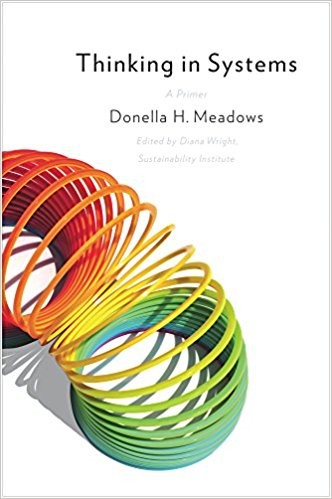
Donella Meadows was an environmental scientist and lead author of the influential 1972 report The Limits to Growth. She drafted Thinking in Systems: A Primer in the 1990s, and it was published in 2008, after her death in 2001, edited by Diana Wright of the Sustainability Institute. It has since become the go-to introduction to systems thinking for students, managers, policymakers and designers.
Table of Contents
Thinking in Systems at a Glance
| Detail | Info |
|---|---|
| Author | Donella H. Meadows (edited by Diana Wright) |
| Published | 2008 |
| Genre | Systems thinking / science / management |
| Structure | Three parts: system structure and behavior, systems and us, and creating change |
| Best for | Students, managers, policy makers, designers and problem solvers |
What Is a System?
Meadows defines a system as a set of elements interconnected in a way that achieves something. A system has elements (like trees in a forest or players on a team), interconnections (the relationships between them) and a function or purpose. Purpose is often the least obvious part and the most important: a system’s real purpose is revealed by its behavior, not by its stated goals.
Key Ideas From Thinking in Systems
Stocks and Flows
A stock is anything that accumulates: water in a bathtub, money in a bank account, trust in a relationship. Flows fill or drain the stock. Stocks change slowly, which acts as a buffer and creates delays. Understanding this helps explain why change in organizations and economies takes time.
Feedback Loops
Balancing feedback loops push a system toward a goal, like a thermostat keeping a room at a set temperature. Reinforcing feedback loops amplify change, like compound interest or population growth, leading to exponential growth or collapse.
Delays
Delays between action and result cause oscillations. Meadows uses the example of a car dealer adjusting inventory: reacting quickly to delayed information can make swings worse, not better.
Why Systems Work Well
Healthy systems tend to have resilience (the ability to recover from shocks), self-organization (the ability to create new structures) and hierarchy (subsystems that serve the larger whole).
Why Systems Surprise Us
We tend to see events rather than underlying patterns, assume straight-line relationships in a nonlinear world, draw boundaries in the wrong places and forget that every actor has limited information.
System Traps
Meadows describes common archetypes that create problems, including policy resistance (competing goals cancel each other out), the tragedy of the commons (shared resources get overused), drift to low performance (standards slowly slip), escalation (competitors keep raising the stakes), success to the successful (winners get more resources to keep winning), shifting the burden to an intervenor (dependency on outside fixes), rule beating and seeking the wrong goal.
Leverage Points
Her famous list ranks places to intervene in a system from least to most effective. Changing numbers, like taxes or subsidies, is usually least powerful. More powerful are changing feedback loops, information flows, rules, the power to self-organize and system goals. The most powerful leverage point is changing the mindset or paradigm from which the system arises, and, beyond that, staying flexible about paradigms altogether.
5 Key Takeaways From Thinking in Systems
- Look for structure, not just events. Behavior comes from how systems are built.
- Respect stocks and delays. Change takes time, and overreacting causes oscillation.
- Understand feedback. Balancing loops stabilize; reinforcing loops amplify.
- Watch for traps. Many recurring problems follow familiar archetypes.
- Aim for high leverage. Changing goals and mindsets beats tweaking numbers.
Ideas Worth Remembering
- A system’s purpose is shown by what it does, not by what it says it does. (paraphrased)
- You can’t control systems, but you can design and redesign them. (paraphrased)
- The deepest leverage lies in the mindset behind the system. (paraphrased)
Who Should Read Thinking in Systems?
It’s ideal for anyone who wants to understand complex problems, from climate and economics to company culture and family dynamics. It’s short and accessible, with simple diagrams, though some sections reward slow reading.
What to Read Next
- The Fifth Discipline by Peter M. Senge on systems thinking in organizations.
- The Black Swan by Nassim Nicholas Taleb on uncertainty and rare events.
- Factfulness by Hans Rosling on seeing the world through data.
Frequently Asked Questions
What is the main idea of Thinking in Systems?
The main idea is that problems are often produced by the structure of systems, made of stocks, flows and feedback loops, and that lasting solutions come from understanding and redesigning that structure.
What are leverage points in systems thinking?
Leverage points are places in a system where a small change can produce big shifts in behavior. Meadows ranked them, with changing paradigms as the most powerful and adjusting numbers as the least.
Is Thinking in Systems hard to read?
No. It’s written as a primer for non-specialists, with clear examples and diagrams, though it’s dense enough to reread.