
Disclosure: As an Amazon Associate, Bookish Wisdom earns from qualifying purchases. This doesn’t change our picks or your price.
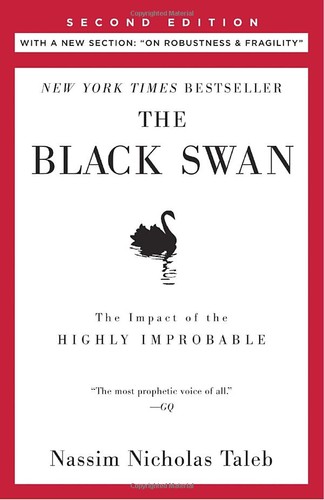
TL;DR: In The Black Swan, Nassim Nicholas Taleb argues that history is shaped by rare, unpredictable events with huge impact, which we explain away afterward as if they were obvious. Since we can’t predict them, we should stop pretending to forecast and instead build lives and systems that limit harm from negative surprises and benefit from positive ones.
Published in 2007, The Black Swan: The Impact of the Highly Improbable became even more famous after the 2008 financial crisis, which seemed to prove its point. Taleb, a former options trader and essayist, writes with sharp opinions and plenty of humor. The book is part of his Incerto series, alongside Fooled by Randomness, Antifragile and Skin in the Game.
Table of Contents
The Black Swan at a Glance
| Detail | Info |
|---|---|
| Author | Nassim Nicholas Taleb |
| Published | 2007 (second edition with an added essay, 2010) |
| Genre | Philosophy / probability / economics |
| Structure | Four parts covering our blindness to uncertainty, prediction, extreme events and what to do about them |
| Best for | Investors, decision-makers and anyone interested in risk and uncertainty |
What Is a Black Swan?
For centuries, Europeans assumed all swans were white, until black swans were seen in Australia. One observation overturned a belief built on thousands. Taleb defines a black swan event by three traits: it’s an outlier that lies outside regular expectations, it carries an extreme impact, and after it happens we invent explanations that make it seem predictable. Examples include the rise of the internet, the First World War and the September 11 attacks.
Key Ideas From The Black Swan
Mediocristan vs. Extremistan
Taleb divides the world into two domains. In Mediocristan, no single observation changes the total much: add the heaviest person on Earth to a room of 1,000 people and the average weight barely moves. In Extremistan, one observation can dominate: add the richest person to that room and the average wealth explodes. Wealth, book sales, city sizes and market crashes live in Extremistan, where averages and bell curves mislead.
The Turkey Problem
A turkey is fed every day for 1,000 days. Each day confirms its belief that humans are kind. Its confidence is highest the day before Thanksgiving. Past data can give false confidence precisely when risk is greatest.
The Narrative Fallacy
We love stories and invent causes to make random events feel orderly. This makes us overestimate how well we understand the world.
Silent Evidence
We only see the winners. Successful entrepreneurs and authors are visible, but the many who took the same risks and failed are silent, which distorts our sense of what works.
The Ludic Fallacy
Real-life uncertainty doesn’t behave like a casino game with known odds. Treating it as if it does leads to models that fail when it matters.
Epistemic Arrogance and the Limits of Prediction
Experts consistently overestimate what they know. Forecasts in economics, politics and business often miss the events that matter most.
The Barbell Strategy
Instead of medium risk everywhere, Taleb suggests combining extreme safety with small, high-upside bets, for example keeping most of your money very safe while putting a small share into speculative opportunities. You cap your downside while leaving room for positive black swans.
5 Key Takeaways From The Black Swan
- Expect the unexpected. Rare, high-impact events shape history more than ordinary ones.
- Know which world you’re in. Bell curves work in Mediocristan, not Extremistan.
- Distrust tidy stories. Explanations after the fact create an illusion of understanding.
- Look for silent evidence. Ask who tried and failed, not just who succeeded.
- Limit downside, keep upside. Robust strategies matter more than accurate forecasts.
Ideas Worth Remembering
- Absence of evidence isn’t evidence of absence. (paraphrased)
- What you don’t know matters more than what you do know. (paraphrased)
- Prepare for what you can’t predict instead of predicting what you can’t prepare for. (paraphrased)
What Do Critics Say?
Some readers find Taleb’s tone combative and his digressions long. Statisticians have debated some of his criticisms of standard models. But the core ideas, especially fat tails and the danger of overconfident forecasting, are widely influential in finance and risk management.
Who Should Read The Black Swan?
It’s essential reading for investors, entrepreneurs, policy makers and anyone who makes decisions under uncertainty. Readers who enjoy philosophical, opinionated writing will love it; those who want a quick guide may prefer a summary like this one first.
What to Read Next
- Antifragile by Nassim Nicholas Taleb on things that gain from disorder.
- Thinking, Fast and Slow by Daniel Kahneman on overconfidence and bias.
- Superforecasting by Philip E. Tetlock and Dan Gardner on what good prediction actually looks like.
Related: best books on logic and critical thinking and Freakonomics summary.
Frequently Asked Questions
What is a black swan event?
A black swan event is a rare, unpredictable event with extreme impact that people rationalize afterward as if it had been predictable.
What is the difference between Mediocristan and Extremistan?
In Mediocristan, single observations don’t change averages much, like height or weight. In Extremistan, single observations can dominate the total, like wealth or book sales.
What is Taleb’s barbell strategy?
It’s a strategy of combining very safe positions with a small number of high-risk, high-reward bets, avoiding the middle, so your downside is limited and your upside remains open.