

Disclosure: As an Amazon Associate, Bookish Wisdom earns from qualifying purchases. This doesn’t change our picks or your price.
TL;DR: In Guns, Germs, and Steel, Jared Diamond argues that some societies came to dominate others not because of differences in intelligence or character, but because of geography and environment. Access to domesticable plants and animals, the east-west shape of Eurasia and the germs that came from livestock gave some peoples a head start that compounded over thousands of years.
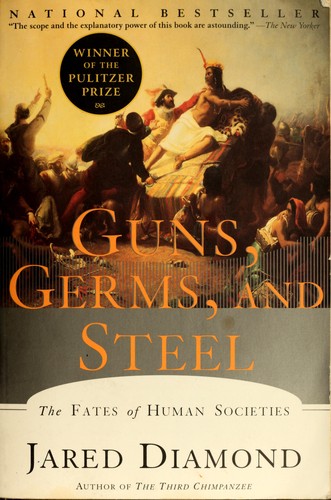
Published in 1997 and winner of the 1998 Pulitzer Prize for General Nonfiction, Guns, Germs, and Steel: The Fates of Human Societies is one of the most influential popular history books ever written. Diamond, a scientist who trained in physiology and worked for decades on bird ecology in New Guinea, set out to answer a question that has shaped the modern world: why did wealth and power become distributed as they are?
Table of Contents
Guns, Germs, and Steel at a Glance
| Detail | Info |
|---|---|
| Author | Jared Diamond |
| Published | 1997 (Pulitzer Prize 1998) |
| Genre | History / anthropology / geography |
| Structure | Four parts: from Eden to Cajamarca, the rise of food production, from food to guns, germs and steel, and a tour around the world |
| Best for | History lovers, students and readers who like big-picture explanations |
Yali’s Question
The book opens with a conversation in 1972 with Yali, a local politician in New Guinea, who asked Diamond why white people had developed so much cargo (goods and technology) while New Guineans had so little. Diamond rejects racial explanations outright. Instead, he searches for the ultimate causes behind the proximate ones like guns, steel weapons and epidemic diseases.
Key Ideas From Guns, Germs, and Steel
The Collision at Cajamarca
Diamond describes the 1532 encounter at Cajamarca, where Francisco Pizarro and about 168 Spanish soldiers captured the Inca emperor Atahualpa, who was surrounded by an army of tens of thousands. The Spaniards had steel weapons, horses, guns and writing, and the Inca Empire had already been weakened by smallpox and civil war. Diamond asks why it happened this way and not the reverse.
Food Production Was the Head Start
Farming allowed denser populations, food surpluses and specialists like soldiers, craftspeople and rulers. Regions like the Fertile Crescent had many wild plants suitable for domestication, like wheat, barley and peas, giving them an early lead.
The Anna Karenina Principle of Domestication
Out of the many large mammal species in the world, only around 14 were domesticated in ancient times, and most were native to Eurasia. Diamond argues an animal must pass many tests to be domesticable, including diet, growth rate, temperament and social structure, so failing any one rules it out. Zebras, for instance, proved too unpredictable.
Continental Axes
Eurasia stretches mainly east to west, so crops and animals could spread across regions with similar climates and day lengths. The Americas and Africa run mainly north to south, across very different climate zones, which slowed the spread of farming, animals and ideas.
Germs From Livestock
Living close to domesticated animals exposed Eurasians to diseases like smallpox and measles over thousands of years, building partial immunity. When Europeans arrived in the Americas, these diseases killed a huge share of Indigenous populations, often before direct conflict.
Writing, Technology and Government
Large, settled societies developed writing, more complex technology and centralized states, which helped organize armies, spread knowledge and conquer neighbors.
5 Key Takeaways From Guns, Germs, and Steel
- Geography shaped history. Environment, not innate ability, explains early advantages.
- Farming was the turning point. Food surpluses enabled cities, specialists and states.
- Few animals could be domesticated. Eurasia had most of them, giving it a major edge.
- Continental shape mattered. East-west continents spread innovations faster.
- Germs changed the world. Disease played a huge role in European conquest.
Ideas Worth Remembering
- History followed different courses for different peoples because of differences in environments, not biology. (paraphrased)
- Successful domestication requires passing many tests; failing just one is enough to rule an animal out. (paraphrased)
- Germs often did more than weapons to reshape the world. (paraphrased)
What Do Critics Say?
Many historians and anthropologists praise the book’s ambition but argue it leans toward geographic determinism, underplays the role of human choices, culture and politics, and simplifies complex histories. Others question specific claims about particular regions. It’s best read as a powerful, debatable thesis rather than the final word.
Who Should Read Guns, Germs, and Steel?
It’s ideal for curious readers, history and anthropology students, and anyone who enjoys big-picture explanations of the world. It’s long and detailed, so readers new to the topic may want to read it in sections.
What to Read Next
- Sapiens by Yuval Noah Harari for a sweeping history of humankind.
- 1491 by Charles C. Mann on the Americas before Columbus.
- Collapse by Jared Diamond on why some societies fail.
Related: Homo Deus summary and Factfulness summary.
Frequently Asked Questions
What is the main argument of Guns, Germs, and Steel?
The main argument is that differences in power and wealth between societies came from geographic and environmental advantages, like domesticable plants and animals and continental shape, not from differences between peoples.
What is Yali’s question?
Yali, a New Guinean politician, asked Diamond why white people had developed so much cargo while New Guineans had so little. The book is Diamond’s attempt to answer it.
Is Guns, Germs, and Steel accurate?
Its broad ideas about farming, domestication and disease are widely respected, but scholars criticize it for geographic determinism and oversimplification. Read it alongside other perspectives.