

Disclosure: As an Amazon Associate, Bookish Wisdom earns from qualifying purchases. This doesn’t change our picks or your price.
TL;DR: In Talking to Strangers, Malcolm Gladwell argues that we’re bad at understanding people we don’t know, and that our mistakes can have serious consequences. Three ideas explain why: we default to truth, we wrongly assume people’s behavior reveals their feelings (transparency), and we ignore how context shapes behavior (coupling).
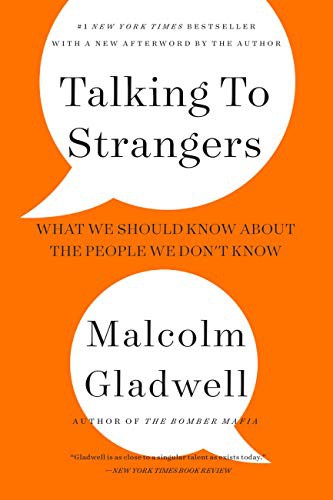
Published in 2019, Talking to Strangers: What We Should Know About the People We Don’t Know is Malcolm Gladwell’s sixth book. It’s framed by the 2015 case of Sandra Bland, a Black woman pulled over for a minor traffic violation in Texas whose encounter with a police officer escalated into an arrest; she was found dead in her jail cell three days later. Gladwell uses this and other stories to ask why encounters between strangers go so wrong.
Content note: this book discusses suicide, sexual assault and police violence. If you or someone you know is struggling, call or text 988 in the US to reach the Suicide and Crisis Lifeline.
Table of Contents
Talking to Strangers at a Glance
| Detail | Info |
|---|---|
| Author | Malcolm Gladwell |
| Published | 2019 |
| Genre | Psychology / social science / narrative nonfiction |
| Structure | Case studies grouped around three main ideas, opening and closing with Sandra Bland’s story |
| Best for | Readers interested in psychology, policing, justice and communication |
What Is Talking to Strangers About?
For most of history, people lived among those they knew. Today we constantly deal with strangers: colleagues, customers, officials and police. Gladwell argues that the strategies we use to judge strangers are deeply flawed, and that instead of blaming individuals, we should understand those flaws.
Key Ideas From Talking to Strangers
Default to Truth
Drawing on research by psychologist Tim Levine, Gladwell explains that people tend to assume others are honest unless doubts pile up past a threshold. This explains how Cuban spy Ana Montes rose through the US Defense Intelligence Agency, and how Bernie Madoff fooled investors for years, even after analyst Harry Markopolos repeatedly warned regulators. Gladwell argues that defaulting to truth is usually worthwhile, because constant suspicion would make society unworkable, but it has costs.
The Transparency Problem
We assume people’s outward behavior matches their inner feelings, that a liar looks nervous and an innocent person looks sincere. In reality, many people are mismatched. Gladwell discusses how Amanda Knox’s unusual behavior after her roommate’s murder in Italy led many to believe she was guilty, though she was eventually acquitted. He also cites research showing that judges were no better than an algorithm at predicting which defendants would reoffend, partly because meeting defendants in person misled them.
Neville Chamberlain and Hitler
British prime minister Neville Chamberlain met Hitler in person and came away believing he could be trusted, while some who never met him saw the danger more clearly. Gladwell uses this to show that face-to-face meetings can make us worse, not better, at judging strangers.
Coupling
Behavior is linked to specific contexts. Gladwell describes how suicides in Britain dropped sharply when toxic town gas was replaced by safer natural gas, suggesting many suicides were coupled to an easy, available method. He also discusses research showing that crime concentrates in a small number of specific places.
Back to Sandra Bland
Gladwell argues that the officer who stopped Sandra Bland was following a policing approach that encouraged stopping many drivers on minor pretexts and treating ordinary behavior as suspicious, ignoring both default-to-truth and coupling. The tragedy, he suggests, came from a system built on flawed assumptions about strangers.
5 Key Takeaways From Talking to Strangers
- We default to truth. Trust is usually useful, but it means we’ll sometimes be fooled.
- Behavior isn’t transparent. Demeanor is a poor guide to honesty or guilt.
- Context matters. Behavior is often coupled to particular places and conditions.
- Meeting someone can mislead you. Face-to-face impressions aren’t always reliable.
- Approach strangers with humility. Accept the limits of what you can know about others.
Ideas Worth Remembering
- We think we can read strangers easily, but we usually can’t. (paraphrased)
- Defaulting to truth is a price we pay for a functioning society. (paraphrased)
- The right response to our mistakes with strangers is restraint and humility. (paraphrased)
What Do Critics Say?
Some critics argue that Gladwell underplays the role of race in the Sandra Bland case and that his tidy theories don’t fully explain complex events. Others praise the book’s storytelling and its challenge to our confidence in reading people. The audiobook, produced like a podcast with real interview audio, is especially popular.
Who Should Read Talking to Strangers?
It suits readers who enjoy psychology and true stories, as well as anyone working in policing, law, hiring, customer service or management. Because of its heavy topics, sensitive readers may want to approach some chapters with care.
What to Read Next
- Blink by Malcolm Gladwell on snap judgments.
- Thinking, Fast and Slow by Daniel Kahneman on the biases behind our judgments.
- Biased by Jennifer L. Eberhardt on hidden prejudice.
Related: Predictably Irrational summary and The Laws of Human Nature summary.
Frequently Asked Questions
What is the main idea of Talking to Strangers?
The main idea is that we’re poor at understanding strangers because we default to truth, assume behavior reveals feelings and ignore context, and these errors can lead to serious consequences.
What does default to truth mean?
Default to truth is our tendency to assume people are honest unless we have overwhelming evidence otherwise, a concept from psychologist Tim Levine.
What is coupling in Talking to Strangers?
Coupling is the idea that behaviors are tied to specific contexts and conditions. Change the context and the behavior often changes too.