
Disclosure: As an Amazon Associate, Bookish Wisdom earns from qualifying purchases. This doesn't change our picks or your price.
TL;DR: In the 1920s, members of the Osage Nation in Oklahoma became wealthy from oil on their land, and then many of them began to die. David Grann tells how the murders were carried out, how the case grew into one of the FBI's first big investigations, and how much more was hidden.
Table of Contents
Killers of the Flower Moon at a Glance
| Author | David Grann |
| First published | 2017 |
| Type | True-crime history |
| Best for | readers of narrative nonfiction and American history |
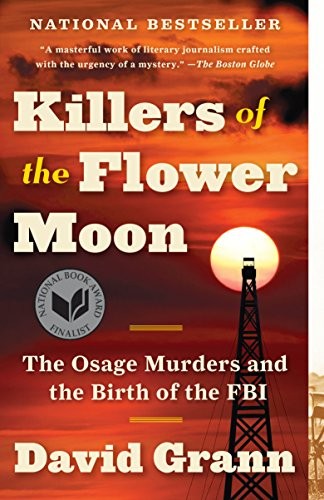
Killers of the Flower Moon is a nonfiction book by David Grann, first published in 2017. It was a finalist for a National Book Critics Circle Award and was adapted into a 2023 film directed by Martin Scorsese. Below you will find a part-by-part summary, five key takeaways, a few ideas worth remembering and a note on who will enjoy it most. The summary paraphrases the author's ideas rather than quoting them at length, so it works as a refresher or a preview, not a replacement for the book.
Content note: Describes murder, racism and greed.
Key Ideas, Part by Part
The Osage and the oil
The Osage were moved to land in Oklahoma that proved to sit on enormous oil deposits. Under headrights, Osage individuals shared in the royalties, and they became some of the richest people per capita in the world.
The killings begin
In the 1920s, Osage people started to die in suspicious ways. The book follows Mollie Burkhart, an Osage woman whose family members were killed one after another, from shootings to poison to bombing.
A system that allowed it
Local officials, lawyers and doctors looked away or took part. Many Osage were assigned white guardians who controlled their money, and that system created chances for theft and murder.
The FBI steps in
The young Bureau of Investigation, led by J. Edgar Hoover, sent Tom White to take over the case. White built a team, including undercover agents, to gather evidence in a community where witnesses were afraid.
William Hale
The investigation pointed to William Hale, a rancher who called himself the King of the Osage Hills. Hale was charged and convicted, along with others, though not before more people died.
The part still unsolved
In the final section, Grann turns to descendants and records and shows that the killings went far beyond the cases that were prosecuted. Many murders were never investigated, and some of the people responsible were never held to account.
5 Key Takeaways
- Wealth does not protect a marginalized community when the system around it is corrupt.
- Guardianship laws treated the Osage as unable to manage their own money and made them targets.
- Official histories can hide a larger crime, and journalists and descendants can recover the truth.
- Justice in the case was partial, and many victims never saw it.
- The FBI's early reputation rested partly on this case, which raises questions about how history is told.
Ideas Worth Remembering
These are paraphrased, not direct quotes:
- The murders show that systems can enable crimes even when no single villain is responsible.
- Grann ends by recognizing that the story was larger than the court record.
- A story told only from the investigators' side leaves the victims' families out.
Who Should Read Killers of the Flower Moon?
Read it if you like narrative nonfiction, American history or true crime that is serious about its victims. It is also a good choice if you have seen the film and want the fuller story, which the book handles differently.
Questions to Think About After Reading
These prompts work for solo reading, a book club or a classroom discussion of Killers of the Flower Moon:
- Which idea could you use this week, and what would the first step be?
- Where do you disagree with the author, and what evidence would change your mind?
- Who in your life would benefit most from this book, and why?
How to Use This Summary
Use this page as a quick reference before a book club meeting, an exam, or a decision about whether Killers of the Flower Moon is worth your time. The takeaways are written to stand on their own. If a point interests you, go back to the book for the author's full argument, examples and style, which no short summary can carry.
A Note on Accuracy and Spoilers
This summary is based on the published text of Killers of the Flower Moon, not on any film, series or stage adaptation, which often change the story. Details are kept at the level of the main events so that nothing is invented. Editions differ slightly in length and wording, so page numbers and small details may vary from your copy.
Should You Read the Book?
If you decide to read it, skim the contents page first and read the sections that match your goal. Take notes in your own words, because ideas stick better when you rephrase them.
Check price of Killers of the Flower Moon on Amazon
What to Read Next
- The Lost City of Z by David Grann: another gripping story from the same author
- Say Nothing by Patrick Radden Keefe: a true story of murder in Northern Ireland
- The Devil in the White City by Erik Larson: history told like a thriller
Related: 15 Books Like Killers of the Flower Moon You’ll Love: True Crime and Hidden History · The Lost City of Z by David Grann: Summary and Key Takeaways
Frequently Asked Questions
Is Killers of the Flower Moon a true story?
Yes. It is nonfiction based on archives, interviews and records about the Osage murders of the 1920s.
How is the book different from the film?
The book follows Tom White and the FBI investigation more directly, while the film centers on Mollie and Ernest Burkhart.
Who was William Hale?
He was a cattleman who held great influence in Osage County and was convicted in connection with the killings.
What happened to the Osage?
The Osage Nation survived and continues to this day, and the book is part of a wider effort to recognize what was done to them.
Is Killers of the Flower Moon worth reading?
It depends on what you want. The book is best for readers of narrative nonfiction and American history. If that describes you, it is likely a good fit. If not, the titles under What to Read Next may suit you better.
Can this summary replace reading Killers of the Flower Moon?
No. A summary covers the main events and ideas, but it cannot carry the author's voice, detail or pacing. Use it to decide whether to read the book, to refresh your memory or to prepare for a discussion.