
Disclosure: As an Amazon Associate, Bookish Wisdom earns from qualifying purchases. This doesn't change our picks or your price.
Quick answer: The best quotes from Holes by Louis Sachar include “There is no lake at Camp Green Lake.” and “If you take a bad boy and make him dig a hole every day in the hot sun, it will turn him into a good boy.” Below are 5 of the most memorable lines, with who says them, where they come from and what they mean.
Quick facts
- Book: Holes by Louis Sachar
- First published: 1998
- Quotes covered: 5
- Best for: essays, captions, book club talks and rereads
Table of Contents
What Holes Is About
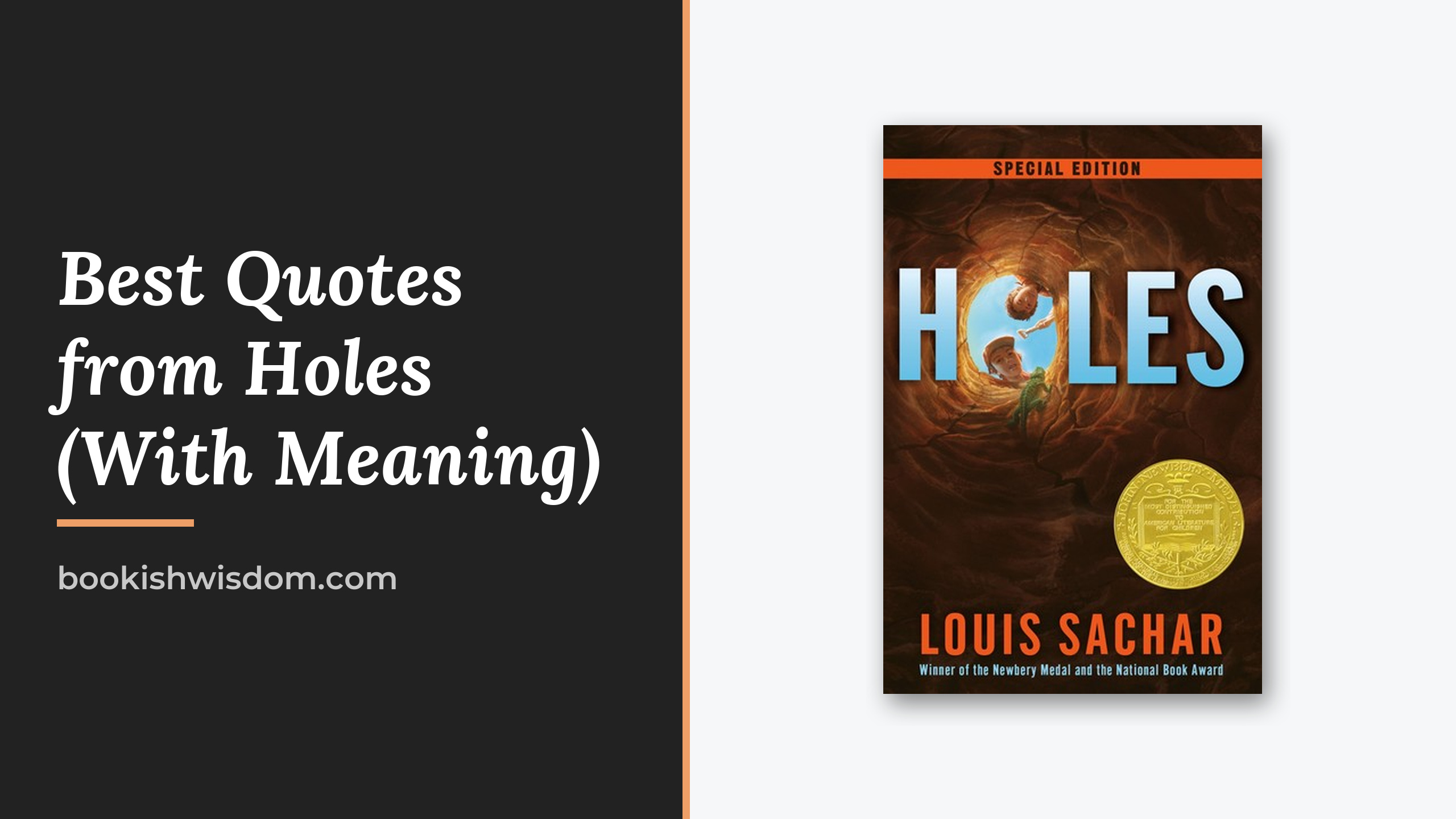
Stanley Yelnats comes from a family with terrible luck, which they blame on his no-good-dirty-rotten-pig-stealing-great-great-grandfather. When Stanley is wrongly convicted of stealing a famous baseball player's sneakers, he is sent to Camp Green Lake, a juvenile detention camp in the Texas desert. There the boys must dig a hole five feet deep and five feet wide every day. Stanley slowly realizes the Warden is looking for something, and the story links his family's curse with the old town's past.
Check price of Holes on Amazon
The Best Quotes from Holes, Explained
1. “There is no lake at Camp Green Lake.”
The opening line. The book begins with a twist. Camp Green Lake was once a lake, but now it is a dry, burning desert. The line sets up the mystery of what happened to the town.
2. “If you take a bad boy and make him dig a hole every day in the hot sun, it will turn him into a good boy.”
The idea behind the camp. This is the official reason for the digging, and it is clearly false. The real reason is the Warden's search for treasure. The line shows how adults can hide selfish goals behind good-sounding rules.
3. “If only, if only, the woodpecker sighs, The bark on the tree was just a little bit softer.”
The Yelnats family song. The song has been passed down through the family. Its gentle wish for things to be a little easier links Stanley to his ancestors and their story.
4. “It was all because of his no-good-dirty-rotten-pig-stealing-great-great-grandfather!”
Stanley's family explaining their bad luck. This long, funny phrase is a family joke. It shows how people blame the past for their troubles, and the book later reveals the truth behind the curse.
5. “You will have to fill in the holes yourself.”
The last line. The narrator hands the rest of the story to readers. It is a clever pun that ends the book with a smile.
Why These Lines Stay With Readers
Holes won the Newbery Medal and the National Book Award. Its lines are funny and clever, and they reward rereading because so many details from different times connect by the end.
How to Use These Quotes
- In an essay: introduce the quote, give its context in one sentence, then explain how it supports your point.
- For a book club: read one line aloud and ask whether everyone agrees with the speaker.
- For a caption or card: pick a short line and credit Louis Sachar and Holes.
- For a reread: look for the moment each line appears and notice what changes around it.
A Note on Quoting Holes Accurately
Wording can differ slightly between editions, translations and film versions, and many lines shared online are paraphrased or misattributed. If you need an exact quote for an essay, check it against a printed copy of Holes and note the edition and page number. The lines above are given as they appear in the book, not as they were changed for later adaptations.
When you quote in an essay, keep the quotation short and let your own explanation do most of the work. A good pattern is to name the speaker, place the line in the story, quote it and then spend two or three sentences on what it shows. Quotes from Holes work best when they support a clear point about a character or theme, rather than standing alone.
Discussion Questions
- Which quote above best sums up Holes for you, and why?
- Do any of these lines mean something different once you know how the book ends?
- Which quote would you disagree with, and what would you say back?
If You Love the Writing in Holes
- The Westing Game by Ellen Raskin
- Hatchet by Gary Paulsen
Related: Holes by Louis Sachar: Summary and Key Takeaways · Themes in Holes Explained
Frequently Asked Questions
What is the most famous quote from Holes?
One of the best-known lines is “There is no lake at Camp Green Lake.” (the opening line).
Who wrote Holes?
Holes was written by Louis Sachar and first published in 1998.
Can I use quotes from Holes in an essay?
Yes. Short quotations with clear credit to Louis Sachar are standard in essays and reviews. Always explain the quote in your own words.
What should I read after Holes?
Try The Westing Game by Ellen Raskin or Hatchet by Gary Paulsen.