
Disclosure: As an Amazon Associate, Bookish Wisdom earns from qualifying purchases. This doesn't change our picks or your price.
Quick answer: The best quotes from The Phantom Tollbooth by Norton Juster include “There was once a boy named Milo who didn't know what to do with himself—not just sometimes, but always.” and “So many things are possible just as long as you don't know they're impossible.” Below are 5 of the most memorable lines, with who says them, where they come from and what they mean.
Quick facts
- Book: The Phantom Tollbooth by Norton Juster
- First published: 1961
- Quotes covered: 5
- Best for: essays, captions, book club talks and rereads
Table of Contents
What The Phantom Tollbooth Is About
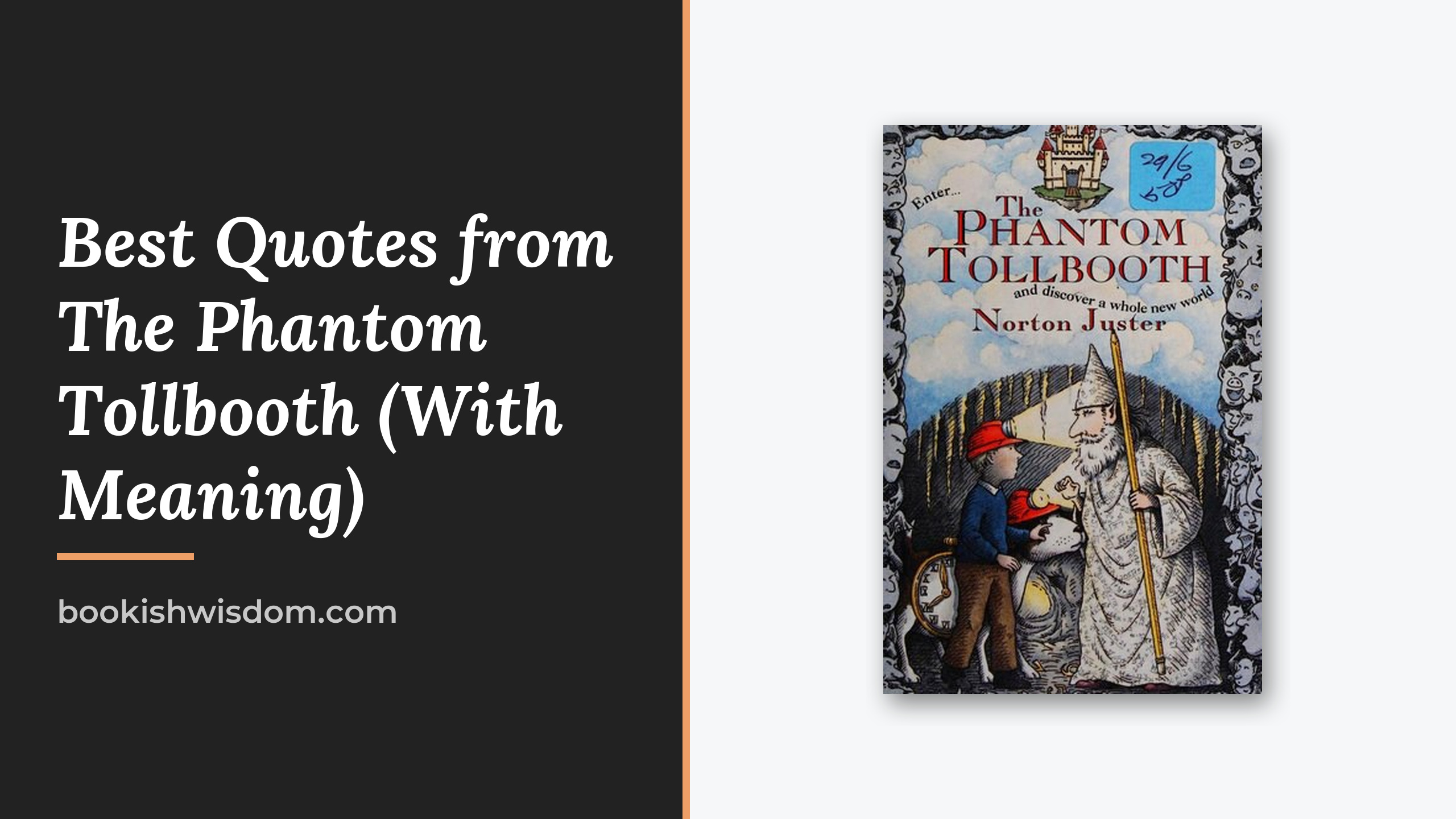
Milo is a boy who is bored by everything. One afternoon a mysterious tollbooth appears in his room, and he drives his toy car through it into the Kingdom of Wisdom. With Tock, a watchdog with a clock in his body, and the Humbug, a boastful insect, Milo sets out to rescue the princesses Rhyme and Reason, who have been banished. On the way he visits Dictionopolis, where words are sold, and Digitopolis, where numbers are mined. Jules Feiffer's drawings illustrate the book.
Check price of The Phantom Tollbooth on Amazon
The Best Quotes from The Phantom Tollbooth, Explained
1. “There was once a boy named Milo who didn't know what to do with himself—not just sometimes, but always.”
The opening line. Milo's boredom is the problem the book solves. By the end he has learned that the world is full of things to learn and do.
2. “So many things are possible just as long as you don't know they're impossible.”
The narrator, after Milo succeeds at a task. Milo achieves something because no one told him he could not. The line is a favorite for encouraging creativity and courage.
3. “Expect everything, I always say, and the unexpected never happens.”
The Whether Man. The Whether Man speaks in confusing, funny riddles. This one plays with logic in a way that makes readers think twice.
4. “Whether or not you find your own way, you're bound to find some way. If you happen to find my way, please return it, as it was lost years ago.”
The Whether Man. This is a perfect example of the book's wordplay. It is silly and also strangely wise about getting lost in life.
5. “You must never feel badly about making mistakes as long as you take the trouble to learn from them.”
Reason, one of the princesses. Reason comforts Milo after the journey. The line is a gentle lesson about learning, which is what the whole book is about.
Why These Lines Stay With Readers
The Phantom Tollbooth is full of puns and jokes that adults enjoy as much as children. Its quotes are used by teachers to show that learning can be an adventure.
How to Use These Quotes
- In an essay: introduce the quote, give its context in one sentence, then explain how it supports your point.
- For a book club: read one line aloud and ask whether everyone agrees with the speaker.
- For a caption or card: pick a short line and credit Norton Juster and The Phantom Tollbooth.
- For a reread: look for the moment each line appears and notice what changes around it.
A Note on Quoting The Phantom Tollbooth Accurately
Wording can differ slightly between editions, translations and film versions, and many lines shared online are paraphrased or misattributed. If you need an exact quote for an essay, check it against a printed copy of The Phantom Tollbooth and note the edition and page number. The lines above are given as they appear in the book, not as they were changed for later adaptations.
When you quote in an essay, keep the quotation short and let your own explanation do most of the work. A good pattern is to name the speaker, place the line in the story, quote it and then spend two or three sentences on what it shows. Quotes from The Phantom Tollbooth work best when they support a clear point about a character or theme, rather than standing alone.
Discussion Questions
- Which quote above best sums up The Phantom Tollbooth for you, and why?
- Do any of these lines mean something different once you know how the book ends?
- Which quote would you disagree with, and what would you say back?
If You Love the Writing in The Phantom Tollbooth
- Alice's Adventures in Wonderland by Lewis Carroll
- The Westing Game by Ellen Raskin
Related: The Phantom Tollbooth by Norton Juster: Summary and Key Takeaways · Themes in The Phantom Tollbooth Explained
Frequently Asked Questions
What is the most famous quote from The Phantom Tollbooth?
One of the best-known lines is “There was once a boy named Milo who didn't know what to do with himself—not just sometimes, but always.” (the opening line).
Who wrote The Phantom Tollbooth?
The Phantom Tollbooth was written by Norton Juster and first published in 1961.
Can I use quotes from The Phantom Tollbooth in an essay?
Yes. Short quotations with clear credit to Norton Juster are standard in essays and reviews. Always explain the quote in your own words.
What should I read after The Phantom Tollbooth?
Try Alice's Adventures in Wonderland by Lewis Carroll or The Westing Game by Ellen Raskin.