
Disclosure: As an Amazon Associate, Bookish Wisdom earns from qualifying purchases. This doesn't change our picks or your price.
TL;DR: Walter Isaacson's authorized biography traces Steve Jobs's life from his adoption and childhood in California to co-founding Apple, being forced out, building NeXT and Pixar, and returning to transform Apple with the iMac, iPod, iPhone and iPad. It shows a brilliant, demanding and often difficult man who changed technology.
Table of Contents
Steve Jobs at a Glance
| Author | Walter Isaacson |
| First published | 2011 |
| Type | Biography |
| Best for | readers who want an in-depth, candid portrait of a technology pioneer |
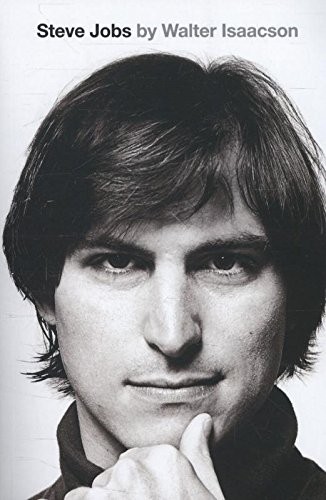
Steve Jobs is a biography by Walter Isaacson, published in 2011, weeks after Jobs's death. It is based on more than forty interviews with Jobs and over a hundred with family, friends and rivals. Below you will find a part-by-part summary, five key takeaways, ideas worth remembering and a note on who will enjoy it.
Content note: Includes illness and death.
Key Concepts
- Steve Jobs: The co-founder of Apple.
- Steve Wozniak: Jobs's engineering partner and Apple's co-founder.
- John Sculley: The Apple CEO who forced Jobs out.
- Laurene Powell Jobs: Jobs's wife.
- Jony Ive: Apple's design chief and Jobs's close collaborator.
The Main Ideas, Part by Part
Early life
Jobs was born in 1955 and adopted by Paul and Clara Jobs. He grew up in what became Silicon Valley, dropped out of Reed College, worked at Atari and traveled to India. With his friend Steve Wozniak, he started Apple in 1976 in his parents' garage.
Apple rises
The Apple II became a huge success. Jobs drove the creation of the Macintosh, launched in 1984 with a famous ad. His perfectionism and harsh treatment of staff caused conflict. In 1985, after a power struggle with CEO John Sculley, Jobs was forced out.
NeXT and Pixar
Jobs founded NeXT, a computer company, and bought the animation studio that became Pixar. Pixar's Toy Story, in 1995, was a huge hit and made Jobs a billionaire. In 1997, Apple bought NeXT, and Jobs returned.
The comeback
Back at Apple, Jobs cut product lines and launched the iMac, the iPod and iTunes, the Apple Stores, the iPhone in 2007 and the iPad in 2010. Apple became one of the world's most valuable companies.
Illness and legacy
Jobs was diagnosed with pancreatic cancer in 2003. He first delayed surgery, a choice he later regretted. He had a liver transplant in 2009 and stepped down as CEO in August 2011. He died on October 5, 2011, at age 56.
5 Key Takeaways
- Passion and focus drive innovation.
- Simplicity is a powerful design principle.
- Great products come from combining art and technology.
- Brilliant leaders can also be difficult people.
- Failure can lead to comeback.
Ideas Worth Remembering
These are paraphrased, not direct quotes:
- Stay hungry, stay foolish.
- Simplicity is the ultimate sophistication.
- The people who are crazy enough to think they can change the world are the ones who do.
Who Should Read Steve Jobs?
Read Steve Jobs if you want an honest, detailed biography of a technology icon. It suits adults and older teens interested in business and design.
Questions to Think About After Reading
These prompts work for solo reading, a book club or a classroom discussion of Steve Jobs:
- Was Jobs's harshness necessary for his success?
- What made Apple's products different?
- What does his return to Apple teach about failure?
How to Use This Summary
Use this page as a quick reference before a book club meeting, an exam, or a decision about whether Steve Jobs is worth your time. The takeaways are written to stand on their own. If a point interests you, go back to the book for the author's full argument, examples and evidence, which no short summary can replace.
A Note on Accuracy and Spoilers
This summary is based on the published text of Steve Jobs, not on any film, series or stage adaptation, which often change the story. Details are kept at the level of the main arguments so that nothing is invented. Editions differ slightly in length and wording, so page numbers and small details may vary between copies.
Should You Read the Book?
Yes, if you want the fullest single account of Jobs's life. Isaacson does not flatter him, showing both his genius and his cruelty to people close to him. At over 600 pages, it is long, and some readers wish it said more about how Apple's products were engineered, but it is a remarkable portrait.
Check price of Steve Jobs on Amazon
What to Read Next
- Elon Musk by Walter Isaacson: Isaacson's biography of another tech leader
- Becoming Steve Jobs by Brent Schlender and Rick Tetzeli: a softer portrait
- iWoz by Steve Wozniak: Wozniak's own story
Related: 15 Books Like Steve Jobs You’ll Love
Frequently Asked Questions
What is Steve Jobs about?
The authorized biography of Apple's co-founder.
Who wrote it?
Walter Isaacson.
Was Jobs involved?
Yes, he sat for many interviews but did not control the content.
When did Jobs die?
October 5, 2011.
Why was Jobs fired from Apple?
After a power struggle with CEO John Sculley in 1985.
What is the reality distortion field?
Jobs's ability to convince people the impossible was possible.
Is there a film?
Yes, the 2015 film Steve Jobs, partly based on the book.
How long is it?
Over 600 pages.
What did Jobs say about Pixar?
He saw it as proof that art and technology together could create something magical.
Who are the main ideas in Steve Jobs?
The key concepts are Steve Jobs, Steve Wozniak, John Sculley, Laurene Powell Jobs and Jony Ive. Steve Jobs: The co-founder of Apple. Steve Wozniak: Jobs's engineering partner and Apple's co-founder. John Sculley: The Apple CEO who forced Jobs out.
Is Steve Jobs worth reading?
It depends on what you want. The book is best for readers who want an in-depth, candid portrait of a technology pioneer. If that describes you, it is likely a good fit. If not, the titles under What to Read Next may suit you better.