
Disclosure: As an Amazon Associate, Bookish Wisdom earns from qualifying purchases. This doesn't change our picks or your price.
TL;DR: Physicist Shevek lives on Anarres, a dry moon where settlers built an anarchist society without government, money or private property. Frustrated by the limits on his research, he becomes the first person in over a century to travel to Urras, the rich, unequal planet his ancestors left. Between the two worlds, he searches for freedom and for a theory that could connect civilizations.
Table of Contents
The Dispossessed at a Glance
| Author | Ursula K. Le Guin |
| First published | 1974 |
| Type | Science fiction |
| Best for | readers who want a deep, thoughtful science fiction novel about politics and freedom |
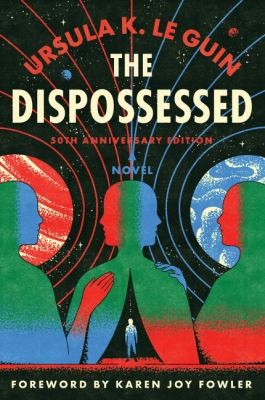
The Dispossessed is a science fiction novel by Ursula K. Le Guin, published in 1974. It won the Hugo, Nebula and Locus Awards and is subtitled “An Ambiguous Utopia.” Below you will find a part-by-part summary, five key takeaways, ideas worth remembering and a note on who will enjoy it.
Content note: Includes political violence, famine, police brutality and sexual content.
Main Characters
- Shevek: A brilliant physicist from Anarres.
- Takver: Shevek's partner, a biologist.
- Bedap: Shevek's friend, who criticizes Anarres from within.
- Sabul: A senior physicist who takes credit for Shevek's work.
- Vea: A wealthy woman Shevek meets on Urras.
What Happens, Part by Part (Contains Spoilers)
Two worlds
The novel alternates between Shevek's past on Anarres and his present on Urras. Anarres was settled by followers of the thinker Odo, who left Urras to build a society based on sharing. People there choose their own work and share everything, but resources are scarce. Urras is rich and beautiful, but divided by class, with powerful states competing for power.
Life on Anarres
Shevek grows up in a community where selfishness is discouraged. He studies physics and works on a General Temporal Theory, a way of uniting ideas about time. But Sabul, a senior scientist, blocks and steals his work. Shevek learns that public opinion and habit can be as limiting as laws. He falls in love with Takver, and they have children.
Hard times
A long drought brings famine to Anarres. Shevek is sent to do hard labor and is separated from Takver. He sees people sacrifice for each other, but also sees that society has grown rigid. With Bedap, he starts a group to share ideas freely and to contact Urras, which many on Anarres see as betrayal.
Urras
On Urras, Shevek is welcomed by a university in the nation of A-Io, which wants his theory for its own power. He is shocked by luxury, by poverty and by how people treat women and workers. He attends a party with Vea, who shows him wealth and desire. When he joins a huge workers' demonstration, the police open fire, and Shevek flees.
Return
Shevek finds refuge in the embassy of Terra, Earth, whose ambassador tells him Earth was nearly destroyed by greed and war. Shevek decides to share his theory with all worlds by radio so no single nation can own it. The theory makes possible the ansible, a device for instant communication across space. He returns home to Anarres with a visitor from another world.
5 Key Takeaways
- No society is perfect.
- Freedom must be renewed, not just declared.
- Knowledge should be shared, not owned.
- Wealth can create both comfort and injustice.
- Social pressure can limit freedom as much as laws.
Ideas Worth Remembering
These are paraphrased, not direct quotes:
- Utopias need constant questioning.
- Walls can be built in the mind.
- Real change begins with people who dare to cross borders.
Who Should Read The Dispossessed?
Read The Dispossessed if you enjoy political science fiction, big ideas and thoughtful characters. It suits adults and older teens.
About Ursula K. Le Guin
Ursula K. Le Guin (1929–2018) was an American writer of science fiction and fantasy. Her works include the Earthsea series, The Left Hand of Darkness and The Lathe of Heaven. She won many Hugo and Nebula Awards and the National Book Foundation Medal in 2014. Her Hainish Cycle, which includes The Dispossessed, imagines many human worlds linked across space.
Questions to Think About After Reading
These prompts work for solo reading, a book club or a classroom discussion of The Dispossessed:
- Is Anarres a utopia?
- What does Shevek learn on Urras?
- Why does he share his theory with everyone?
How to Use This Summary
Use this page as a quick reference before a book club meeting, an exam, or a decision about whether The Dispossessed is worth your time. The takeaways are written to stand on their own. If a point interests you, go back to the book for the author's full story, characters and style, which no short summary can replace.
A Note on Accuracy and Spoilers
This summary is based on the published text of The Dispossessed, not on any film, series or stage adaptation, which often change the story. Details are kept at the level of the main events so that nothing is invented. Editions differ slightly in length and wording, so page numbers and small details may vary between copies.
Should You Read the Book?
Yes. It is one of the great novels of ideas in science fiction.
Check price of The Dispossessed on Amazon
What to Read Next
- The Left Hand of Darkness by Ursula K. Le Guin: another Hainish classic
- Walden Two by B.F. Skinner: a novel about an ideal community
- Red Mars by Kim Stanley Robinson: settlers debate how to build a new society
Related: The Ones Who Walk Away from Omelas by Ursula K. Le Guin: Summary and Key Takeaways · A Wizard of Earthsea by Ursula K. Le Guin: Summary and Key Takeaways
Frequently Asked Questions
What is The Dispossessed about?
A physicist from an anarchist moon travels to a rich, unequal planet.
Who wrote it?
Ursula K. Le Guin, in 1974.
What is Anarres?
A moon where people live without government or property.
What is Urras?
A rich planet with class divisions and competing nations.
What is the General Temporal Theory?
Shevek's theory of time, which makes instant communication possible.
What is the ansible?
A device for instant communication across space.
What does “An Ambiguous Utopia” mean?
That the ideal society has flaws as well as strengths.
Did it win awards?
Yes, the Hugo, Nebula and Locus Awards.
Is it part of a series?
Yes, the Hainish Cycle, but it stands alone.
What age is it for?
Adults and older teens.
How long is it?
About 390 pages.
Is it political?
Yes, it explores anarchism and capitalism.
Is The Dispossessed a good first Le Guin book?
Yes, for readers who enjoy ideas. Readers who prefer fantasy could start with A Wizard of Earthsea.
Is The Dispossessed worth reading?
It depends on what you want. The book is best for readers who want a deep, thoughtful science fiction novel about politics and freedom. If that describes you, it is likely a good fit. If not, the titles under What to Read Next may suit you better.