
Disclosure: As an Amazon Associate, Bookish Wisdom earns from qualifying purchases. This doesn't change our picks or your price.
TL;DR: In a future shaped by nanotechnology, a poor girl named Nell receives a stolen copy of an extraordinary interactive book, the Young Lady's Illustrated Primer, designed to educate a rich aristocrat's granddaughter. The Primer teaches Nell to read, fight and think for herself. As she grows, she becomes part of a struggle that changes the future of China and the world.
Table of Contents
The Diamond Age at a Glance
| Author | Neal Stephenson |
| First published | 1995 |
| Type | Science fiction |
| Best for | readers who want a rich, inventive science fiction novel about education and technology |
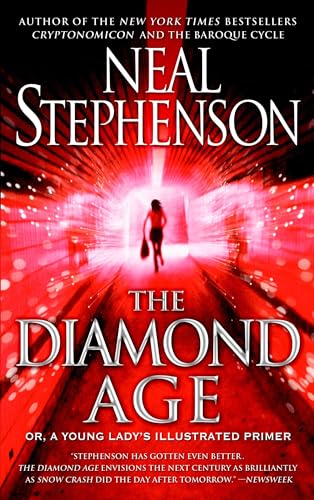
The Diamond Age: Or, A Young Lady's Illustrated Primer is a science fiction novel by Neal Stephenson, published in 1995. It won the Hugo and Locus Awards. Below you will find a part-by-part summary, five key takeaways, ideas worth remembering and a note on who will enjoy it.
Content note: Includes child abuse, violence, war and sexual content.
Main Characters
- Nell: A poor girl who receives the Primer.
- John Percival Hackworth: An engineer who creates the Primer.
- Lord Finkle-McGraw: A powerful aristocrat who commissions the Primer.
- Miranda: An actress who secretly voices the Primer's stories.
- Dr. X: A mysterious figure in the Chinese underworld.
What Happens, Part by Part (Contains Spoilers)
A world of matter
In the future, nanotechnology lets people build almost anything from tiny machines. Society is divided into “phyles,” communities based on shared culture rather than nation. The neo-Victorian phyle of New Atlantis lives near Shanghai and values manners and discipline. Lord Finkle-McGraw hires engineer Hackworth to create the Primer, an interactive book to help his granddaughter grow independent and clever.
A stolen book
Hackworth secretly makes a second copy for his own daughter, Fiona, with the help of the shady Dr. X. On the way home, he is mugged, and the copy is taken. The thief, a boy named Harv, gives it to his little sister Nell, who lives in poverty with a neglectful mother and dangerous men. Nell begins to read.
Learning with the Primer
The Primer tells Nell stories in which Princess Nell faces challenges and learns. The stories teach her to read, defend herself and solve problems. The voice of the Primer is performed by Miranda, a remote actor who does not know who Nell is but grows to love her. Nell escapes her abusive home and gets an education at a neo-Victorian school.
Hackworth's punishment
Hackworth's crime is discovered. As punishment, he spends ten years among the Drummers, an underground group that forms a strange collective mind. Meanwhile, Dr. X uses copies of the Primer to raise thousands of abandoned Chinese girls. A violent movement, the Fists of Righteous Harmony, rises against foreign influence in China.
Nell's rise
Grown and independent, Nell faces danger as China breaks into conflict. The girls raised by the Primer, called the Mouse Army, recognize her as their leader. Nell completes the Primer's final challenges, rescues Miranda, and leads the girls into a new future. The book suggests that education and imagination can shape a person, and even a society.
5 Key Takeaways
- Education can transform a life.
- Technology reflects the values of those who design it.
- Culture shapes community more than borders.
- Love and care matter as much as information.
- Independence must be learned.
Ideas Worth Remembering
These are paraphrased, not direct quotes:
- Good teachers adapt to each learner.
- Stories can teach courage and problem-solving.
- Even the most advanced technology needs a human touch.
Who Should Read The Diamond Age?
Read The Diamond Age if you enjoy inventive science fiction, stories about education and complex world-building. It suits adults.
About Neal Stephenson
Neal Stephenson (born 1959) is an American writer who often explores technology, history and society. His novel Snow Crash is a cyberpunk classic, and Cryptonomicon and the Baroque Cycle combine history with ideas about information. The Diamond Age inspired real-world projects in educational technology and is often cited by people who build learning software.
Questions to Think About After Reading
These prompts work for solo reading, a book club or a classroom discussion of The Diamond Age:
- How does the Primer shape Nell's personality?
- Why is Miranda's role so important?
- What does the novel say about class and opportunity?
How to Use This Summary
Use this page as a quick reference before a book club meeting, an exam, or a decision about whether The Diamond Age is worth your time. The takeaways are written to stand on their own. If a point interests you, go back to the book for the author's full story, characters and style, which no short summary can replace.
A Note on Accuracy and Spoilers
This summary is based on the published text of The Diamond Age, not on any film, series or stage adaptation, which often change the story. Details are kept at the level of the main events so that nothing is invented. Editions differ slightly in length and wording, so page numbers and small details may vary between copies.
Should You Read the Book?
Yes. It is dense, but its ideas about learning and technology are fascinating.
Check price of The Diamond Age on Amazon
What to Read Next
- Snow Crash by Neal Stephenson: an earlier, wilder Stephenson novel
- Neuromancer by William Gibson: the classic cyberpunk novel
- Ender's Game by Orson Scott Card: a gifted child shaped by special training
Related: Cryptonomicon by Neal Stephenson: Summary and Key Takeaways
Frequently Asked Questions
What is The Diamond Age about?
A poor girl learns from a stolen interactive book and grows into a leader.
Who wrote it?
Neal Stephenson, in 1995.
What is the Primer?
An interactive book that teaches and adapts to its reader.
Who is Nell?
The poor girl who receives the Primer.
Who voices the Primer?
Miranda, a remote actress.
What is nanotechnology?
Technology that builds things from tiny, molecule-sized machines.
What are phyles?
Communities based on shared culture, not countries.
Did it win awards?
Yes, the Hugo and Locus Awards.
What age is it for?
Adults.
How long is it?
About 500 pages.
Is it hard to read?
It is dense, with many invented terms.
Has it inspired real technology?
Yes. Some educational tech projects cite the Primer as inspiration.
Is the ending clear?
Some readers find it abrupt, as Stephenson's endings often are.
Is The Diamond Age worth reading?
It depends on what you want. The book is best for readers who want a rich, inventive science fiction novel about education and technology. If that describes you, it is likely a good fit. If not, the titles under What to Read Next may suit you better.