
Disclosure: As an Amazon Associate, Bookish Wisdom earns from qualifying purchases. This doesn't change our picks or your price.
TL;DR: Physics student William Mandella is drafted into an elite force to fight the Taurans, an alien species humans barely understand. Because soldiers travel near the speed of light, a few months for them means decades or centuries on Earth. Each time Mandella returns home, Earth has changed beyond recognition, and the war seems more pointless than ever.
Table of Contents
The Forever War at a Glance
| Author | Joe Haldeman |
| First published | 1974 |
| Type | Military science fiction |
| Best for | readers who want a powerful anti-war science fiction novel shaped by the Vietnam era |
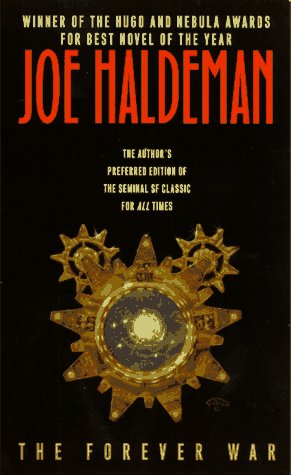
The Forever War is a science fiction novel by Joe Haldeman, published in 1974. It won the Hugo, Nebula and Locus Awards and is often read as a response to the Vietnam War. Below you will find a part-by-part summary, five key takeaways, ideas worth remembering and a note on who will enjoy it.
Content note: Includes graphic war violence, death, drug use and sexual content.
Main Characters
- William Mandella: A soldier who fights across more than a thousand years.
- Marygay Potter: A fellow soldier and Mandella's great love.
- The Taurans: The alien enemy humans are fighting.
- Captain Stott: A harsh early commander.
- Man: A future human collective that appears at the end.
What Happens, Part by Part (Contains Spoilers)
Drafted
In 1997, Mandella and other highly intelligent young people are drafted into the United Nations Exploratory Force after a human ship is supposedly attacked by aliens called Taurans. They train in brutal conditions on the frozen planet Charon, where many recruits die. Soldiers travel through “collapsars,” a kind of shortcut between stars, and the time effects of near-light speed mean years pass at home.
First battle
The soldiers land on a Tauran planet and attack a base. The Taurans hardly fight back, and the humans, under hypnotic conditioning, massacre them. Mandella is shaken. When the unit returns to Earth, twenty-two years have passed for those at home, even though they have aged only two.
A changed Earth
Earth is now crowded, violent and expensive. Governments control almost everything, and people struggle to find meaning. Mandella and Marygay feel like strangers. Mandella's mother dies. Unable to fit in, they re-enlist, hoping at least to stay together. But the army separates them, sending them on missions that will place centuries between them.
A stranger in his own army
Mandella is promoted to major and given command of a unit. Centuries have passed, and Earth's culture is completely different. Many of his soldiers speak a new form of English, and he feels like an outsider. They fight a long, bloody battle on a distant planet where both sides use slow weapons because of a field that stops fast ones. Many soldiers die.
The end of the war
When the battle ends, Mandella learns that the war is over. It lasted 1,143 years and began from a misunderstanding: the Taurans had not started the attack. Humanity has evolved into “Man,” a single cloned collective that can communicate with the Taurans. Marygay, who used near-light travel to wait for him, is alive. They reunite on a planet for veterans and start a family.
5 Key Takeaways
- War can rest on lies and misunderstandings.
- Soldiers often return to a world that no longer fits them.
- Time dilation turns distance into a kind of exile.
- Military systems can treat people as tools.
- Love can endure across centuries.
Ideas Worth Remembering
These are paraphrased, not direct quotes:
- Questioning why a war started is essential.
- Change at home can be as shocking as battle.
- Communication could prevent many conflicts.
Who Should Read The Forever War?
Read The Forever War if you enjoy military science fiction, anti-war stories and books based on real experience. It suits adults.
About Joe Haldeman
Joe Haldeman (born 1943) is an American science fiction writer who served as a combat engineer in Vietnam, where he was seriously wounded. The Forever War drew on his experiences. He later wrote Forever Peace and Forever Free, which explore related themes. He has won multiple Hugo and Nebula Awards and was named a Grand Master by the Science Fiction and Fantasy Writers of America.
Questions to Think About After Reading
These prompts work for solo reading, a book club or a classroom discussion of The Forever War:
- How does the book reflect the experience of Vietnam veterans?
- Why is time dilation so important to the story?
- Was the war's ending hopeful or bitter?
How to Use This Summary
Use this page as a quick reference before a book club meeting, an exam, or a decision about whether The Forever War is worth your time. The takeaways are written to stand on their own. If a point interests you, go back to the book for the author's full story, characters and style, which no short summary can replace.
A Note on Accuracy and Spoilers
This summary is based on the published text of The Forever War, not on any film, series or stage adaptation, which often change the story. Details are kept at the level of the main events so that nothing is invented. Editions differ slightly in length and wording, so page numbers and small details may vary between copies.
Should You Read the Book?
Yes. It is gripping and thoughtful, and its message about war feels timeless.
Check price of The Forever War on Amazon
What to Read Next
- Starship Troopers by Robert A. Heinlein: the classic military SF novel Haldeman responds to
- Old Man's War by John Scalzi: soldiers in an interstellar war
- Slaughterhouse-Five by Kurt Vonnegut: a powerful anti-war classic
Frequently Asked Questions
What is The Forever War about?
A soldier fights an interstellar war that lasts more than a thousand years because of time dilation.
Who wrote it?
Joe Haldeman, in 1974.
Who are the Taurans?
The alien species humans are at war with.
Why does time pass so quickly at home?
Because near-light-speed travel slows time for the soldiers.
How long does the war last?
1,143 years.
Why did the war start?
Through a misunderstanding.
Does Mandella find Marygay again?
Yes, at the end.
Did it win awards?
Yes, the Hugo, Nebula and Locus Awards.
Is it based on Vietnam?
It is inspired by Haldeman's experiences in Vietnam.
What age is it for?
Adults.
How long is it?
About 280 pages.
Are there sequels?
Yes, Forever Free, and a related novel, Forever Peace.
Is The Forever War a good first military SF book?
Yes. It is short and thoughtful, and it gives a very different view of war than most action-focused space novels.
Is The Forever War worth reading?
It depends on what you want. The book is best for readers who want a powerful anti-war science fiction novel shaped by the Vietnam era. If that describes you, it is likely a good fit. If not, the titles under What to Read Next may suit you better.