

Disclosure: As an Amazon Associate, Bookish Wisdom earns from qualifying purchases. This doesn’t change our picks or your price.
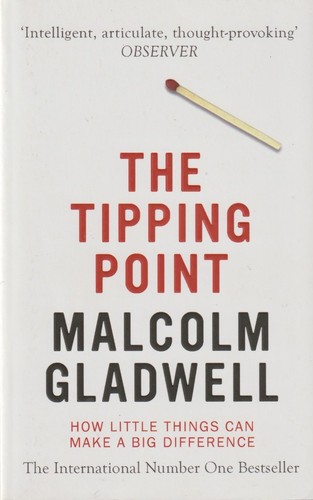
TL;DR: The Tipping Point: How Little Things Can Make a Big Difference by Malcolm Gladwell argues that ideas, products and behaviors spread like epidemics. Three rules explain the sudden jump: the Law of the Few (connectors, mavens and salesmen), the Stickiness Factor (a message that sticks) and the Power of Context (small changes in surroundings that shift behavior).
Why did Hush Puppies suede shoes go from dying brand to fashion hit almost overnight? Why did crime in New York City fall so sharply in the 1990s? In The Tipping Point, first published in 2000, Malcolm Gladwell, a staff writer at The New Yorker, answers with one big idea: change often arrives in a sudden rush, and a few small forces trigger it. The book is easy to read, full of stories and became a business and culture classic. It’s also been debated, since some of its examples are simplified. Here’s a summary of its main ideas.
Table of Contents
The Tipping Point at a Glance
| Detail | Info |
|---|---|
| Author | Malcolm Gladwell |
| Published | 2000 |
| Genre | Social science, popular psychology, business |
| Core idea | Small causes can tip a trend into a sudden epidemic |
| Structure | Three rules of epidemics, followed by case studies |
| Best for | Marketers, founders, teachers and anyone curious about how trends spread |
What Is The Tipping Point About?
Gladwell borrows the language of epidemiology. A flu outbreak can stay small for weeks and then explode once it reaches a critical point, which he calls the tipping point. He suggests that fashion, crime, word of mouth and even teenage smoking behave in a similar way: they start with a few people, then spread rapidly when the conditions are right.
He offers three rules that explain how epidemics start. The first is the Law of the Few, the second is the Stickiness Factor and the third is the Power of Context. Most of the book explores these rules through stories, studies and case examples.
Key Ideas, Part by Part
The Law of the Few
Gladwell says that a small group of people does most of the work in spreading an idea. He describes three types. Connectors know a huge number of people across different social worlds and bring them together. He tells the story of Paul Revere, who rode through the night of April 18, 1775 to warn colonists, and argues that Revere was a connector whose wide network helped the message spread, while William Dawes, who rode a different route, had a much smaller effect.
Mavens are information specialists who collect knowledge and love to share it, such as the friend who always knows the best deal. Salesmen are persuaders with a charisma that makes people want to agree with them. When connectors, mavens and salesmen all pick up an idea, it travels far faster than usual.
The Stickiness Factor
An idea can reach a lot of people and still fail if it doesn’t stick. Gladwell studies children’s programs such as Sesame Street and Blue’s Clues. The creators of Sesame Street tested which scenes held children’s attention, then reshaped the show to keep it. Blue’s Clues used repetition, direct address and a slower pace, and tested episodes repeatedly to make learning memorable.
The lesson is that small changes in presentation, such as a clearer message or an easier format, can make a big difference in whether people remember and act. Stickiness is often about packaging, not about changing the core idea.
The Power of Context
The third rule says that people are strongly influenced by their environment. Gladwell discusses the broken windows theory, which holds that visible signs of disorder, such as graffiti or broken windows, invite more crime. He recounts how New York’s transit system cleaned graffiti off subway cars and cracked down on fare evasion, and how the city saw crime fall in the 1990s. He presents this as evidence that small changes in context can influence behavior.
He also discusses the Stanford prison experiment, in which volunteers playing guards and prisoners quickly adopted harsh roles, to illustrate that situations shape behavior more than we expect. Later critics have questioned that experiment’s methods, so many readers treat it with caution.
Another idea in this part is the rule of 150. Gladwell cites anthropologist Robin Dunbar’s suggestion that humans can maintain stable social relationships with around 150 people, and shows how the company W. L. Gore kept its plants to about that size so that people knew one another.
Case Studies
The later chapters apply the three rules. Gladwell looks at how Hush Puppies became fashionable after a few trendsetters in downtown Manhattan began wearing them, and how sales then exploded. He explores a syphilis outbreak in Baltimore in the 1990s, tracing how changes in the environment, including the rise of crack cocaine and the closing of clinics, tipped an epidemic. He also looks at teenage smoking and suicide trends in Micronesia, using them to show how behaviors can spread through peer influence.
Throughout, his advice is practical: to start a positive epidemic, find the right messengers, make the message memorable and shape the environment.
6 Key Takeaways From The Tipping Point
- Small causes can have large effects. Change doesn’t always move in a straight line; it can jump.
- A few people matter a lot. Connectors, mavens and salesmen spread ideas faster.
- Stickiness is a design problem. How a message is packaged affects whether it’s remembered.
- Context shapes behavior. Cleaner, safer, clearer settings guide how people act.
- Group size matters. Close communities may work best below about 150 people.
- Focus your energy. Put effort where it creates the most leverage.
Ideas Worth Remembering
- Trends often spread slowly, then suddenly. (paraphrased)
- The messenger is as important as the message. (paraphrased)
- Small changes to an environment can change big behaviors. (paraphrased)
- Ask whether your message is memorable, not just whether it’s true. (paraphrased)
How to Apply The Tipping Point in Real Life
- Find your connectors. Identify people in your community who link different groups, and share your idea with them first.
- Test for stickiness. Try different wording and formats and see which one people remember.
- Tweak the context. Change a setting, such as layout or defaults, to make good choices easier.
- Keep groups small. Break big teams into smaller units where people know one another.
- Be patient, then ready. Keep investing in small efforts, since a tipping point may arrive suddenly.
Criticisms and Limits
Critics point out that many of the book’s examples are simplified. Researchers have questioned whether the broken windows theory fully explains New York’s crime drop, since crime fell in many cities for several reasons. Others note that the Stanford prison experiment has faced strong criticism. Studies of how things spread online also suggest that ordinary people, not only influencers, often drive trends.
The book is best read as a set of useful lenses and stories, not as a formula. Gladwell’s own writing style favors compelling narrative over rigorous proof, so check big claims before relying on them.
How Marketers and Teachers Use the Ideas
Many marketers apply the book by seeking out influential early adopters rather than advertising to everyone at once. A bookshop might invite local book club leaders to a preview, knowing they will pass recommendations along. Teachers use stickiness by adding stories, repetition and hands-on activities to lessons. Public health groups use context by changing defaults, such as placing healthy foods at eye level. The common thread is to look for small, well-placed actions that make an idea easier to spread.
A Simple Tipping Point Plan
If you want to apply the book, try a three-step plan. First, write your idea in one sentence and test whether a friend can repeat it back a day later. Second, list ten people who could carry it, and think about whether each is a connector, a maven or a salesperson. Third, change one thing about the setting, like a link, a sign or a default option, that makes acting on the idea easier. Review results after a month and adjust.
Epidemic Language in Everyday Life
Gladwell’s vocabulary has become common. People talk about ideas going viral, messages being sticky and products reaching a tipping point. It’s helpful to remember that these are metaphors, and that real adoption is often less sudden than the stories suggest. Even so, the language gives you questions to ask about any trend: who started it, why did it stay in people’s minds and what about the setting helped it grow?
The Tipping Point in One Minute
Epidemics of ideas start small and then jump. Three rules explain the jump. The Law of the Few says connectors, mavens and salesmen carry ideas. The Stickiness Factor says the message must be memorable. The Power of Context says surroundings shape behavior more than we expect. To spark a positive trend, find the right messengers, polish the message until it sticks and adjust the setting so that people find it easy to act. Expect slow progress, then sudden change.
Who Might Be Your Connector, Maven and Salesperson?
A helpful exercise is to look around your own community. The connector is the friend who seems to know everyone and who introduces people to one another. The maven is the person who researches every purchase and loves to share what they learn. The salesperson is the one who can persuade a group to try a new restaurant or join a cause. If you’re launching a project, ask which of these people might be willing to try it first, and give them an easy way to pass it on, such as a short message, a sample or an invitation.
Books to Pair With It
The Tipping Point works well with books that look at persuasion and memory. Made to Stick explains the traits of ideas that last, Influence covers the psychology of saying yes and Contagious studies the features of products that people talk about. For more of Gladwell’s storytelling, read Outliers and Blink. Reading two or three of these together helps you separate the compelling stories from the repeatable lessons.
Who Should Read The Tipping Point?
Read it if you work in marketing, product, teaching or community building, or if you simply enjoy stories about how the world changes. It’s quick and entertaining. If you want more rigorous research on persuasion, pair it with a book like Influence, and for hands-on advice on making ideas memorable, try Made to Stick.
What to Read Next
- Made to Stick by Chip Heath and Dan Heath a guide to making ideas memorable
- Blink by Malcolm Gladwell how quick judgments work
- Contagious by Jonah Berger the science of why things catch on
Related: Outliers summary and key takeaways and Thinking, Fast and Slow summary and key takeaways.
Frequently Asked Questions
What is the main idea of The Tipping Point?
That ideas and trends spread like epidemics, and that small changes can trigger sudden, large effects.
What are the three rules of The Tipping Point?
The Law of the Few, the Stickiness Factor and the Power of Context.
Who are connectors, mavens and salesmen?
Connectors link many social groups, mavens collect and share knowledge, and salesmen persuade others.
Is The Tipping Point still relevant?
Yes, as a way to think about trends, though some examples are simplified or have been challenged.
What should I read after The Tipping Point?
Try Blink, Outliers or Made to Stick.