
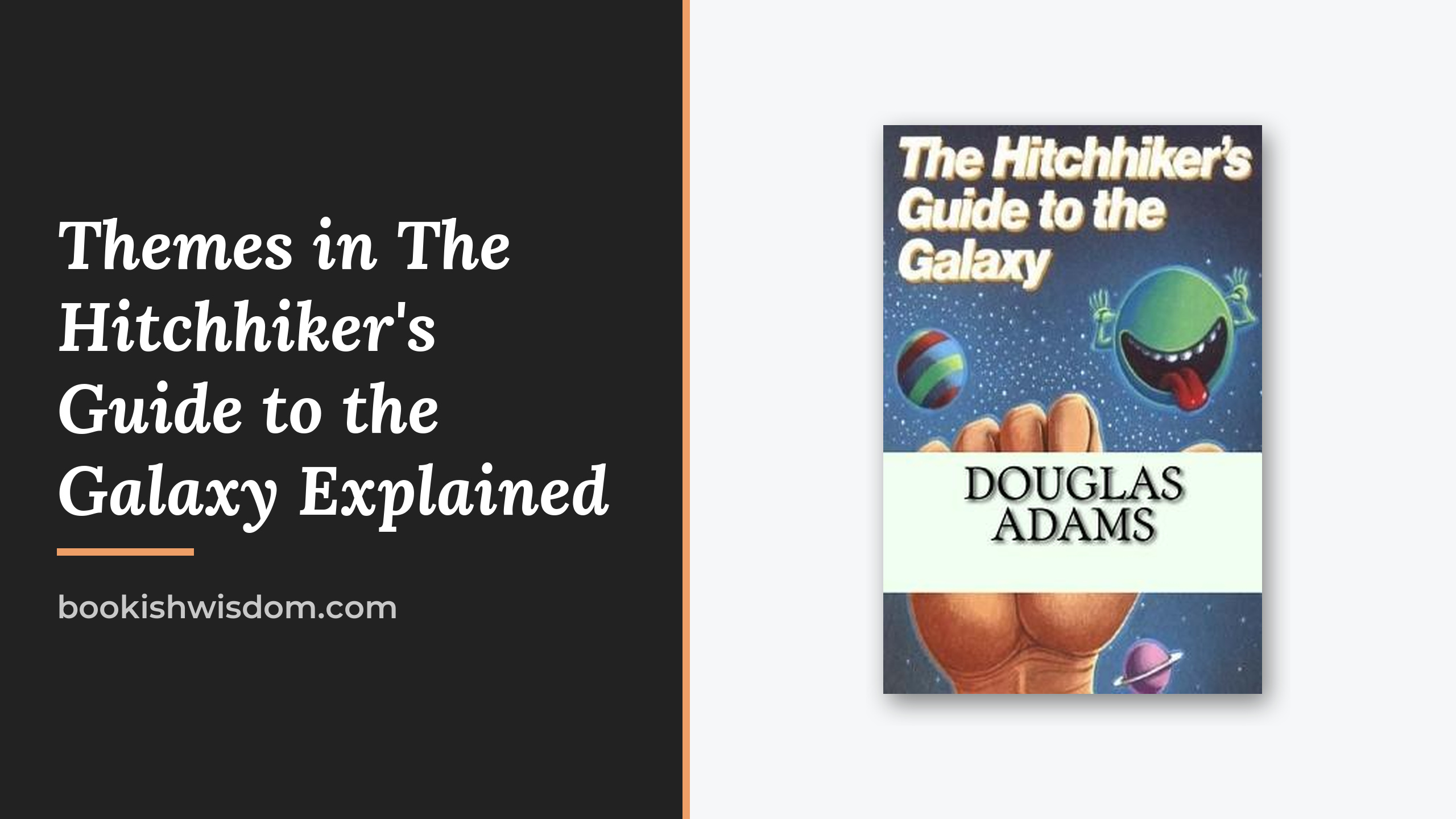
Disclosure: As an Amazon Associate, Bookish Wisdom earns from qualifying purchases. This doesn't change our picks or your price.
Spoiler warning: this analysis discusses the whole book, including the ending of The Hitchhiker's Guide to the Galaxy.
Quick answer: The main themes in The Hitchhiker's Guide to the Galaxy by Douglas Adams are absurdity and meaning, bureaucracy, technology, humanity's place in the universe and friendship and survival. Each is explained below with what it means, how it develops in the story and questions you can use for study or discussion.
Quick facts
- Book: The Hitchhiker's Guide to the Galaxy by Douglas Adams
- First published: 1979
- Main themes: absurdity and meaning, bureaucracy, technology, humanity's place in the universe and friendship and survival
Table of Contents
About The Hitchhiker's Guide to the Galaxy
Seconds before Earth is demolished to make way for a hyperspace bypass, ordinary Englishman Arthur Dent is rescued by his friend Ford Prefect, who turns out to be an alien researcher for the Hitchhiker's Guide to the Galaxy. Wearing his dressing gown and carrying a towel, Arthur is swept through space alongside the two-headed president Zaphod Beeblebrox, the clever Trillian and Marvin, a depressed robot. Their journey leads to the legendary planet Magrathea and the answer to life, the universe and everything: forty-two.
Check price of The Hitchhiker's Guide to the Galaxy on Amazon
The Main Themes in The Hitchhiker's Guide to the Galaxy
1. Absurdity and meaning
The universe in the novel is ridiculous and random. Adams uses comedy to explore the search for meaning, suggesting that the right question may be harder to find than the answer.
Question to consider: Where in The Hitchhiker's Guide to the Galaxy does absurdity and meaning matter most to the characters, and what does Douglas Adams want readers to think about it?
2. Bureaucracy
Earth is destroyed because of a planning notice no one read. Adams mocks official rules and paperwork that ignore common sense and human lives.
Question to consider: Where in The Hitchhiker's Guide to the Galaxy does bureaucracy matter most to the characters, and what does Douglas Adams want readers to think about it?
3. Technology
Supercomputers, robots and ships with improbability drives show technology as both amazing and absurd. Marvin's misery and the Guide's quirks show machines with human flaws.
Question to consider: Where in The Hitchhiker's Guide to the Galaxy does technology matter most to the characters, and what does Douglas Adams want readers to think about it?
4. Humanity's place in the universe
Arthur discovers that Earth was a giant computer built by mice. The novel cheerfully cuts humans down to size, inviting readers to see themselves with humility.
Question to consider: Where in The Hitchhiker's Guide to the Galaxy does humanity's place in the universe matter most to the characters, and what does Douglas Adams want readers to think about it?
5. Friendship and survival
Arthur survives through luck and his unlikely companions. The book shows that friendship and a good towel help people cope with an overwhelming universe.
Question to consider: Where in The Hitchhiker's Guide to the Galaxy does friendship and survival matter most to the characters, and what does Douglas Adams want readers to think about it?
Symbols and Motifs
- The towel. It represents preparedness and the comfort of small things.
- Forty-two. The number symbolises the absurd search for meaning.
- The Guide. Its “Don't Panic” cover represents calm in chaos.
- Marvin. The robot stands for intelligence weighed down by gloom.
How the Themes Connect
Absurdity runs through everything, while the search for meaning gives it heart. Bureaucracy and technology are satirised as forces that make the universe stranger, and humanity's small place in it is played for laughs. Friendship and survival remind readers that, in a chaotic universe, the best advice is still “Don't Panic.”
How to Write About the Themes of The Hitchhiker's Guide to the Galaxy
If you are writing an essay or preparing for class, these steps help:
- Pick one theme. A focused argument is stronger than a list of everything.
- Find evidence in the text. Point to specific scenes, characters and choices rather than general impressions.
- Explain, don't just describe. After each example, say what it shows about the theme.
- Connect to the ending. Ask how the final chapters resolve or complicate the theme.
- Consider other readings. A fair essay acknowledges that readers can disagree.
Discussion Questions
- Which of the themes above feels most relevant to your own life, and why?
- Do the characters in The Hitchhiker's Guide to the Galaxy handle absurdity and meaning well or badly?
- How does the title relate to the themes of the book?
- Would the story change if it were set in a different time or place?
- What does Douglas Adams leave unresolved, and why might that be?
Books With Similar Themes
- The Restaurant at the End of the Universe by Douglas Adams
- Good Omens by Terry Pratchett and Neil Gaiman
Related: The Hitchhiker’s Guide to the Galaxy by Douglas Adams: Summary and Key Takeaways · The Hitchhiker’s Guide to the Galaxy Ending Explained
Frequently Asked Questions
What is the main theme of The Hitchhiker's Guide to the Galaxy?
The central theme is absurdity and meaning, supported by bureaucracy and technology.
How many themes does The Hitchhiker's Guide to the Galaxy have?
This guide covers 5 main themes, but readers may find others.
Who wrote The Hitchhiker's Guide to the Galaxy?
The Hitchhiker's Guide to the Galaxy was written by Douglas Adams and first published in 1979.
Is The Hitchhiker's Guide to the Galaxy a good book for studying themes?
Yes. Its themes are clear enough to follow and rich enough to support essays and group discussion.
What should I read after The Hitchhiker's Guide to the Galaxy?
Try The Restaurant at the End of the Universe by Douglas Adams or Good Omens by Terry Pratchett and Neil Gaiman.