
Disclosure: As an Amazon Associate, Bookish Wisdom earns from qualifying purchases. This doesn’t change our picks or your price.
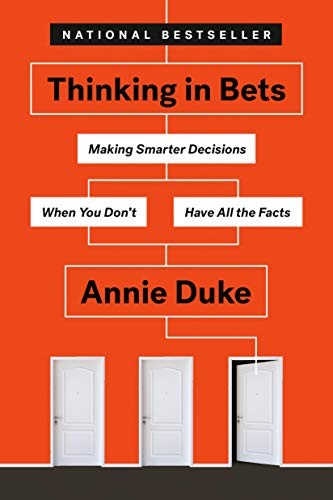
TL;DR: In Thinking in Bets: Making Smarter Decisions When You Don’t Have All the Facts, former professional poker player Annie Duke argues that life is more like poker than chess: every decision is a bet made with incomplete information and luck involved. To decide better, separate decision quality from outcomes, think in probabilities and build habits and groups that seek the truth.
Annie Duke studied cognitive psychology at the graduate level before becoming one of the most successful women in professional poker, winning a World Series of Poker bracelet. Published in 2018, Thinking in Bets applies lessons from the poker table to business, investing, parenting and everyday choices. It’s an accessible, practical guide to making decisions under uncertainty. Here’s a complete summary of the book’s key ideas.
Table of Contents
Thinking in Bets at a Glance
| Detail | Info |
|---|---|
| Author | Annie Duke |
| Published | 2018 |
| Genre | Psychology / decision-making / business |
| Core idea | Treat decisions as bets under uncertainty |
| Best for | Leaders, investors, entrepreneurs and anyone facing tough decisions |
What Is Thinking in Bets About?
Duke argues that we often judge decisions by how they turn out, but outcomes depend on both skill and luck. A good decision can lead to a bad result, and a bad decision can get lucky. Learning to tell the difference, and to think in terms of probabilities rather than certainties, leads to better choices over time.
Key Ideas From the Book
Resulting
Duke calls the habit of judging decisions by their outcomes “resulting.” She uses a famous example: at the end of Super Bowl XLIX, Seattle Seahawks coach Pete Carroll called a pass play that was intercepted, and he was widely labeled foolish. Duke argues the decision was reasonable given the situation; the outcome was unlucky.
Life Is Poker, Not Chess
Chess has complete information and little luck. Poker involves hidden information and chance, just like real life. Accepting uncertainty helps us make better bets instead of pretending we can control everything.
“Wanna Bet?”
Imagining someone challenging you to bet on a belief makes you more careful. Duke encourages expressing beliefs with confidence levels, such as “I’m about 70% sure,” which makes it easier to update your views when new information arrives.
Learning From Outcomes
We tend to credit ourselves for good outcomes and blame luck for bad ones (self-serving bias). Duke recommends honestly examining which parts of an outcome came from skill and which came from luck.
Truth-Seeking Groups
Surround yourself with people who will challenge your thinking. Duke draws on norms described by sociologist Robert K. Merton, which emphasize sharing information, judging ideas on their merits rather than their source, avoiding conflicts of interest and practicing healthy skepticism.
Mental Time Travel
Imagine how you’ll feel about a decision in the future, and use exercises like “backcasting” (imagining success and working out how you got there) and a “premortem” (imagining failure and identifying what went wrong) to plan better.
5 Key Takeaways From Thinking in Bets
- Good decisions can have bad outcomes. Judge the process, not just the result.
- Think in probabilities. Replace “I’m sure” with “I’m 70% sure.”
- Separate luck from skill. Be honest about what you could and couldn’t control.
- Find people who challenge you. Truth-seeking groups improve decisions.
- Plan for uncertainty. Use premortems and backcasting before big decisions.
Ideas Worth Remembering
- The quality of a decision and the quality of its outcome are not the same thing. (paraphrased)
- Being willing to say “I’m not sure” is a strength, not a weakness. (paraphrased)
- Every decision is a bet on one possible future over another. (paraphrased)
Who Should Read Thinking in Bets?
It’s valuable for business leaders, investors, entrepreneurs, coaches and anyone who second-guesses decisions. You don’t need to know anything about poker; Duke explains the necessary concepts simply.
What to Read Next
- How to Decide by Annie Duke, a practical workbook-style follow-up.
- Thinking, Fast and Slow by Daniel Kahneman on the psychology of decisions.
- The Art of Thinking Clearly by Rolf Dobelli on common thinking errors.
Related: The Art of Thinking Clearly summary and best books on logic and critical thinking.
Frequently Asked Questions
What is resulting in Thinking in Bets?
Resulting is the habit of judging the quality of a decision by its outcome, ignoring the role of luck and the information available when the decision was made.
Who is Annie Duke?
Annie Duke is a former professional poker player and World Series of Poker bracelet winner who studied cognitive psychology and now writes and speaks about decision-making.
Do I need to know poker to read Thinking in Bets?
No. Duke uses poker as an example but explains everything simply, and the lessons apply to business, investing and everyday life.