

Disclosure: As an Amazon Associate, Bookish Wisdom earns from qualifying purchases. This doesn’t change our picks or your price.
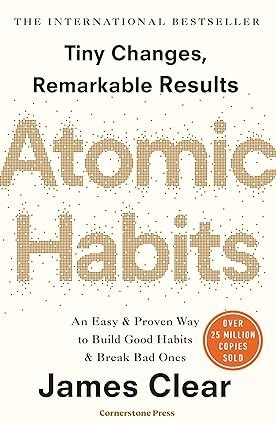
TL;DR: Atomic Habits by James Clear argues that tiny changes, repeated daily, compound into remarkable results. Instead of chasing big goals, build systems and an identity around small habits using four laws: make it obvious, attractive, easy and satisfying. Clear shows how to start good habits, break bad ones and stay consistent.
Atomic Habits has been on bestseller lists for years, and for good reason: it turns the science of habit formation into a clear, practical method anyone can use. James Clear, a writer and entrepreneur, built the book on his own recovery from a serious sports injury in high school, when he learned that small improvements, repeated, can change a life. The book is full of short stories, from Olympic cyclists to ordinary workers, and it avoids jargon. Here’s a complete summary of the main ideas and how to use them.
Table of Contents
Atomic Habits at a Glance
| Detail | Info |
|---|---|
| Author | James Clear |
| Published | 2018 |
| Genre | Self-help, personal development |
| Core idea | Small habits compound into big results |
| Framework | Four laws of behavior change |
| Best for | Anyone building routines, breaking bad habits or improving focus |
What Is Atomic Habits About?
The book opens with the idea of marginal gains: if you get one percent better each day for a year, you end up thirty-seven times better, and if you get one percent worse, you decline almost to zero. Clear explains that people often overestimate what they can do in a day and underestimate what they can do in a year, because change shows up late. He calls this stretch the plateau of latent potential, like an ice cube that doesn’t melt until the temperature crosses a threshold.
From there, Clear explains that habits are the compound interest of self-improvement and that results are a lagging measure of habits. He urges readers to focus on systems rather than goals, and to ground habits in identity: instead of saying I want to run a marathon, say I am a runner. The rest of the book gives a four-step model of habits and a set of tactics for each step.
Key Ideas, Part by Part
The Fundamentals: Why Tiny Changes Matter
Clear introduces the habit loop of cue, craving, response and reward. Every habit, good or bad, follows this loop, and the four laws of behavior change correspond to each stage: make the cue obvious, make the craving attractive, make the response easy and make the reward satisfying. To break a habit, invert the laws: make it invisible, unattractive, difficult and unsatisfying.
He also argues that the deepest layer of change is identity. Outcomes change what you have, processes change what you do, and identity changes what you believe. Each time you repeat a habit, you cast a vote for the type of person you want to become.
Law 1 and 2: Make It Obvious and Attractive
The first law says to make cues visible. Clear recommends a habit scorecard, listing your current habits to become aware of them, and implementation intentions, a plan in the form I will [behavior] at [time] in [location]. Habit stacking links a new habit to an existing one: after I pour my morning coffee, I will meditate for one minute. He also stresses environment design, such as placing fruit on the counter and moving the television out of the bedroom.
The second law uses temptation bundling, pairing a habit you need with one you want, and the influence of social groups. We tend to adopt the habits of the people around us, so joining a group where your desired behavior is normal makes it easier. Clear also suggests reframing habits so they feel like opportunities rather than obligations.
Law 3 and 4: Make It Easy and Satisfying
The third law is about reducing friction. The two-minute rule says that any new habit should take less than two minutes to start, such as reading one page or putting on running shoes. Clear explains that the goal is to master the art of showing up, and then the habit can grow. He also suggests automating good habits and using commitment devices.
The fourth law is about immediate rewards. Because the benefits of good habits often come later, add a small reward now. Habit tracking, such as marking an X on a calendar, makes progress visible, and the rule never miss twice helps you recover from mistakes. An accountability partner or habit contract can add stakes.
Advanced Tactics: Goldilocks and the Dark Side
Clear describes the Goldilocks rule: we stay motivated when working on tasks that are right at the edge of our abilities, not too hard and not too easy. To stay engaged after the novelty fades, he recommends embracing boredom and practicing even when you don’t feel like it.
He ends with a warning: success can lead to complacency, and the more a habit becomes a part of your identity, the harder it is to adapt. He suggests reflecting and reviewing regularly, and holding your identity lightly so you can grow.
7 Key Takeaways From Atomic Habits
- Focus on systems, not goals. Goals set direction, but systems of daily habits produce progress.
- Change your identity. Lasting change comes from becoming the type of person who does the habit.
- Make it obvious. Use cues, implementation intentions and habit stacking to trigger habits.
- Make it attractive. Pair habits with things you enjoy and surround yourself with supportive people.
- Make it easy. Reduce friction and start with the two-minute version.
- Make it satisfying. Add immediate rewards and track progress.
- Never miss twice. One slip is a blip; two is the start of a new habit.
Ideas Worth Remembering
- Small gains repeated every day add up to results that look sudden but are the product of patient work. (paraphrased)
- Your results depend less on your goals than on the systems you follow each day. (paraphrased)
- Each repeated action is a small vote for the kind of person you are becoming. (paraphrased)
- Seeing your own progress is one of the strongest motivators there is. (paraphrased)
How to Apply Atomic Habits in Real Life
- Start with a two-minute habit. Pick one change, such as writing one sentence a day, and make it so easy you can’t say no.
- Stack it. Attach the new habit to a daily routine you already have.
- Design your space. Put the cue where you can see it and hide cues for bad habits.
- Track it. Use a calendar or app, and aim to never miss twice.
- Review monthly. Look at what’s working and adjust your habits as you grow.
Criticisms and Limits
Some readers feel that Atomic Habits repeats a handful of ideas, and that many of its stories and studies are simplified. Critics note that habit change is harder for people dealing with stress, poverty or mental health challenges, and that the book leans on individual willpower and environment while giving less attention to circumstances beyond a person’s control.
Others point out that not everything worth doing can be reduced to a habit, and that obsessive tracking can backfire. Clear himself acknowledges that habits are a tool, not a cure-all, and the book is best used flexibly, adopting what helps and ignoring what doesn’t.
Stories and Examples From the Book
Clear fills the book with memorable cases. He describes how Dave Brailsford, performance director of British Cycling, applied the aggregation of marginal gains, improving everything by a tiny amount, from tire grip to the pillows riders slept on, and how the team went on to win Olympic and Tour de France titles. He tells of Jerry Seinfeld’s habit of marking a red X on a calendar for every day he wrote jokes, which turned a goal into a chain he didn’t want to break. These examples show that tiny actions, when stuck to, produce results far beyond their size.
A 30-Day Plan to Try the Method
To put the book to work, choose one habit and run a month-long experiment. In week one, define the habit in the form of an implementation intention and attach it to an existing routine. In week two, shrink it to a two-minute version and prepare your environment. In week three, start tracking with a simple calendar and add a small reward. In week four, review what’s working, increase the difficulty a little and, if you slip, apply the never-miss-twice rule. At the end, write down your identity statement, such as I am someone who moves every day, to anchor the change.
How Atomic Habits Compares With Similar Books
Atomic Habits is often compared with The Power of Habit by Charles Duhigg, which explains habit loops through stories, and Tiny Habits by B.J. Fogg, which stresses starting small and celebrating. Clear’s strength is synthesis: he combines research from psychology and behavioral science with an easy framework and plenty of examples. If you want more science, read Duhigg; if you want a very small, emotionally driven method, try Fogg; if you want a single clear set of rules to keep on your desk, Clear is the best fit.
Who Should Read Atomic Habits?
Read it if you want a clear, practical introduction to habit change, if you’ve struggled to stick to routines, or if you’re a coach, parent or manager who wants to help others build habits. It’s especially useful for people who like frameworks and short stories. If you already know the basics, you may prefer to skim the later chapters and use the summary of the four laws as a quick reference.
What to Read Next
- Tiny Habits by B.J. Fogg a research-based method for starting small and celebrating wins
- The Power of Habit by Charles Duhigg the story of how habits work in individuals, companies and societies
- Deep Work by Cal Newport a guide to focus once your routines are in place
Related: books like Atomic Habits and Tiny Habits summary and key takeaways.
Frequently Asked Questions
What is the main idea of Atomic Habits?
Small habits, repeated consistently, compound into major results. Focus on systems and identity rather than goals alone.
What are the four laws of behavior change?
Make it obvious, make it attractive, make it easy and make it satisfying.
What is the two-minute rule?
Scale any new habit down to a version that takes two minutes or less, so it’s easy to start.
Is Atomic Habits worth reading?
Most readers find it clear, practical and easy to apply, especially if they have struggled to keep routines.
How long does it take to form a habit?
It varies. Clear points to research showing that the average is about two months, but it depends on the habit and the person.