
Disclosure: As an Amazon Associate, Bookish Wisdom earns from qualifying purchases. This doesn’t change our picks or your price.
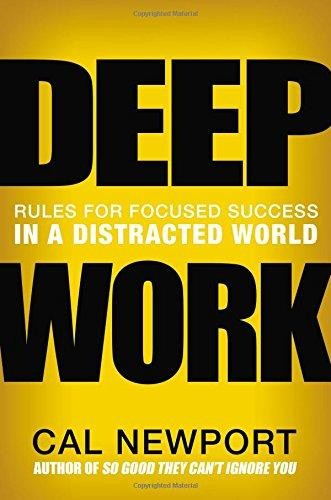
TL;DR: Deep Work by Cal Newport argues that the ability to concentrate without distraction on hard tasks is increasingly valuable and increasingly rare. Newport lays out why deep work matters and gives four rules for building it: work deeply, embrace boredom, quit social media and drain the shallows.
Deep Work arrived in 2016, when many people were realizing that email, chat and social media were breaking their attention into pieces. Cal Newport, a computer science professor at Georgetown University, argues that the people who can focus will produce better work in less time, and thrive in the new economy. The book is part argument and part manual, and its ideas have shaped how many writers, programmers and managers organize their days. Here’s a complete summary of the main ideas and rules.
Table of Contents
Deep Work at a Glance
| Detail | Info |
|---|---|
| Author | Cal Newport |
| Published | 2016 |
| Genre | Productivity, career |
| Core idea | Focused work is valuable and rare |
| Structure | Two parts: the idea and four rules |
| Best for | Knowledge workers, students and creators who struggle with distraction |
What Is Deep Work About?
Newport defines deep work as professional activities performed in a state of distraction-free concentration that push your cognitive abilities to their limit. These efforts create new value, improve your skills and are hard to replicate. Shallow work, in contrast, is noncognitively demanding, logistical-style tasks, often performed while distracted. Examples include answering email and attending meetings. Shallow work isn’t worthless, but it doesn’t make you better or rarer.
The first part of the book explains why deep work matters. In an economy where machines handle routine tasks, three groups will thrive: those who can work well with intelligent machines, superstars in their fields and owners of capital. All three depend on the ability to learn hard things quickly and produce at an elite level, both of which require deep concentration. Yet modern work environments reward constant availability.
Key Ideas, Part by Part
Part One: The Idea
Newport argues that deep work is valuable, rare and meaningful. It’s valuable because it lets you master complicated skills and produce high-quality work. It’s rare because the culture of connectivity, open offices and instant messaging encourage shallowness. It’s meaningful because craftsmanship, whether in writing or coding or woodworking, can give a sense of purpose.
He gives examples of focus in action, such as Carl Jung’s retreat to a stone tower at Bollingen to think and write, and Bill Gates’s famous Think Weeks, when he left his office to read and reflect. He also uses the term attention residue to describe how switching tasks leaves part of your mind on the previous task, lowering performance.
Rule 1: Work Deeply
Newport describes four philosophies for scheduling deep work. The monastic philosophy removes shallow obligations almost entirely. The bimodal philosophy divides time into stretches of deep work and stretches of other work. The rhythmic philosophy sets a regular daily time for deep work, such as the first two hours of the morning. The journalistic philosophy slots deep work into any free moment, which requires practice.
He also recommends rituals, such as choosing where and how long you’ll work, what you’ll do to support it and a clear end point. Grand gestures, such as traveling to a quiet place to write, can raise the stakes. And he suggests four disciplines of execution: focus on the wildly important, act on lead measures, keep a compelling scoreboard and create a cadence of accountability.
Rule 2: Embrace Boredom
Newport argues that the ability to concentrate is like a muscle that needs training, and that constantly seeking novelty weakens it. He recommends scheduling blocks for internet use, rather than taking breaks from distraction, so that you practice resisting the urge to switch. He also describes productive meditation, in which you focus on a single problem while physically occupied, such as on a walk.
Another technique is memory training, such as memorizing a deck of cards, which builds concentration. The point is to treat focus as a skill you can practice rather than a trait you have or don’t have.
Rule 3: Quit Social Media
Newport doesn’t tell everyone to delete all accounts. Instead, he proposes the craftsman approach to tool selection: adopt a tool only if its positive impacts on your most important goals substantially outweigh its negatives. He contrasts this with the any-benefit approach, in which any possible benefit justifies using a tool.
He suggests the law of the vital few, which says that in many pursuits, 80 percent of the benefit comes from 20 percent of the activities. He also encourages leisure that is high-quality rather than passive scrolling, such as hobbies, exercise and time with friends.
Rule 4: Drain the Shallows
The final rule is about reducing shallow work. Newport recommends scheduling every minute of your workday, deciding in advance what you will do in each block and revising as needed. He suggests quantifying the depth of your tasks by asking how long it would take to train a smart recent graduate to do them.
He also urges readers to finish work at a set time, such as 5:30 p.m., a practice he calls fixed-schedule productivity, and to become hard to reach by email by sending fewer messages, setting expectations and using process-centric replies.
7 Key Takeaways From Deep Work
- Deep work is a superpower. It lets you learn quickly and produce high-quality work.
- Distraction has a cost. Switching tasks leaves attention residue that reduces performance.
- Choose a philosophy. Monastic, bimodal, rhythmic or journalistic: pick one that fits your life.
- Train your focus. Treat concentration as a skill, and practice resisting distraction.
- Be selective with tools. Use technology that clearly supports your goals.
- Schedule your time. Plan every minute and revise, so deep work gets protected.
- Rest matters. A fixed shutdown time helps your brain recover.
Ideas Worth Remembering
- Producing valuable output, rather than looking busy, determines who thrives. (paraphrased)
- Knowing what matters most makes it easier to see what can be dropped. (paraphrased)
- Focus is a skill that has to be trained like a muscle. (paraphrased)
- The ability to concentrate is becoming more valuable precisely because it is becoming rarer. (paraphrased)
How to Apply Deep Work in Real Life
- Block your calendar. Reserve one or two daily blocks of 60 to 90 minutes for your most important work.
- Create a ritual. Start each session with the same steps, such as clearing your desk and silencing notifications.
- Schedule your shallow work. Batch email and messages into set windows.
- Practice boredom. Wait in lines without your phone, and resist checking it.
- End your day. Review tomorrow’s plan, then declare a shutdown and stop work.
Criticisms and Limits
Critics point out that Deep Work is aimed at a particular kind of worker, mainly those with some control over their schedules. People in jobs that require constant responsiveness, such as customer service or healthcare, may not be able to follow many of the rules. Newport acknowledges this but offers fewer solutions for them.
Others say that the book is repetitive and that the argument for quitting social media can be extreme, especially for people whose work or friendships rely on it. Even so, the core idea, that protecting focused time pays off, is widely accepted, and many readers adapt the rules rather than following them literally.
Case Studies and Stories in Deep Work
Newport illustrates his ideas with writers, scientists and executives. He describes Carl Jung retreating to a stone tower in Bollingen where he wrote without electricity and developed his theories. He tells of Bill Gates taking Think Weeks twice a year, spending a week in a cabin reading and thinking, He also describes Adam Grant, a professor who batches teaching and research into focused periods. These cases show that elite output often comes from guarded solitude.
A Sample Day Using the Rules
Here is how someone might apply the book in a day. At 8:00, the person starts with ninety minutes of deep work on their most important project, with their phone in another room and notifications off. At 9:30 they take a short walk, then spend an hour on email and messages in a scheduled window. In the afternoon they hold meetings, and later schedule a second deep block of an hour. At 5:30 they review tomorrow’s plan, say a shutdown phrase and stop. Over weeks, the rhythm gets easier, and the output of the deep blocks becomes the most visible result.
How Deep Work Compares With Similar Books
Deep Work is often paired with Digital Minimalism, in which Newport applies similar ideas to personal life, and with Essentialism by Greg McKeown, which emphasizes choosing the vital few. Indistractable by Nir Eyal offers psychological tools to manage the urge to get distracted, while Four Thousand Weeks takes a gentler view of productivity. If you want a rule-based guide for professional focus, Deep Work is the clearest. If you want to examine why you feel distracted in the first place, add Indistractable or Stolen Focus.
Deep Work in One Minute
Deep work is focused, distraction-free effort on hard tasks, and it is both valuable and rare. Pick a philosophy, schedule it, build a ritual, practice boredom, be selective about tools and drain the shallows by planning every minute and ending the workday on time. Start with one daily block of 60 to 90 minutes, protect it from interruptions and review how it went each week.
Who Should Read Deep Work?
Read it if you write, code, study, design or do other cognitively demanding work, and you feel your attention is scattered. It’s useful for managers who want to create focus-friendly teams and for students who want to study more effectively. If you already protect your focus, you may find the book most helpful for its examples and its structure for talking about deep work with colleagues.
What to Read Next
- Digital Minimalism by Cal Newport a follow-up on building a healthier relationship with technology
- Essentialism by Greg McKeown a guide to focusing on what matters most
- Four Thousand Weeks by Oliver Burkeman a thoughtful look at time and limits
Related: books like Deep Work and Digital Minimalism summary and key takeaways.
Frequently Asked Questions
What is the main idea of Deep Work?
The ability to focus without distraction on demanding tasks is increasingly valuable and increasingly rare, so you should build habits that protect it.
What is the difference between deep and shallow work?
Deep work needs full concentration and creates new value. Shallow work is logistical and easy to replicate.
What are the four rules of Deep Work?
Work deeply, embrace boredom, quit social media and drain the shallows.
How many hours of deep work can you do a day?
Newport suggests that most people can do about four hours at most, in blocks of 60 to 90 minutes.
Is Deep Work worth reading?
Most readers find it a persuasive and practical guide, especially if distraction is a problem.