
Disclosure: As an Amazon Associate, Bookish Wisdom earns from qualifying purchases. This doesn’t change our picks or your price.
TL;DR: The 7 Habits of Highly Effective People by Stephen R. Covey teaches that lasting success comes from character and principles, not quick tricks. Its seven habits move you from dependence to independence to interdependence: be proactive, begin with the end in mind, put first things first, think win-win, seek first to understand, synergize and sharpen the saw.
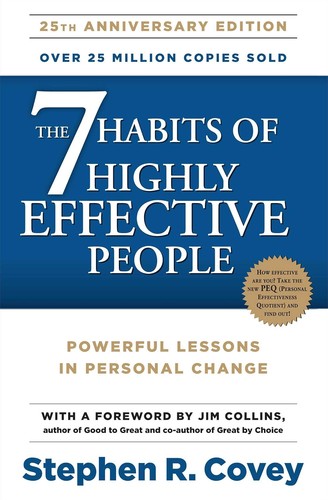
First published in 1989, The 7 Habits of Highly Effective People has sold tens of millions of copies and shaped how generations think about leadership, time and relationships. Stephen R. Covey, a business professor and consultant, argues that much of the self-help literature of the 20th century focused on techniques, which he calls the personality ethic, while earlier writing emphasized character, the character ethic. The book makes a case for returning to principles such as fairness, honesty and integrity. Here’s a complete summary of the ideas and habits.
Table of Contents
The 7 Habits of Highly Effective People at a Glance
| Detail | Info |
|---|---|
| Author | Stephen R. Covey |
| Published | 1989 |
| Genre | Self-help, leadership |
| Core idea | Character and principles produce lasting effectiveness |
| Structure | Seven habits in three stages |
| Best for | Anyone who wants a principled approach to goals, time and relationships |
What Is The 7 Habits of Highly Effective People About?
Covey begins with a paradigm shift: the way we see the world shapes our behavior, so changing results means changing our perceptions. He introduces the maturity continuum, which runs from dependence, in which you rely on others, to independence, in which you take responsibility for yourself, to interdependence, in which you cooperate with others to achieve more than you could alone.
The first three habits address independence, which he calls private victory. The next three focus on interdependence, or public victory. The seventh habit, sharpen the saw, is about renewal and keeps the others going. Each habit is explained with stories, exercises and examples from business, family and school.
Key Ideas, Part by Part
Habits 1 to 3: Private Victory
Habit 1, be proactive, means taking responsibility for your choices rather than blaming circumstances. Covey describes the circle of concern, things you worry about, and the circle of influence, things you can affect. Proactive people focus on the latter, which expands it over time.
Habit 2, begin with the end in mind, asks you to imagine what you want your life to stand for, and to write a personal mission statement. Habit 3, put first things first, is about time management. Covey’s time management matrix sorts tasks into four quadrants by urgency and importance. Quadrant II, important but not urgent, includes planning, relationships and prevention, and is where effective people spend most of their time.
Habits 4 to 6: Public Victory
Habit 4, think win-win, is a mindset of seeking mutual benefit in all interactions. Covey contrasts it with win-lose and lose-win thinking, and describes the emotional bank account, a metaphor for trust: kindness, honesty and keeping promises make deposits, while disrespect and broken promises make withdrawals.
Habit 5, seek first to understand, then to be understood, is about empathic listening, listening with the intent to understand rather than to reply. Habit 6, synergize, is the creative cooperation that results when people value their differences, so that the whole is greater than the sum of its parts.
Habit 7: Sharpen the Saw
The final habit is about renewal. Covey describes four dimensions: physical, through exercise, nutrition and rest; spiritual, through values, reflection or time in nature; mental, through reading, learning and writing; and social-emotional, through meaningful relationships and service. He says we need to invest in all four to sustain effectiveness, and that neglecting any of them makes us less able to apply the other habits.
He ends with the upward spiral, the idea that each cycle of learning, committing and doing takes us to a higher level of understanding. Readers are encouraged to revisit the habits regularly.
7 Key Takeaways From The 7 Habits of Highly Effective People
- Be proactive. Focus on what you can influence, and own your choices.
- Begin with the end in mind. Define your values and mission, and let them guide your decisions.
- Put first things first. Spend time on what’s important, not just what’s urgent.
- Think win-win. Look for solutions where everyone benefits.
- Listen to understand. Seek to understand the other person before explaining your view.
- Synergize. Value differences and combine strengths to find better solutions.
- Renew yourself. Invest in your body, mind, heart and spirit so you can sustain your effectiveness.
Ideas Worth Remembering
- Between what happens to us and how we respond, there is a space in which we can choose. (paraphrased)
- Many of us give our time to what feels urgent rather than to what is important. (paraphrased)
- Trust is built through many small deposits and can be lost in a single withdrawal. (paraphrased)
- Effectiveness means balancing results with the care of the ability to produce them. (paraphrased)
How to Apply The 7 Habits of Highly Effective People in Real Life
- Write a personal mission statement. Spend an hour listing your values and roles, and what you want to be known for.
- Plan your week around Quadrant II. Schedule important but non-urgent tasks first, such as exercise and relationship time.
- Practice empathic listening. In your next conversation, repeat back what you heard before sharing your view.
- Make deposits. Do small kindnesses and keep promises to build trust with family and colleagues.
- Review and renew. Pick one activity for body, mind, heart and spirit each week.
Criticisms and Limits
Some readers find The 7 Habits long, dated and heavy on corporate language, with many stories from the 1980s. Others feel that its emphasis on principles can sound abstract, and that it overlooks structural problems at work, such as unfair systems that individuals can’t fix through personal effectiveness alone.
Critics also note that Covey’s examples and tone carry the viewpoint of his own background and values, and that some of the later sections, particularly on spiritual renewal, may not suit every reader. Still, many people find the core habits useful, and the book’s influence on time management and leadership remains strong.
Discussion Questions for The 7 Habits
To reflect on the book, ask: Which habit do you practice best, and which is hardest? What would your personal mission statement say? How do you currently spend your time in each quadrant? Where could you create more win-win outcomes in a relationship? When did someone really listen to you, and how did it feel? Writing brief answers to these questions can turn the habits from ideas into a plan.
Stories and Examples From the Book
Covey uses vivid illustrations. He describes a subway scene in which a father sits quietly while his children run wild, and the narrator’s irritation changes when he learns the family has just lost the children’s mother, a classic example of a paradigm shift. He compares a fixed focus on urgent tasks to a woodcutter who won’t stop to sharpen his saw. He also retells Aesop’s fable of the goose that laid golden eggs to show that you must balance producing results with caring for your ability to produce. Such images make the habits easy to remember.
About Stephen R. Covey
Stephen R. Covey (1932–2012) was a professor, consultant and author born in Salt Lake City, Utah. He taught at Brigham Young University and co-founded what became FranklinCovey, a leadership training company. He wrote several sequels, including First Things First and The 8th Habit, and his family, including his son Stephen M. R. Covey, continues to write about trust and leadership. Knowing the author’s background helps explain the book’s emphasis on principles, family and service, and why it has been so widely used in business training and schools.
A Seven-Week Practice Plan
If you’d like to practice the habits one at a time, give each a week. In week one, notice your language, and replace I have to with I choose to. In week two, write a personal mission statement. In week three, plan your week using the quadrants and protect time for what’s important. In week four, look for a win-win in one conflict. In week five, practice listening without interrupting. In week six, ask a colleague or family member to combine ideas with you on a project. In week seven, plan a weekly renewal for body, mind, heart and spirit. After seven weeks, review what has changed.
How The 7 Habits Compares With Similar Books
Compared with Atomic Habits, which focuses on routines and mechanics, The 7 Habits focuses on principles and character. Compared with How to Win Friends and Influence People, it covers more than relationships, including time and purpose. Compared with Essentialism, it takes a broader view of life roles. Many readers use Covey to decide what matters and then use Clear or McKeown to implement it. Together they form a toolkit: values from Covey, habits from Clear and focus from McKeown.
Who Should Read The 7 Habits of Highly Effective People?
Read it if you want a values-based framework for work and life, if you’re stepping into a leadership role or if you’d like to improve family and workplace relationships. It’s a good choice for readers who prefer principles to quick hacks, and for teams that want a shared language. If you’re short on time, the summary of the seven habits and the time management matrix cover the core.
What to Read Next
- How to Win Friends and Influence People by Dale Carnegie the classic on building relationships and influence
- Atomic Habits by James Clear a practical guide to building routines
- First Things First by Stephen R. Covey a deeper look at priorities and time
Related: books like The 7 Habits of Highly Effective People and Atomic Habits summary and key takeaways.
Frequently Asked Questions
What are the 7 habits of highly effective people?
Be proactive, begin with the end in mind, put first things first, think win-win, seek first to understand then to be understood, synergize and sharpen the saw.
What is the time management matrix?
It sorts tasks into four quadrants by urgency and importance. Covey recommends spending the most time on important but not urgent tasks.
What is the emotional bank account?
It’s a metaphor for trust in relationships. Positive actions make deposits and negative ones make withdrawals.
Is The 7 Habits still worth reading?
Many readers say yes. Some examples are dated, but the core ideas about responsibility and listening remain useful.
Is there a version for teens?
Yes. The 7 Habits of Highly Effective Teens by Sean Covey adapts the ideas for younger readers.