
Disclosure: As an Amazon Associate, Bookish Wisdom earns from qualifying purchases. This doesn’t change our picks or your price.
TL;DR: In Digital Minimalism, Cal Newport argues that small tweaks like turning off notifications aren’t enough to fix our relationship with technology. Instead, he proposes a philosophy: spend your online time on a small number of carefully chosen activities that strongly support what you value, and happily miss out on everything else. The starting point is a 30-day digital declutter.
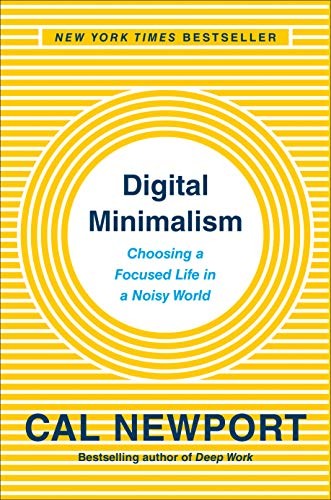
Cal Newport, a computer science professor at Georgetown and author of Deep Work, published Digital Minimalism in 2019. He wrote it after hearing from many readers who felt their phones and social media were controlling them rather than serving them. The book is split into two parts: the foundations of the philosophy and a set of practices to put it into action.
Table of Contents
Digital Minimalism at a Glance
| Detail | Info |
|---|---|
| Author | Cal Newport |
| Published | 2019 |
| Genre | Self-help / technology / productivity |
| Structure | Part 1: Foundations; Part 2: Practices |
| Best for | Anyone who feels addicted to their phone or overwhelmed by social media |
What Is Digital Minimalism About?
Newport argues that many apps are designed to capture as much of our attention as possible, often using techniques like intermittent rewards and the drive for social approval. Willpower alone can’t beat products engineered by teams of designers. What’s needed is a clear philosophy that decides which technologies earn a place in your life and how you’ll use them.
Key Ideas: The Foundations
The Three Principles
Newport’s case rests on three principles. Clutter is costly: too many apps and services create a hidden cost in time and attention that outweighs the small benefits of each. Optimization is important: deciding to use a technology is only the first step; how you use it matters just as much. Intentionality is satisfying: being deliberate about technology is rewarding in its own right.
The 30-Day Digital Declutter
The heart of the book is a month-long reset. First, define which technologies are optional in your life. Second, take a 30-day break from those optional technologies. Third, use that time to explore and rediscover activities and behaviors you find meaningful. Finally, reintroduce technologies one at a time, only if they serve something you deeply value and only with clear rules for how you’ll use them. Newport tested this with more than 1,600 volunteers who signed up for his experiment.
Key Ideas: The Practices
Spend Time Alone
Newport warns of solitude deprivation: a state where you almost never spend time alone with your own thoughts, because a phone fills every gap. He recommends leaving your phone at home sometimes, taking long walks and writing letters to yourself to process ideas.
Don’t Click Like
Low-effort interactions such as likes and quick comments replace real conversation. He suggests adopting conversation-centric communication: prioritizing calls, face-to-face time and set hours when friends know they can reach you.
Reclaim Leisure
Fill your free time with demanding, high-quality activities instead of passive consumption: craft, physical skills, structured social activities like clubs or sports, and hobbies that produce something real.
Join the Attention Resistance
Practical tactics include deleting social media apps from your phone, using single-purpose devices, scheduling low-quality leisure, embracing slow media like long-form articles and books, and even trying a basic phone.
5 Key Takeaways From Digital Minimalism
- Start with values, not tools. Decide what matters, then keep only technology that supports it.
- Reset with a 30-day declutter. A clean break shows you what you actually miss.
- Protect solitude. Time alone with your thoughts is essential for clarity and creativity.
- Prefer conversation to connection. A phone call beats a hundred likes.
- Replace, don’t just remove. Fill reclaimed time with demanding, satisfying activities.
Ideas Worth Remembering
- Focus on a small number of tools that strongly support what you value, and happily miss out on the rest. (paraphrased)
- Convenience isn’t the same as value. (paraphrased)
- Time alone with your own thoughts is a resource, not a void to fill. (paraphrased)
Who Should Read Digital Minimalism?
It’s for anyone who reaches for their phone without thinking, feels drained by social media or wants more time for reading, hobbies and people. Parents will find useful ideas for modeling healthy tech habits. Readers who already use technology sparingly may find some advice familiar, but the declutter framework is still worth trying.
What to Read Next
- Deep Work by Cal Newport on doing focused work in a distracted world.
- Stolen Focus by Johann Hari on the wider forces eroding our attention.
- The Anxious Generation by Jonathan Haidt on smartphones and childhood.
Related: Getting Things Done summary and 12 tips to remember what you read.
Frequently Asked Questions
What is the main idea of Digital Minimalism?
The main idea is to use technology intentionally: focus your online time on a few carefully chosen activities that support your values and let go of everything else, starting with a 30-day digital declutter.
How does the 30-day digital declutter work?
You step away from optional technologies for 30 days, use the time to rediscover meaningful offline activities, then reintroduce only the tools that clearly serve your values, with rules for how you’ll use them.
Is Digital Minimalism the same as quitting social media?
Not necessarily. Newport doesn’t demand that you quit everything. He asks you to keep only the tools that pass a high bar of value and to use them deliberately.