

Disclosure: As an Amazon Associate, Bookish Wisdom earns from qualifying purchases. This doesn’t change our picks or your price.
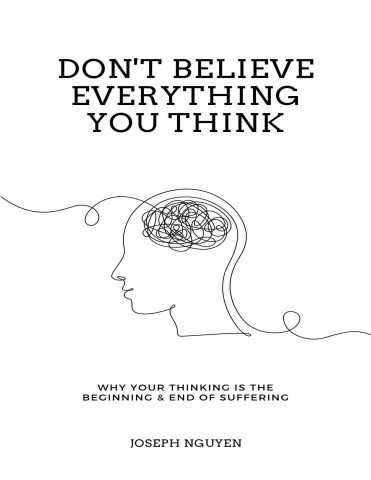
TL;DR: Don’t Believe Everything You Think: Why Your Thinking Is the Beginning and End of Suffering by Joseph Nguyen argues that much of our emotional pain comes not from events but from believing our thoughts about them. By noticing thoughts, letting them pass and returning to the present moment, he says, you can feel more peace, clarity and freedom.
Have you ever lain awake replaying a conversation, or felt dread about something that never happened? Don’t Believe Everything You Think, a self-published book by Joseph Nguyen that took off in 2022, tackles that experience. Nguyen is an author and speaker, and his writing is short, simple and repetitive on purpose. The book sold widely through word of mouth and social media. Here’s a summary of its main ideas.
Table of Contents
Don’t Believe Everything You Think at a Glance
| Detail | Info |
|---|---|
| Author | Joseph Nguyen |
| Published | 2022 |
| Genre | Self-help, mindfulness |
| Core idea | Suffering comes from believing your thoughts, and calm comes from letting them pass |
| Structure | Short chapters of reflections and exercises |
| Best for | Overthinkers and readers who want a brief introduction to mindfulness |
What Is Don’t Believe Everything You Think About?
Nguyen’s central claim is that we suffer because we believe our thinking. The mind produces thousands of thoughts a day, many of them repetitive, negative or inaccurate, and when we take them as truth, we feel anxious, angry or sad.
He says that thoughts are not facts and that you are not your thoughts. By stepping back and observing them, you can create space between a thought and your reaction, and reduce its power.
Key Ideas, Part by Part
Thinking and Suffering
Nguyen draws a line between pain and suffering. Pain is a natural response to events, like grief at a loss, but suffering is prolonged by the stories we tell. He suggests that every time we feel a strong negative emotion, we can ask what thought is behind it.
He proposes that our thoughts come from the past or future, not the present. Regret and worry take us away from now, where much of life actually happens.
Observing Thoughts
A practical piece of advice is to watch your thoughts as an observer. When a thought appears, label it as a thought, such as I am having the thought that I am not good enough, and notice that it passes. This method is similar to techniques used in mindfulness and in acceptance and commitment therapy.
Nguyen also recommends letting go of the need to figure everything out. You don’t have to solve every problem in your mind; often a clearer answer comes when you are calm.
Presence, Peace and Responsibility
Nguyen encourages returning to the present moment through the body: feel your breath, notice your senses or take a slow walk. He says peace is not something to achieve but something that is revealed when the noise of thinking quiets.
He also addresses responsibility. Seeing that your feelings come from your thoughts does not mean you are at fault for your pain; it means you have more power over your response than you think. He suggests taking action from clarity, not from fear.
Relationships and Letting Go
The book looks at how thinking affects relationships. We often react to what we imagine others think or intend. Nguyen suggests checking assumptions, listening without judging and letting go of the need to be right.
The closing chapters encourage readers to practice daily, to be gentle with themselves and to trust that insight and calm can arise on their own.
6 Key Takeaways From Don’t Believe Everything You Think
- Thoughts aren’t facts. You can notice them without believing them.
- Suffering is prolonged by stories. Pain is natural, but rumination adds to it.
- Observe, don’t fight. Label thoughts and let them pass.
- Return to the present. Use your breath and senses to ground yourself.
- Check your assumptions. Don’t treat guesses about others as truth.
- Act from clarity. Decisions are better when the mind is calm.
Ideas Worth Remembering
- You are not your thoughts. (paraphrased)
- Peace comes when you stop feeding the story. (paraphrased)
- Awareness creates choice. (paraphrased)
- Small daily practice matters more than big insights. (paraphrased)
How to Apply Don’t Believe Everything You Think in Real Life
- Label a thought. Say I’m having the thought that… when worry arises.
- Take three slow breaths. Pause before you respond to something stressful.
- Ask what you know for sure. Separate facts from assumptions.
- Limit rumination. Set a short time to think about a problem, then move on.
- Try a short daily sit. Spend five minutes noticing thoughts without judging.
Criticisms and Limits
Critics point out that the book makes broad claims, such as that thinking is the beginning and end of suffering, without much evidence, and that it can read as repetitive. It offers few concrete exercises beyond noticing thoughts, and the approach may not suit people dealing with trauma, depression or situations of real danger or injustice. Some also feel it oversimplifies ideas from philosophy and psychology.
For many readers, though, the short length and plain language make it a useful reminder to pause. Treat it as a gentle introduction, and look to evidence-based sources for deeper help.
Don’t Believe Everything You Think in One Minute
Thoughts are not facts, and much suffering comes from believing them. Notice thoughts, label them and let them pass. Return to the present through your breath and senses. Check assumptions in relationships and act from calm, not fear. Peace is revealed when the noise quiets.
Connections to Cognitive Therapy
Ideas in the book overlap with techniques from cognitive-behavioral therapy, which helps people identify and test unhelpful thoughts, and acceptance and commitment therapy, which teaches people to observe thoughts without being controlled by them. Research supports these methods for anxiety and depression. The book offers a simplified, non-clinical version, so it may help with everyday worry, but it does not replace treatment.
A Five-Minute Practice
Sit comfortably and close your eyes. For the first minute, notice your breath. Then, as thoughts arise, silently say thinking and return to the breath. If a strong emotion appears, name it, such as worry or sadness, and feel where it sits in your body. After five minutes, ask yourself what you know for sure about the problem on your mind. Repeating this daily trains the habit of stepping back.
Using the Book Wisely
Because Nguyen’s style is repetitive and absolute, some readers may take it to mean that all distress is just thinking. Real events like illness, loss and injustice cause real pain, and some mental health conditions need professional care. The book is best used as a tool for the ordinary overthinking that adds stress. If worry feels overwhelming or constant, talk to a doctor or therapist, and in the US you can call or text 988 in a crisis.
Daily Reminders That Help
Some readers write short prompts on sticky notes: this is a thought, not a fact; I don’t have to figure it out right now; what is true in this moment? Placing them on a mirror, laptop or phone case reminds you to pause. Pair the prompts with a physical cue, like a hand on your chest and a slow breath. Over time, the reminders can become automatic and interrupt the spiral earlier.
Overthinking at Night
Many people struggle most at bedtime, when the day’s worries replay. Try writing a short worry list before bed, noting one next step for each item, then closing the notebook. Follow with a slow breathing exercise, counting longer exhales than inhales. If thoughts return, label them and gently turn attention to the feeling of the bed or your breath. If sleep problems persist for weeks, talk with a health professional.
Who Should Read Don’t Believe Everything You Think?
Read it if you tend to overthink, want a short and calming read or are curious about mindfulness. It takes only an hour or two. For a more developed take on presence, you might try The Power of Now, and for a research-based approach, a book on cognitive therapy.
What to Read Next
- The Power of Now by Eckhart Tolle a guide to present-moment awareness
- Feeling Good by David D. Burns a classic on cognitive therapy for mood
- 10% Happier by Dan Harris a skeptic’s guide to meditation
Related: The Power of Now summary and key takeaways and The Mountain Is You summary and key takeaways.
Frequently Asked Questions
What is the main idea of Don’t Believe Everything You Think?
That suffering comes from believing our thoughts, and peace comes from observing them and returning to the present.
Who wrote the book?
Joseph Nguyen, a self-help author who first self-published it.
Is it a substitute for therapy?
No, it is a self-help book; therapy offers personalized, evidence-based care.
How long is the book?
It is short, usually under 200 pages, and can be read in a few hours.
Is it similar to The Power of Now?
Both focus on presence and thought, but Nguyen’s book is shorter and more practical.